admin
admin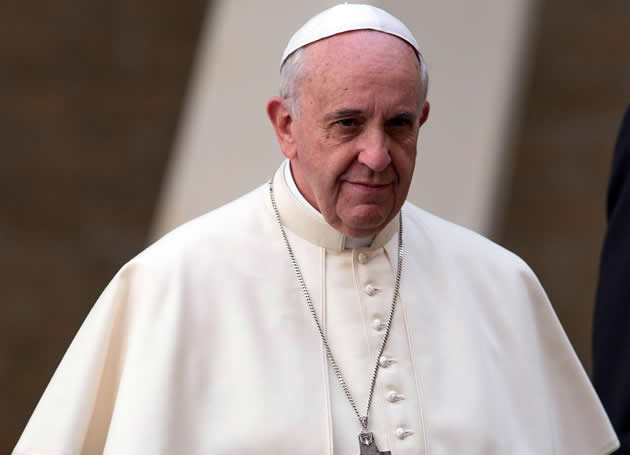
Vatican City — Pope Francis presided over the solemn Easter Vigil service on Saturday night amid mounting Vatican concern for modern-day Christian martyrs whose deaths have dominated this Easter season.
Francis walked in the dark down an utterly silent St Peter’s Basilica at the start of the vigil Mass, which precedes the joyous celebration on Easter Sunday commemorating Christ’s resurrection after his crucifixion.
In his homily, Francis said the Easter mystery requires the faithful to seek an answer “to the questions which challenge our faith, our fidelity and our very existence.”
During the late-night service, 10 people from Italy, Portugal, Albania, Kenya and Cambodia were being baptised.
During the Via Crucis procession at Rome’s Colosseum on Friday, Francis denounced the “complicit silence” of the international community before the massacres of Christians in many parts of the world by Islamic extremists. The latest was the Kenya university attack by al-Qaeda-affiliated Somali militants that left nearly 150 people dead, many of them Christians.
Francis has voiced increasing alarm about the attacks, which have led Christians to abandon communities in the Mideast that have existed since Jesus’s time. He is likely to refer to those concerns during his “Urbi et Orbi” message on Easter Sunday.
Pope Francis yesterday also denounced the “intolerable brutality” being inflicted on Christians and other minorities in Iraq and Syria by Islamic State group militants.
“Unfortunately the tragic news just keeps coming from Iraq and Syria,” the pontiff said after his weekly prayer in St Peter’s Square, without specifically naming ISIS.
“We want to assure all those who find themselves in these situations that we haven’t forgotten them,” he said.
“We’re with them and we’re praying intently for the rapid end of the intolerable brutality of which they’re victims.”
ISIS last week kidnapped 220 Assyrians in the Tal Tamr area of Syria where the extremist Islamist group has seized control of 10 Christian villages, according to the Syrian Observatory for Human Rights.
A video released by the jihadists on Thursday showed men smashing ancient Assyrian statues and other priceless artefacts at the main museum and an archaeological site in the northern city of Mosul.
The pope also called on Venezuelans to refuse violence and “resume a common path for the good of the nation,” after a 14-year-old boy was killed in anti-government protests last week.
He also expressed deep sadness for the beheading of 21 Egyptian Coptic Christians in Libya, departing from the script of an address to emphasise the unity of all Christians regardless of the sect they follow.
Addressing members of the Church of Scotland, the Argentine pope mentioned the killings which took place on a beach in Libya and were filmed and broadcast yesterday by a website that supports Islamic State.
“Their only words were: ‘Jesus, help me!’ They were killed simply for the fact that they were Christians,” Francis said in his native Spanish, departing from the Italian he uses at most formal events.
The leader of the world’s 1.2 billion Catholics, who has said it is “lawful” to stop an unjust aggressor, went on: “The blood of our Christian brothers and sisters is a testimony which cries out to be heard. It makes no difference whether they be Catholics, Orthodox, Copts or Protestants. They’re Christians!”
Francis added: “The martyrs belong to all Christians.”
Egypt, where Christians make up around a tenth of a predominantly Muslim population, is stepping up its battle against Islamist militants in neighbouring Libya.
The Coptic Church is founded on the teachings of St Mark who took Christianity to Egypt during the reign of the Roman emperor Nero.
Meanwhile, about 1, 500 people gathered at Jerusalem’s Garden Tomb at sunrise yesterday to celebrate Easter when Christians believe Jesus rose from the dead after being crucified.
On a sunny but chilly morning, crowds of Christians from all over the world massed at a rock-cut tomb, which is next to a skull-shaped hill and is seen as a possible site of the crucifixion and resurrection.
Located in Israeli-annexed east Jerusalem, the so-called Garden Tomb was first discovered in the 19th century and quickly became a popular alternative site to the Church of the Holy Sepulchre.
According to both Latin and Orthodox Christian tradition, Jesus was crucified, buried and rose again on the site of the sprawling basilica in the Old City.
According to the Gospels, Jesus was crucified and buried a day after he celebrated Passover, then rose from the dead on the morning of what has become known as Easter Sunday — the most important day of the year for Christians.
Known as Gordon’s Calvary after the British general who discovered it in 1894, the garden is situated about 200m outside the Old City walls under the shadow of a rocky outcrop that looks like a skull and is believed to be Golgotha, which is also known in Latin as Calvary.
Orthodox Christians celebrate Easter next weekend, according to the old-style Julian calendar. — AFP


 Online Reporter