Chronicle Editor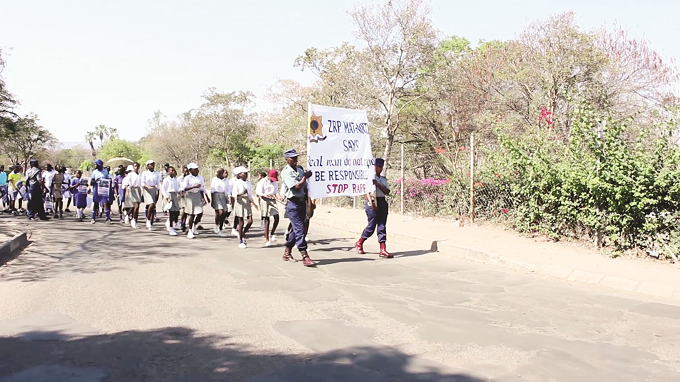
Pamenus Tuso
Poverty is turning some school going girls into warriors of many battles. They are driven onto the streets to sell various goods. But in their endeavour to survive the challenging economy, the poor girls at times fall prey to child molesters and paedophiles.
*Gogo Nhlalwenhle Nyoni (79) of Mlonga Village 17, Jambezi area in Matabeleland North under Chief Shana, bears the agony of dispatching two of her teenage granddaughters out to sell fruits.
“I have no choice but to let two of my granddaughters sell fruits for us to have food on the table. I live with eight grandchildren most of them orphans and I am too old to work. It pains me to expose such young lives to the dangers of the streets but what can I do to end this?” she asks rhetorically.
The elderly woman has an appreciation of the dangers that may befall her vending grandchildren aged 13 and 14, but draws strength in her religion, Christianity.

She says as a religious woman, she always prays to God to take care of her grandchildren each time they leave home.
“It is a risk that I have learnt to live with for years. I always pray to God to intervene. I have to make sure that the children are fed and the only viable option is to sell fruits and at times curios. It’s either that or we turn to street begging, which to me, is a worse crime. I have grandsons, three of them, but they are too young to send onto the streets. The oldest boy is only nine,” said Gogo Nyoni.
Gogo Nyoni’s grandchildren, like many others in Hwange, sell their wares along the Bulawayo-Victoria Falls highway. They target tourists who visit the magnificent Victoria Falls, one of the Seven Wonders of the World and the vast Hwange National Park.
Most communities in the rural areas of Hwange are food insecure and experience grinding poverty.
The ever increasing cases of girls who are abused are threatening to dim Hwange and the resort town’s gloss as internationally acclaimed tourist destinations.
Officer commanding Hwange District Chief Superintendent Newton Mutomba revealed that since January this year the district has so far recorded 95 cases of child sexual abuse.
“These cases are far too many compared to 65 cases which we received during the same period last year. Ordinarily we would want to reduce these cases, say by 10 percent but they are on the increase,” he said.
Chief Supt Mutomba who was speaking at a recent official launch of the campaign to end sexual violence against children held at Old Grounds in the district said of the received cases, 32 involved rape against young people, nine attempted rape while 41 involved sexual intercourse with young children.
“Of the 32 cases, 20 cases happened in homes while the other 12 occurred in the bush. So we see more cases of rape are happening in our homes. Out of the 32 cases, 19 were committed by neighbours while relatives accounted for 10 cases. These statistics simply show that sexual violence against our children is being committed by people whom we trust,” said Chief Supt Mutomba.
The Hwange police district comprises of Hwange, Lusulu, Binga, Siyabuwa, Kamativi and Dete.
The police boss warned parents to desist from leaving their children in the hands of neighbours and relatives while doing their day to day errands such as fetching water, firewood or attending meetings.
Speaking at the same occasion, Mr Lovemore Nyoni, Hwange World Vision Area Development Programme Manager (ADP), said the Hwange campaign is part of the world organisation’s recently launched global campaign on child protection known as, “It takes a world to stop violence against children”.
“World Vision Zimbabwe took that theme and further engaged various stakeholders to prioritise sexual violence in Zimbabwe as the theme we are going to run with for the next five years. Under this theme, we are saying no to cultural brides. If parents receive lobola for an underage child they are an accomplice and they should be prosecuted,” said Mr Nyoni.
The ADP manager also attributed the high increase of cases of child abuse in Hwange to traditional practices ceremonies such as chiperu, an all-night traditional ceremony commonly practised by the Nambya and Tonga people.
Hwange district with over 3 400 households, predominantly made up of the Nambya and Dombe-speaking communities is still one of the few places in the country where the inhabitants are still practising undiluted traditional practices.
“Here in Hwange children are abused at all night traditional ceremonies and initiations such as chiperu. We should protect our children from attending functions where they are abused,” he said.
Mr Nyoni said very soon the organisation would be taking the campaign to ward level but would first engage various stakeholders, including traditional leaders and councillors.
Chief Hwange urged police to arrest all perpetrators of sexual violence against children.
“I know long ago we used to have some cultural practices which were acceptable that time but now things have changed. For example, people used to get married at functions such as chiperu but our Constitution and the Traditional Leaders Act do not allow the abuse of our children. Only older people should participate in such ceremonies. I need all the people in my area to understand this point,” said Chief Hwange.
Miss Robina Chimowa from the Child Network hailed World Vision and the Zimbabwe Republic Police’s Victim Friendly Unit for organising the launch.
“Cases of child abuse in Hwange have been on the increase. The problem is people were afraid to come out in the open. With these types of campaigns, I think the girl child has been empowered to report any abuse which she might experience,” said Miss Chimowa.
She said a lot of perpetrators of child abuse were relatives and therefore most victims were afraid to report them.
Chief Supt Mutomba assured the nation that the police would arrest all perpetrators of child abuse without fear or favour.
“Whenever you hear a case of child abuse please report to the police as soon as possible,” he said.



 Online Reporter