Chronicle Editor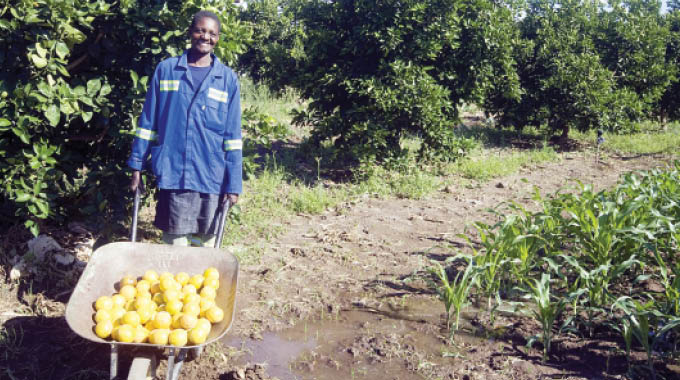
Thupeyo Muleya
Matabeleland South province is one of the rain-starved areas in the country, where crops cannot do well.
As a result, the Government has been prioritising irrigation farming in the area.
Since rains are erratic in this part of the country only cattle, sheep and goat rearing does well. Many smallholder farmers in the province have worked very hard to sustain crop husbandry with the aid of irrigation water. Most of these projects are located near water bodies including dams and rivers.
However, despite their proximity to water sources, some farmers are finding it hard to maintain equipment, infrastructure and sustain operations due to a number of challenges including the unfriendly economic climate.
In essence, community irrigation projects are a source of livelihood at household level for most rural communities in Matabeleland South, but infrastructure at many facilities has succumbed to wear and tear or has been destroyed by wild animals, especially elephants.
The one hundred and twenty-hectare Shashe Irrigation Scheme, has for most of the past two decades been struggling due to a number of challenges. The project which draws irrigation water from Shashe River is located some 115km west of Beitbridge town and has over 180 plot holders.
Until recently, it was one of the major community-based citrus projects for Beitbridge District, producing several tonnes of oranges to supply the Schweppes-run Beitbridge Juice Plant.
The Government and its partners have been working on a number of initiatives to revive irrigation-based farming and this saw the European Union pouring $1,5 million into the Shashe citrus projects.
At full capacity, the 92, 5 hectares project produces at least 1 000 tonnes of oranges per-season leaving each farmer with an average income of $15 000 from the sale of oranges.
Each farmer has 60 trees, which they take care of with technical support and capacity building from a non-governmental organisation, Cesvi.
However, hopes for success for Shashe villagers are threatened by electricity and irrigation water shortages. This follows a disaster which befell them on November 14, last year, when strong winds left a trail of destruction in Ward 8 felling electricity pylons and damaging key infrastructure including a clinic, shops, homesteads, and shops.
Since then, the citrus farmers have endured the agony of having to fork out $80 000 to irrigate the orange trees monthly instead of $3 000 if grid electricity is available.
According to the project’s agronomist Mr Godman Moyo, they need at least 120 litres of diesel to irrigate the project for 16 hours daily, mainly during the night.
“About 23 poles fell last year and the delays are affecting operations here. We’re now relying on diesel-powered engines.
“In the wake of zero power supply, we’re likely to lose 40 to 50 percent of our targeted yield of 1 000 tonnes. The situation is bad and as we go forward, we’re looking at adopting the use of renewable energy to beat the intermittent power cuts,” said Mr Moyo.
A distraught plot holder who is also a member of the irrigation management committee, Ms Bonang Muleya said: “This was our hope as a community, but now we face a bleak future especially women who carry the bulk of social problems. Besides getting income from these projects, we also get stock feed for our cattle, but now all that is a pipe dream.
“Some plot holders have started pulling out of the project because of the state of affairs. Around 2012, we were 200 now we are 180. We have been rapidly losing people.”
Another plot holder, Ms Silibaziso Dube said they were now looking at mobilising resources to install solar-powered irrigation pumps.
“This is our livelihood; we’re calling on the national power company to come to our rescue. It’s heartbreaking to see such huge resources going to waste,” she said.
The project’s chairperson, Mr Shadreck Bepere said their situation was that of falling from a tree to a hard rock, with criminals stealing the parameter fence and other resources from the project.
“We have wild animals preying on the project. We now take turns to guard the place. Our hope is to get ZETDC to fix the pylons as soon as yesterday as we look into adopting solar in the long run. Before the November disaster, we were spending $3 000 on electricity to power irrigation pumps,” said Mr Bepere.



 Online Reporter