

 Online Reporter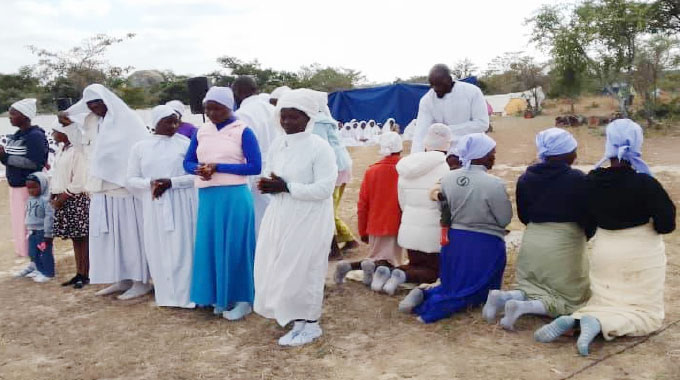
Daimon Phiri
SOCIAL pressures, silent struggles and the search for answers draw scores of women to apostolic faith shrines. On any weekday morning in Bulawayo, Gweru and parts of Harare, the scene is familiar.
While husbands leave for work, buses fill with commuters, and factories open their gates, a different kind of traffic moves in the opposite direction. Groups of women, wrapped in white garments, make their way to apostolic shrines tucked away in peri-urban bushes, at riverbanks, and on open fields.
By 10AM, some shrines host dozens, sometimes hundreds, of women on their own.
The scene raises a question many ask quietly but few answer openly: Why are there mostly women at Madzibaba shrines during working hours? And if the visits are in good faith, why do husbands rarely accompany their wives?
The trend also raises questions about safety and accountability.
The answer lies at the intersection of faith, gender roles, economics and social pressure in Zimbabwe.
Faith as a space for women’s voices
For many women, the shrine is one of the few public spaces where their concerns are heard without interruption.
“At home, a woman is expected to endure. At the shrine, she can speak about infertility, marital problems, illness, and poverty,” says Dr Tariro Mhlanga, a sociologist at the National University of Science and Technology.
Apostolic churches, particularly the Johanne Marange and Johanne Masowe groups, allow women to pray, prophesy and seek counsel directly.
In a society where many women still defer to male authority in the home and in mainstream churches, the shrine offers a sense of agency.
The timing is not accidental. Most shrine gatherings for women are held mid-morning during weekdays, precisely when men are at work and children are at school.
“It’s practical,” explains Apostle Peter Mutasa of an apostolic assembly in Mpopoma suburb, Bulawayo.
“Women have domestic duties in the morning. After that, they come for prayer and fellowship. Husbands cannot leave work for that.”
However, this same timing creates a perception problem; with men absent, outsiders often assume secrecy or wrongdoing.
The unspoken problems women bring
Interviews with women at shrines reveal recurring themes: barrenness, sickness in the family, domestic violence, unemployment among husbands, and financial strain.
“In the church, we are told to fast and pray for our marriages. If I tell my husband I’m going to the shrine for this, he will say I’m disrespecting him,” said a 34-year-old mother of three who spoke on condition of anonymity.
For many, the shrine is the only place where they can seek spiritual intervention without confronting their husbands directly.
The trend is not without controversy. Over the past five years, police have recorded cases in which women reported sexual abuse at some shrines, often linked to self-proclaimed prophets.
Zimbabwe Republic Police spokespersons have repeatedly urged women to report such cases and warned against visiting shrines where leaders demand isolation or secret rituals.
“It is true that some criminals use religion as a cover,” said one police official. “But it is wrong to say all shrines are unsafe. The majority are legitimate places of worship.”
Apostolic church leaders have also frequently condemned abuse.
The Zimbabwe Council of Apostolic Churches has expelled members found guilty of misconduct and now runs awareness programmes on safeguarding women and children at gatherings.
Why husbands stay away
Men rarely visit these shrines due to three main reasons, according to community leaders: work commitments, doctrinal differences, and stigma.
Many men belong to mainstream churches or identify as non-religious. Visiting a wife’s shrine is seen by some as an admission of weakness or failure to provide spiritual leadership.
“When a man goes to the shrine with his wife, people say he is bewitched or he can’t manage his home,” said Dr Mhlanga.
The absence of men leaves women exposed to both spiritual manipulation and, in some cases, exploitation.
Social workers and church leaders agree that shrines should operate openly, with female guardians and church elders present at all women-only gatherings. They also emphasise the need for couples to have spaces to discuss marital and health issues without stigma, reducing the need for secrecy.
“The shrine is not the problem,” Dr Mhlanga said. “The problem is when desperation meets unaccountable authority.”
A place of hope, not blame
For many Zimbabwean women, spiritual shrines are places of hope, prayer and community. They fill gaps left by economic hardship, limited healthcare, and restricted dialogue at home.
However, the fact that women visit these shrines alone also reflects deeper social fractures – in marriages, churches, and in how society responds to women’s suffering.
If the trend is to continue without harm, it requires more than suspicion. It requires protection, accountability, and honest conversations between husbands, wives and church leaders.
As one woman at a shrine in Luveve suburb put it: “We don’t come here to hide from our husbands. We come here because we are tired of hiding from life.”


