

 admin
admin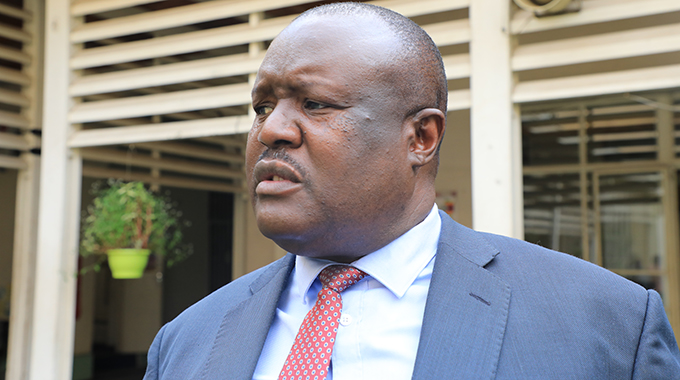
Zvamaida Murwira in Midrand, South Africa
PRESIDENT Mnangagwa is keen to ratify the Malabo Protocol which seeks to convert the Pan African Parliament into a fully-fledged legislative organ, Speaker of the National Assembly Advocate Jacob Mudenda said yesterday.
In an interview on the sidelines of the 11th Conference of Speakers of Parliaments and regional Parliaments hosted by PAP in Midrand, South Africa, he said Zimbabwe’s membership of PAP meant it was committed to the values of the legislative body and what it stood for.
In the past weeks, PAP, led by its president Chief Fortune Charumbira, has been calling for member countries to ratify the protocol so that the continental organ has legislative powers.
PAP has been conducting a strategic and reorientation workshop with legislators aimed at exploring ways to reposition the continental Parliament in light of a new Bureau led by Chief Charumbira that assumed office in June this year.
The continental Parliament is one of the nine African Union organs whose mandate has so far been restricted to consultative and advisory oversight, pending the ratification of protocols.
“The fact that we sponsored a candidate from Zimbabwe, through our Head of State and Government, His Excellency, President Mnangagwa, means we were in agreement with the Constitutive Act of the AU which establishes the PAP,” said Adv Mudenda.
“So, from that angle, we believe we were implementing what the Act provides. We are in the process of ratifying the Protocol. I had a conversation with His Excellency, the President, when the campaign team for Hon Chief Charumbira came to tender their gratitude to His Excellency over the unflinching support that he gave to the regional caucus campaign team.
“I raised the issue of the ratification of Malabo Protocol and he indicated that I should have conversation with (Minister of Justice, Parliamentary and Legal Affairs) Hon Ziyambi Ziyambi whose responsibility is to table the Malabo Protocol for ratification by our Parliament in terms of the Constitution and he is in the process of doing that.”
There were a few articles that some countries might have reservations about, such as how legislators were seconded to PAP, but that should not stop them from ratifying the protocol.
“We feel that the current position where the five delegates to PAP are selected from MPs is sufficient. But in terms of the Vienna Convention you can ratify a protocol with reservations.”
Some countries in Africa have been reluctant to ratify the protocol fearing that it had the potential to undermine their sovereign role to legislate laws.
Commenting on that, Adv Mudenda said Zimbabwe did not feel that ratification of the protocol would have adverse effect on its legislative powers.
“Our interpretation is that it does not interfere,” he said. “We can still operate within the ambit of PAP without losing our sovereign status as a country and as a national Parliament.
“Since 2004 (PAP inception) we have been members of PAP. We have not experienced that sense of loss of sovereignty by being members of PAP.”
Adv Mudenda outlined what the Government was doing to improve food security that includes Command Agriculture where the private sector is providing funding for agriculture as well as the Presidential input scheme.
He called for the full use of Inga Dam in the Democratic Republic of Congo which had the potential to provide 65 percent of Africa’s electricity requirements.
He said this will see the attainment of Africa Union Agenda 2063 and the Continental Free Trade Area.
“Very little has happened in this regard,” he said. “The Inga Dam project, we believe will supply up to 65 percent of the electricity required by Africa. Electricity is an important infrastructure in the implementation of both the Continental Free Trade Area and Agenda 2063.
“But we need peace in the DRC, particularly in the eastern parts. The PAP is, therefore, implored to engage the AU Commission and through it the peace and security of AU as well as the Sadc Treaty so that the eastern part of DRC is demilitarised so that there is peace in the DRC.
“We are losing an important African resource because of insecurity. The same applies with the northern part of Mozambique where banditry is emerging and destabilising good economic projects in the production of gas. PAP must engage stakeholders so that there is peace and economic development.”



 Online Reporter