

 admin
admin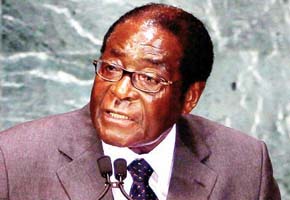
where he will deliver an address.
The First Lady Amai Grace Mugabe, Foreign Affairs Minister Simbarashe Mumbengegwi, Health and Child Welfare Minister Henry Madzorera and other senior Government officials were part of the delegation accompanying him.
President Mugabe was seen off at the Harare International Airport by senior Government officials.
The main plenary of the UN General Assembly – whose agenda was still embargoed yesterday – would be preceded by high-level meetings, chief among them the Summit on Non-Communicable
Diseases (NCDs) scheduled for Monday and Tuesday.
The meeting is the second in the international body’s history to focus on a global disease after the HIV and Aids Summit of 2001 that led to the creation of the Global Fund.
UN members organised the interface on NCDs to formulate a co-ordinated global strategy to prevent and control the diseases. Deliberations would centre on prominent NCDs such as cancers, cardiovascular ailments, chronic respiratory disorders and diabetes.
Leaders are expected to discuss Millennium Development Goals.
On Monday, the President of the General Assembly will chair plenary meetings that will also be addressed by UN Secretary-General, Mr Ban Ki-moon, World Health Organisation Director-General, Dr Margaret Chan, and a civil society representative.
Three roundtable discussions are expected to tackle the rising incidence and socio-economic impact of NCDs and their risk factors.
Participants would also explore methods of strengthening the national capacities and policies of member states to address their prevention and control.
Tuesday will see the adoption of an action-oriented outcome document comprising submissions from the plenary meetings and roundtables.
In Zimbabwe, resource constraints continue to hamper the fight against NCDs.
Those living with such conditions – including top local musician, Tongai Moyo, who is battling non-Hodgkin’s lymphoma – have complained that authorities seem to be concentrating on diseases such as HIV and Aids, while turning a blind eye to their plight.
The omission of NCD indicators in the Millennium Development Goals (MDGs) also makes it difficult for the country to secure donor support. So far, only Government and the WHO are channeling funds towards the diseases.
In an interview last Thursday, Cancer Centre knowledge manager Mr Tafadzwa Chigariro, urged world leaders to avail more resources for NCD awareness and treatment programmes.
“The world is yet to acknowledge that NCDs are a major challenge in terms of resources. They are now the major killer globally,” he said.
“The developing world, in particular, has experienced a transition from communicable to non-communicable diseases. NCDs are easier to prevent as they have a lot to do with healthy lifestyles. They are, nonetheless, more expensive to treat and manage than communicable diseases.
Latest statistics show that NCDs account for 60 percent of deaths worldwide.
More than 12 million people are diagnosed with cancer worldwide annually with 7,6 million of them eventually dying. Zimbabwe records an average of 7 000 cancer cases every year. Indications are that the figure could be higher if rural communities were included.



 Online Reporter