Online Reporter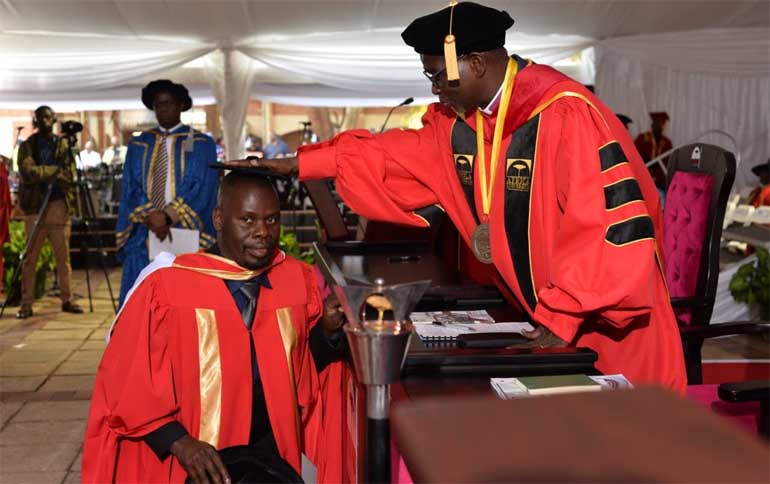
Samuel Kadungure
News Editor
BY 7pm, the Anglican Diocese of Manicaland Secretary’s Office is silent, its high ceilings no longer echoing with the clatter of school fees queries or parish disputes.
Behind a closed door, Reverend Dr Edmund Samutereko pours a cup of tea that will soon go cold.
He opens his laptop, and for three hours each evening, the diocesan secretary transforms into a student once more.
“This office demands a lot. It is a political office. Issues rising, issues coming out. Education, church, politics, the family. I do not rest during the day. So I dedicated 7pm to 10pm to my studies,” he said, leaning back in his chair, the blue glow of the screen catching the edge of his clerical collar.
Last Saturday, that discipline walked across a stage at Africa University’s 32nd graduation.
The black suit was gone, replaced by a doctoral gown.
Rev Dr Samutereko, 11 years after his bishop, Reverend Eric Ruwona, set a new standard for clergy education, graduated with a PhD in Public Policy and Governance. He was one of five doctoral graduates at the university.
Why this thesis matters to the province
Zimbabwe’s 2020 devolution policy promised to move power, money, and decisions from Harare to the provinces. On paper, it would build clinics, fix roads, and let Mutare clear fingerprints without sending citizens to Harare.
In practice, Rev Dr Samutereko found something else.
His thesis: Evaluation of the Devolution and Decentralisation Policy Implementation in Manicaland Province, argues that devolution in the province is physically present, administratively visible, but politically and fiscally constrained.
The story of his PhD is the story of why a priest spent six years asking who really holds the purse, and what happens when the pulpit studies the budget.
“I was lambasted. I had to say, I wanted to quit,” he said about the academic journey that began in August 2018.
“I started this programme in August 2018 with some theoretical courses. I travelled to Harare every weekend to study, and we wrote exams for those 12 courses. I went for about four semesters,” he recalls.
Then came the proposal.
His first supervisor was the late national hero and former Cabinet Minister, Dr Christopher Mushohwe.
“It was my first thesis. I wrote a proposal, he marked it, and I submitted it to the college, did some proposal defence, and first time, I did not come out well. I was lambasted, yes, by the examiners, in the proposal. I harboured thoughts of quitting, but I soldiered on,” he said.
He tried to change topics, to study disaster preparedness after Cyclone Idai hit Chimanimani in March 2019, but the university’s ethics committee sent him back – someone else was already on it. When Dr Mushohwe passed on, he was assigned Dr Kenneth Maregere and Professor Alois Chilunjika in Eswatini as co-supervisors.
The varsity raised the bar again. He wanted to focus on Mutasa and Nyanga.
“The university said, no, it is too shallow for a PhD, I had to do it for the whole Manicaland Province,” he said, adding that he widened the lens to Rusape Town Council, Makoni Rural District Council, District Development Co-ordinators for Makoni and Mutare, Mutare RDC, Mutare City Council, Minister of State for Manicaland Provincial Affairs and Devolution’s Office, Local Government ministry, United Mutare Residents and Ratepayers Trust, and Rusape Residents Trust.
Two focus groups – one in Sakubva and Rusape.
“Approval was very difficult. It was back and forth again. I think around five times of collections, which I did. I later got the approval to do data collection.”
What the pews and the policy papers found
He has seen the wins.
“Though we have seen a lot of progress in certain areas with infrastructure being developed, some clinics, roads being maintained, some schools being built through devolution, but the money still ‘lives’ in Harare.
“The fiscus is still controlled at the national level, yet actual devolution should reconcile between physical, political, and administrative. Yes, we have devolution, the Minister of State for Provincial Affairs and Devolution in the province, but the councils are not fully capacitated to implement the devolution policy.”
His solution draws on the Fallets Theory of Decentralisation and new public management, predicated on efficiency and a bottom-up pulse.
“There should be some kind of bottom up approach in terms of decision-making. The people on the ground should tell the Government what projects they want in their areas and then request for the funds, which should be directed straight to the local authorities and used there.”
And he is taking the findings back.
“When I was doing the data collection, the local authorities in Manicaland requested that after finishing this research, they needed some copies so that they will follow through and find out what was the outcome of the evaluation. I think, through that, they can also see where they are lacking, and where they are doing better.”
A bishop’s bet on books
For Bishop Ruwona, this is strategy, not coincidence.
“When I became the Bishop of the Anglican Diocese of Manicaland in 2015, I realised that most, if not all of our clergies had no degrees. Our vision was to make sure that at least the standard of education of our clergy also increases.
‘‘We embarked on a programme to encourage and also sponsor those who wanted to pursue their education. I am proud to say more than half of my 70 clergy have at least one degree and one third have masters’ degrees. In fact, I gave all who those left seminary a three-year target to get at least a first degree, and another three years to attain a masters’ degree. A masters’ degree is the standard.
“From my encouragement, Reverend Dr Samutereko went a step further to acquire a PhD from a reputable institution. There are many PhDs flying around, but Africa University’s PhD is quite rigorous. I am happy that he was able to go through, and this will serve as an inspiration to other colleagues.”
Why does it matter?
“It is extremely crucial because once you are ordained in the church, automatically you assume a leadership position. Our church is episcopally-led and synodically governed, which means the church is led by the clergy. They assume leadership into the rest. Imagine, you are chairing a meeting, and you are a holder of a certificate, and the people you are leading, three have masters’ degrees, and the other, PhD and the others have diplomas.
‘‘You know, the issue of trust to start with, falls away, because how can they trust somebody without a decent understanding of maybe corporate governance, or maybe leadership,” said Bishop Ruwona.
He learnt that himself.
“I did my first Masters’ Degree in Leadership and Management in 2009, I think 20 years after I was ordained, and I realised, at that moment, how, many things I did thinking that I was doing the right thing, and, oh, boy, how wrong was I? Right now, we have challenges, even in our schools – corporate governance is difficult for many to comprehend. When we have people in leadership, they do not understand the role of a board or School Development Committee. Basically they should act as a board of governors, but you find, in most cases, they are competing with the school heads in the implementation of resolutions and the day-to-day running of the school,” he said.
Theology, yes, but make it holistic
Rev Dr Samutereko’s first degree was theology in South Africa. Then came environmental health. Now, governance.
“The church must be holistic. We don’t only have to study theology. I thought we should also be developmental, and we should also have doctors in the church. Even a clergy who is a doctor is also practical and very useful for the church.
‘‘I saw it prudent to study something through a development approach, because this governance PhD, is into development because devolution is there to develop local authorities, the local people. Devolution is about devolving power from the centre to the bottom,” said Rev Dr Samutereko.
Peace, conflict, and the politics of fingerprints
“Yeah, I am very much an asset because we are at the centre of the church. That is why you see if there is something wrong that is happening in the church, we are the target. Whatever we say affects the church, whatever the bishop says affects the church. While I was studying, I was also implementing what I was learning in the church. Conflict in the church may not be eradicated, but we can improve and adjust. I think we will not stop it, we can improve. We have differences, but worshiping the same God, and at the end we need people to come together. Unity is very critical,” he said.
That same lens must turn to the province.
“There are services that we are still getting from Harare which should be found in the province. In terms of the medical side, we are still referring people to Parirenyatwa Group of Hospitals, and yet our provincial hospital is there, which must be equipped to provide the health care for the people of Manicaland. Yes, the airport, we now have Grand Reef, we are doing very well.
‘‘The Government is doing very well, but we need to improve in terms of getting a flight straight from Mutare to Victoria Falls, and even South Africa, that way trade will improve. And there are also many things that we need to improve on, in terms of police services. For one to clear fingerprints, you have to go to Harare, yet, we have a central police station in Mutare where we can have CIDs clearing a person.
“I am very much thrilled, I am very happy to be the single person who graduated in the province, and also among the five PhD students for the whole university. And I feel like, yeah, going to the moon.”
The work, he said, was “very thorough and vigorous to the extent that if you get a PhD, it is not a kids’ game, you really need to work.”
Bishop Ruwona is already looking past the A-Level ceiling.
“We have plans underway to establish a university because most of our schools, if you look at St Augustine’s, St David’s Bonda, and St Faith’s have achieved anything and everything a high school can achieve. What is left for them now is, first of all, to go back to the basics, because before the new era, these schools were, not only high schools, but were also vocational training centres.
‘‘If you wanted to do nursing, you would go to St Augustine’s and David’s Bonda. But at some point, we gave up that when the Government introduced polytechnics and teachers’ college. I think we need to go further. It is unfortunate that we take people up to A-Level, and abandon them afterwards. We still have that vision because we cannot be running 54 schools, and one morning we cannot be taking our graduates beyond A-Level.”
Back in his office, Rev Dr Samutereko closes the thesis file.
The findings are printed, bound, ready for Mutare City Council, Rusape Town Council, and the Minister of State for Manicaland Provincial Affairs and Devolution’s Office.
“They are getting funds from the Government, though sometimes it comes in bits and pieces. So they will see where they are getting it wrong or whether they are doing their best.”
Outside, Mutare has gone quiet. Inside, a priest who once nearly quit now holds the kind of evidence that can change a council meeting.
He looks at the clock – 10pm.
“Learning remains a lifelong process. And I am a good example of that.”
The tea is cold. The work is not,” he said.