


 peter
peter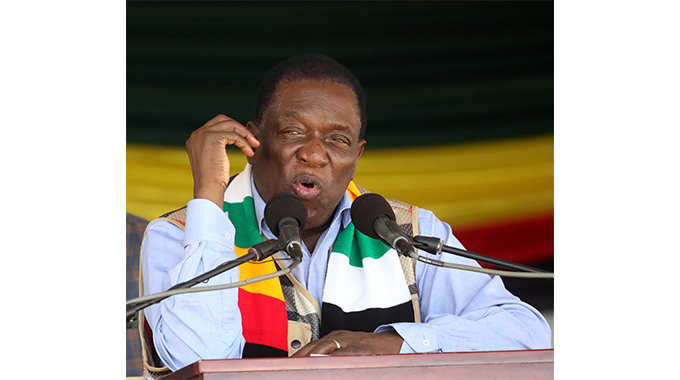
HIS Excellency, the President of the Republic of Zimbabwe, Cde Emmerson Dambudzo Mnangagwa (pictured) was sworn-in as the country’s Head of State and Government on 24 November 2017 after his nomination by the ruling Zanu-PF party on 19 November 2017.
This followed the resignation of his predecessor, Cde Robert Gabriel Mugabe on 21 November 2017.
Cde Mnangagwa is a lawyer by profession. He was admitted to the Bar of the High Court of Zambia in 1976 after completing his law studies at the University of Zambia, a feat he accomplished from studies begun while in prison in Rhodesia for his involvement in Zimbabwe’s liberation struggle.
He was born on 15 September 1942 in Chief Mapanzure’s area in Zvishavane. President Mnangagwa started his primary education at Lundi Primary School in Mnangagwa Village, Zvishavane, before his family was forced by the colonial regime to relocate to then Northern Rhodesia (Zambia) in 1955.

This forced the young Emmerson to complete his secondary education in the then Northern Rhodesia. Thereafter, he enrolled for a four-year City and Guilds Industrial Building course. Midway through his tertiary education, he joined and became active in national liberation politics under the United National Independence Party (UNIP) Youth League of Zambia in 1960.
For his participation in student demonstrations, he got expelled from college.
During the liberation struggle, he joined the Zimbabwe African People’s Union (Zapu) in 1962, which sent him to Tanganyika, now Tanzania en route to Egypt to train as a freedom fighter for the liberation of Zimbabwe from colonial settler rule.
On 19 November, 2017, the Zanu-PF Central Committee nominated him President of the Republic following the resignation of his predecessor, Cde Robert Mugabe. At his inauguration as State President on 24th November 2017, President Mnangagwa committed himself and his new administration to prioritising national economic recovery, elimination of corruption, re-engaging Western countries and engaging the rest of the world in economic and diplomatic relations to restore and strengthen both.
Above all, he committed himself to ensuring a free, fair, transparent and credible 2018 plebiscite for Zimbabweans, a promise he fulfilled on 30 July, 2018. He stepped up the re-engagement process with Western capitals to convey his vision for Zimbabwe in the new political dispensation.
At the same time, he reaffirmed Zimbabwe’s membership to Sadc, Comesa, the African Union, and has made clear overtures to rejoin the Commonwealth. Alongside this broad thrust, President Mnangagwa has deepened Zimbabwe’s relations with her traditional allies across the globe, all for mutually gainful partnerships.
Through the mantra “Zimbabwe is Open for Business”, President Mnangagwa set the vision to transform Zimbabwe into a middle-income economy by the year 2030.
To attain that vision through rapid national economic recovery and sustainable socio-economic development, he immediately instituted critical economic policy reforms upon taking the office of President.
He revised the constraining Indigenisation and Economic Empowerment Act in order to open up all sectors to unlimited foreign investment, except in two strategic national mineral sub-sectors: diamonds and platinum.
He finalised the establishment of special economic zones; stepped up the rebuilding of critical national infrastructure such as roads, rail, energy, irrigation and dams while stepping up construction for food security through enhanced agriculture.
President Mnangagwa secured the renewal of financing arrangements for stalled critical national projects under bilateral arrangements with key partner nations such as the People’s Republic of China, Russia, Brazil, India and others.
His administration has expanded “Command Agriculture”, a national food security programme he successfully spearheaded during his tenure as Vice-President under the country’s much-acclaimed Zimbabwe Agenda for Socio-Economic Transformation (ZIM-ASSET) national blueprint programme.
Anchored on simple projections and the realisation of the Public-Private Partnership model in delivering national development programmes, Command Agriculture yielded a bumper harvest for Zimbabwe in the 2016/2017cropping season, initialising a permanent turnaround towards national food self- sufficiency. Its replication in other agricultural crops and the livestock sector has made Zimbabwe food secure.
Increased direct foreign investment inflows following reforms to open up the economy, has triggered economic recovery with industry hovering above 50 percent capacity utilisation.
President Mnangagwa’s new policy thrust under the mantra, “Zimbabwe is Open for Business”, underpinned by a sincere re-engagement of western capitals including international financial institutions, as well as the renewal and intensification of economic ties with traditional foreign co-operating partners has inspired a lot of confidence and goodwill towards Zimbabwe today.
Zimbabwe boasts of US$20 billion in Foreign Direct Investment (FDI) commitments, up from a lowly average of US$500m a year. His Government has since revised the country’s economic growth projections, with the more conservative Bretton Woods Institutions, the International Monetary Fund (IMF) and the World Bank (WB) increasing their own growth projections.
The historically sluggish economy is showing strong signs of recovery on the back of a structural shift towards productive imports as opposed to consumptive ones which dominated previous years.
On the political front, President Mnangagwa has delivered on his promise for an open political society where freedoms are respected and where elections are free, fair and transparent, and held under international supervision.
Indeed the 2018 elections were largely peaceful. Notwithstanding spirited attempts on his life during the election campaign period, he has remained steadfast in brokering unity, peace and tolerance to divergent views.

On 30 July, 2018, Zimbabwe held its harmonised elections where President Mnangagwa romped to victory having garnered 50,8% of the presidential votes, while his party clinched 145 seats, to secure a two-thirds majority in Parliament.
He was inaugurated as the President of the Republic of Zimbabwe and Commander-in-Chief of the Zimbabwe Defence Forces on 26 August, 2018.
Moving with the Second Republic full realisation that, the country can be developed by Zimbabweans and only Zimbabweans, “Nyika inovakwa nevene vayo/ilizwe lakhiwa ngabaninilo”, the President decided to ensure that local authorities are supported by devolution funds.
The devolution funds have assisted the development and rehabilitation of local authorities’ service provision.
The President in 2022 made full emphasis that there was a need for performance contracts for office bearers in the public sector.
That ensured that everyone in the public sector had a performance contract which was assessed quarterly without failure.
This has helped in ensuring that public service officials work with targets that guide their operations and ensure positive results.


 Bongani Ndlovu
 Online Reporter