admin
admin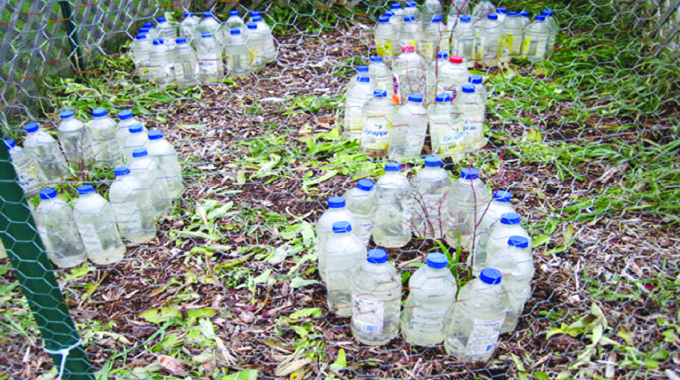
SUMMER has come and gone! And winter is nigh at hand! As farmers bundle up to escape the chilly weather, they also need to protect their crops from the inevitable frost that usually escorts cold temperatures.
Many vegetable crops are vulnerable to frost action and require the farmer’s intervention to mitigate the harsh effects of the cold weather.
Of course, there are a number of solutions farmers can use to protect the crops from the hostile temperatures and most of them do not require any capital for their roll out, but just the energy to adjust conditions in the crops’ immediate environment.
It is vital for farmers to plant in high areas that face the sun and avoid low-lying areas, where cold air settles, exposing crops to frost.
They can also cover plants with plastic or grass during the night and remove to the cover the following day to allow sun heat during the day.
One other way of protecting crops is to fill bottles with water up to the three quarter mark before placing them upright on the ground close to every third plant along the row when the plants are still young.
The bottle neck should be 10 centimetres above the plant top and on a raised platform.
As the plant grows, the bottle must be regularly raised to keep it 10 centimetres above the plant top by either putting a brick under it or by tying it on trellising sticks.
When the temperature drops below freezing, the water in the bottle freezes, but the plants stay frost free. Water in the plants has a lot of dissolved minerals in it and will therefore freeze at lower temperatures than water in the bottle.
When water in the bottles freezes it releases a lot of heat that will keep the air around the plants warmer than the surrounding area.
Soil type can also influence frost incidences, for example, growers within the same general climatic and topographical conditions often experience differences in frost damage that may seem unexplainable.
This can be explained through differences in soil type, ground cover, soil water content and ice nucleating bacteria concentrations. Soil type is clearly one aspect of site selection to consider, for instance, recently drained swamps are highly prone to sub-zero temperatures.
Some farmers use sprinkler irrigation to control and protect crops against frost by irrigating lightly very early in the morning to increase humidity in and around the crop field.
The ground must also be kept free from weeds and mulch to allow absorption of heat during the day and release of heat during the night.
One of the commonest practices is the erection of a one and half to two metres grass or plastic fence around or on the upslope and sides of the crop, leaving the downside open.
This is very effective in preventing frost while a diversion dam can be made by mounding up soil or even simply stacking hay bales.
These and a host of other practices can be used to effectively protect crops from frost and allow the farmer to realise competitive yields that will boost food and nutritional security as well as revenue.
Crops such as tomatoes, peppers, cucumbers, pumpkins and eggplants to name just a handful are commonly referred to as the tender type that cannot readily keep frost at bay.
Generally, the lower the temperature, the more harmful this can be while sudden frost on farms is most damaging when it arrives unexpectedly catching farmers unprepared.
This is usually common during spring when comfortable daytime temperatures provide little warning of incoming frost. It’s best to stay alert during these highly variable seasons.
Farmers, therefore, need to prepare their farms from such eventualities by creating airflow, covering vulnerable crops, using moisture-sealant sprays, keeping the soil well-watered and planting winter-hardy vegetables.
Where all this fails, farmers should always have crop insurance.
The past two seasons – 2020/21 and 2021/22 were blessed with lots of rains that filled most water reservoirs making it possible for those farmers that wish to produce winter crops to do so without worries over water availability.
Obviously, for the majority of such farmers, vegetables will dominate the list of the crops they will grow. Most vegetable crops are by nature susceptible to frost attacks.
Such farmers run the risk of recording total crop failure courtesy because of frost if they do not take precautionary measures to protect the crops from the cold bite.
It is not a secret that even plants that grow naturally in the wild are also at the mercy of the cold weather despite being more resilient to frost attacks than vegetables.
Adequate knowledge of agronomic characteristics of crops is also one important tool in the fight to save crops from unruly winter seasons.
This starts with the farmer planting the right crops. Certain crops fare better in cold temperatures than others with some even preferring cool weather to warm one and need little sunlight to grow.
This makes it crucial for farmers to choose crops known to do well in winter.
As long as the farmer chooses the right crops and plants them at appropriate times, she is sure to have a flourishing farm well into the winter months.
In fact, certain vegetables taste better after a frost, as they produce extra sugars, making them sweeter after reacting to the cold weather. Crops such as beet root, peas, cabbages tend to do well in cooler temperatures than warm ones. This leaves the farmer with the task of protecting them against insects and sometimes diseases mostly.
Most leafy green vegetables are comfortable growing in cooler climates and fare well in winter probably because they require less light to grow.
They favour winter’s minimal sunlight. Vegetables like lettuce, kale and spinach taste sweeter after a light frost.
Carrots on the one hand are tolerant of a wide range of temperatures but naturally need time to grow to maturity before the first frost strikes.
Onions and turnips can withstand frost. Those planted in summer, the will continue to grow in the winter and the farmer can keep harvesting onions well into the winter months.
Cauliflower is another vegetable that can withstand light frost but might need a little protection from heavier frost.
It generally thrives in a mild, consistent climate hence the need for the farmer to consider the possible weather outcomes during the time it will be growing before making the decision to plant it.
The list of crops vulnerable to frost is almost endless and extends to cover fruit trees in the orchard too.
The farmer will need to first understand the geographical location before deciding on the type of fruit trees to grow and the kind of protective measures to implement.
Farmers can help prevent frost by simulating wind over the crops, which reduces frost build-up.
This can be done by placing blowers alongside rows of crops and works best if the cool air blows just over the foliage. Wind machines are most commonly used to protect orchards and deciduous trees.



 Online Reporter