admin
admin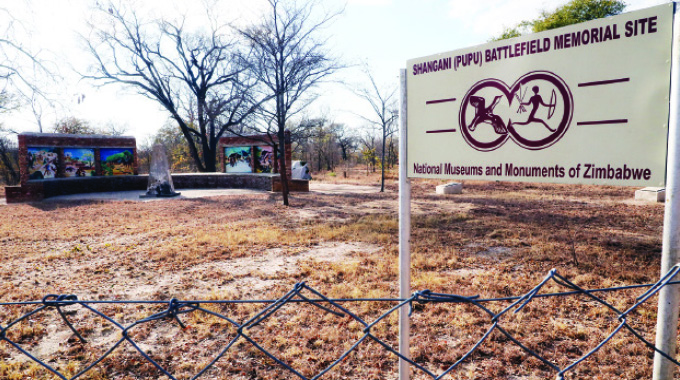
Mashudu Netsianda and Leonard Ncube
TUCKED deep in the forest, about 50 kilometres west of Lupane, Shangani (Pupu) Memorial Site where King Lobengula’s Imbizo Regiment killed settler forces’ commander Allan Wilson and his fighters, is now 90 percent complete.
The iconic monument lies less than 10km from Shangani River west of the Matabeleland North provincial capital.
King Lobengula’s regiment led by General Mtshana Khumalo defeated the Allan Wilson Patrol at the Battle of Pupu on December 4, 1893, blocking the attempted capture of the king by the colonialists.
Despite their superior weaponry comprising Maxim guns and cannons, 32 of 34 Major Wilson’s forces were killed by King Lobengula’s brave warriors.
The epic battle that was fought on the shores of the Shangani River, set in motion the wheels of resistance that subsequently halted Rhodesian Prime Minister Ian Douglas Smith’s colonial train on April 18, 1980.
A military tactician, General Khumalo commanded an elite group of fighters tasked to protect King Lobengula’s life and dignity as he trekked north.
While the Ndebele warriors were unable to stop the wave of colonisation, they took pride in that they managed to ensure a safe passage for their king, avoiding his capture and ridicule by colonialists, when they conquered men of the ill-fated Allan Wilson Patrol.
Major Wilson had been sent by Major Patrick William Forbes to look for the fleeing King Lobengula when his men got killed in a desperate battle against overwhelming numbers of Ndebele warriors.
President Mnangagwa last year posthumously conferred General Khumalo with national hero status in recognition of his contribution to the struggle against colonial subjugation.
General Khumalo’s legacy is set to be immortalised through the unveiling of the shrine at the site of the famous Battle at Pupu.
Our Bulawayo Bureau visited the shrine where Gen Khumalo’s statue will be erected.
Eight kilometres from the shrine, is a “mutswiri” tree (leadwood tree) believed to be 128-year-old where King Lobengula and his entourage briefly rested before proceeding north.
At the war memorial site, there is a tapering stone pillar set up as a landmark. The obelisk, which is riddled with bullet holes, has 34 names of Maj Wilson’s patrol inscribed on it.
Site custodian Mr Mlamuli Khumalo, a descendant of King Lobengula, said Zimbabwe People’s Revolutionary Army (ZIPRA) freedom fighters tried to destroy the pillar during the liberation struggle apparently incensed by Rhodesian government’s decision to exclusively honour their soldiers at the expense of the brave Ndebele warriors who defeated the colonialists.
“The obelisk was constructed in 1946 in honour of the 34 members of the Allan Wilson Patrol,” he said.
“Its original colour was white. During the liberation struggle, ZIPRA guerrillas who were operating in this area tried to destroy this pillar using their AK47 rifles, which is why there are bullet holes.
“After failing to destroy it using their guns, they tried to blow it up using bazooka resulting in it cracking on its foot. The reason why they wanted to destroy it is that they were angered by the fact that it only honoured our oppressors and deliberately omitting the Ndebele army narrative.”
Mr Khumalo said during ceasefire, just before going to assembly points, ZIPRA cadres defaced the tower.
The Government, through the National Museums and Monuments of Zimbabwe (NMMZ), has since refurbished the shrine after it was designated as a national monument.
Some of the improvements include the erection of a perimeter fence and construction of a horseshoe shaped exhibition wall panels at the site.
The memorial site has also been reconfigured to represent the whole story and is now justifying the victors in the battle that took place there.
The display panels show the armed resistance of colonial forces by the Ndebeles manifesting in the battle at Bonko by the Shangani River and at Gadade in Mbembesi.
The Ndebeles were defeated in both clashes thus they failed to stop the onward movement of the pioneers into the interior. This outcome can be attributed to the superior artillery wielded by the settler fighters.
The exhibition also relives the burning of King Lobengula’s Royal capital at Emahlabathini.
When the king got the news of the defeat of the Ndebele army at Bonko and Gadade, he ordered the burning down of the royal town as per tradition and fled towards the Shangani River accompanied by a force of about 2 000 to 3 000 men.
The exhibition also shows the pursuit of the king by the pioneers. A force of 34 men, later known as Shangani Patrol, was assembled to pursue and capture the king.
The settler army reached the southern banks of the Shangani River on the evening of 3 December 1893 only to learn that King Lobengula had crossed the day before and that his entourage had briefly rested under the leadwood tree before proceeding north.
Mr Khumalo said King Lobengula held his last imbizo under the mutswiri tree and that was the last time he was seen alive.
He said the sacred tree has a historical and cultural significance among the local community as it predicts natural disasters.
“When the Ndebele warriors were fighting Allan Wilson and his men, King Lobengula was in Ngazimbi, about 8km from Pupu,” said Mr Khumalo.
“After the Ndebele army had wiped the colonialists, King Lobengula walked to the site of the mutswiri tree where he met the army commanders and chiefs after their military triumph over the enemy.
“He addressed them and ordered them to go back to the colonialists and try to reach a settlement. He, however, assured his subjects that the colonialists would never catch him alive. It is under this tree that King Lobengula was last seen alive.”
Mr Khumalo said three months later, the colonialists got information that King Lobengula had a meeting with his commanders and chiefs under the tree.
“When they got to the mutswiri, they started shooting it under the delusion that King Lobengula had mysteriously turned into a tree since they strongly believed that he was a magician,” he said.
Some of bullet holes are still visible on the tree.
Mr Khumalo said the tree is sacred and visitors to the site are required to remove their shoes before getting near it.
“This tree is sacred and we usually use it a barometer when it comes to issues to do with drought, a bumper harvest, disease outbreak or a bad omen,” he said.
“Usually, when this tree sheds its leaves, it signifies the imminence of drought, disease outbreak or some form of bad omen befalling the nation.
“For instance, on July 1, 1999, one of its branches fell off and everyone in our area was puzzled and in a few hours’ time, news broke that Dr Joshua Mqabuko Nkomo had passed on.
“Whenever we see lots of leaves, it signifies bumper harvest and this is exactly what happened. In 2020, we noticed that the tree had few leaves and in no time, there was a global outbreak of Covid-19. As you can see even up to now there are a few leaves.”
Mr Khumalo said failure to adhere to the stipulated rules results in one getting lost in the middle of the forest.
Plans are underway by the NMMZ to erect a fence around the tree to protect it from being destroyed or tampered with.
Some of the routes, which were used by King Lobengula from Bulawayo to the site have turned into gullies due to heavy rains.
NMMZ director Dr Godfrey Mahachi said final touches will be done on the facility in consultation with various stakeholders, including local traditional leaders to complete the shrine.
The shrine will undoubtedly become a tourism attraction.
“The shrine details the history of the 1893-1894 Anglo-Ndebele war and how it inspired Umvukela/First Chimurenga and colonial efforts to destroy the Ndebele Kingdom,” said Dr Mahachi.
“We have done more than 90 percent of work and now there is something for people to see.
“We have redone the national monument from the former Allan Wilson Memorial so we can tell our own side of the story and the message we want to convey. We have done field information panels around to tell the story of Pupu Battle and fenced off the area.
“We have built ablution facilities and efforts are being made through our parent ministry to make sure there is water for the facility and surrounding community.”
Dr Mahachi said there were plans to construct a clinic nearby in line with the Second Republic’s vision of ensuring services reach every citizen.
He said the NMMZ will soon be consulting stakeholders for a review of work done and additional improvements needed.
Dr Mahachi said the shrine will be a source of history for learners who will take educational trips to Pupu once it is commissioned.
The NMMZ, he said, was working with various stakeholders including the Lotteries and Gaming Board and Ministry of Environment, Climate, Tourism and Hospitality Industry who have chipped in to mobilise funds for the site.
Plans are underway to upgrade the road from Lupane centre to the shrine and to erect signage to give directions.


 Online Reporter