Chronicle Editor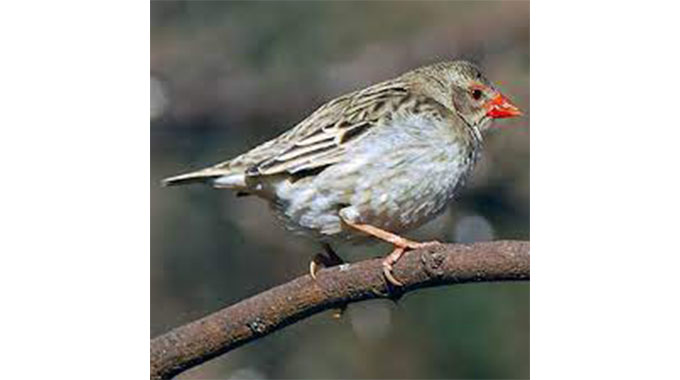
Yoliswa Dube-Moyo, Matabeleland South Bureau Chief
The invasion of crops by the destructive red-billed quelea birds is turning out to be a nightmare for some farmers in Bulilima District, Matabeleland South province as the birds threaten yields.
Villagers who planted small grain crops such as millet and sorghum fear their yields will be reduced significantly as a result.
The birds are ranked by the United Nations Food and Agriculture Organisation (FAO) as the most destructive birds on planted crops.
Matabeleland South provincial agricultural officer Mr Mkhunjulelwa Ndlovu said quelea birds are a persistent problem in the province.
“Year in, year out, quelea birds are problematic when the grasses are almost dry and the crop delays maturity.
The crops are heavily affected by quelea birds,” said Mr Ndlovu.
He said the only way of managing the birds was to destroy their roosting places.
“Farmers need to engage Zimparks so that they destroy their roosting places.
Although it is a challenge, bird scaring is another option.
Bulilima District, in terms of traditional grains, has a better crop.
Next season, we need to plant the beard, the type of pearl millet with spike-like tips.
It prevents the birds from eating the crop because it will be pricking them.
The spikes are about four to five centimetres long,” said Mr Ndlovu.
He said it was important for farmers to engage Zimparks to get assistance .
“It is also important for most of the community to grow traditional grains especially pearl millet,” said Mr Ndlovu.
According to FAO, for thousands of years, subsistence farmers in sub-Saharan Africa have been at the mercy of the red-billed quelea bird and sky-blackening flocks of the tiny feathered bird still decimate fields across the continent.
The organisation notes that quelea populations are notoriously robust.
Millions of birds are killed every year, but reducing their numbers is highly problematic since they are highly mobile and have few natural predators while they breed extremely fast.
Zimparks spokesperson Mr Tinashe Farawo said affected communities must always alert the department whenever they encounter such issues.
“When communities see wildlife in their areas, they must reach out to us, and when that is done, we always reach the areas in time to avert the situation,” said Mr Farawo.
Since the beginning of 2009, relief agencies in Africa have reported quelea bird swarms with a direct impact on food security in Kenya, Zimbabwe, Malawi, Tanzania, Mozambique and Namibia, FAO says.
Quelea birds can completely destroy crops in a short period of time hence the need for farmers to be alert.
According to FAO, the birds can destroy close to US$70 million worth of crops worldwide per annum.
Quelea birds are described as a wild bird species with an estimated adult breeding population of 1,5 billion pairs found in Sub-Saharan Africa.
– @Yolisswa



 Online Reporter