Online Reporter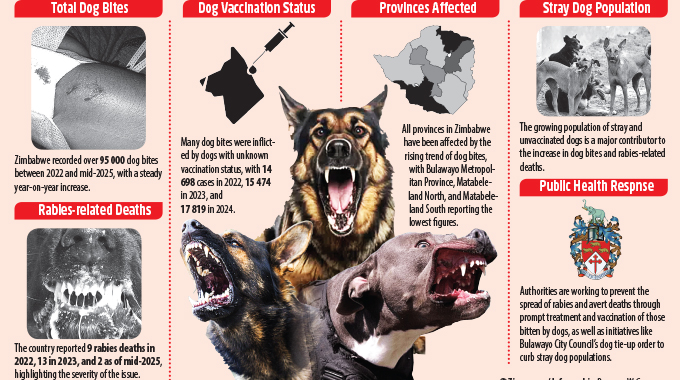
Nqobile Bhebhe, Zimpapers Writer
ZIMBABWE recorded over 95 000 dog bites between 2022 and mid-2025, with nearly all provinces affected by the rising trend. The alarming increase raises the risk of rabies, a disease that is almost always fatal in humans, Minister of Health and Child Care, Dr Douglas Mombeshora, recently told Parliament.
While the surge is nationwide, Dr Mombeshora noted that Bulawayo Metropolitan Province, Matabeleland North and Matabeleland South continue to report the lowest figures.
Latest statistics reveal a steady year-on-year increase, from 25 057 cases in 2022 to 26 273 in 2023, followed by a sharp rise to 30 363 in 2024, according to the Cabinet Minister.
By mid-2025, 13 537 cases had already been reported.
The trend has triggered public health concerns, with authorities warning of a potential surge in rabies, particularly from stray and unvaccinated dogs.
Rabies is a deadly viral disease affecting mammals such as dogs, cats, cattle, donkeys and humans. It causes inflammation of the brain and is transmitted through the bite of an infected animal — especially dogs and jackals — via saliva. Around 99 percent of all human rabies cases are caused by dogs. People bitten by a suspected rabid dog must receive prompt treatment and vaccination.
Dr Mombeshora revealed a concerning upward trend in dog bite incidents and rabies-related deaths, linking the surge to a growing population of stray and unvaccinated dogs.

“We respond to dog bites to treat those affected, prevent the spread of diseases such as rabies and avert deaths,” said Dr Mombeshora.
In 2022, a total of 25 057 dog bites were recorded nationwide. Of these, 4 810 were from vaccinated dogs, 4 969 from unvaccinated dogs, while the vaccination status of 14 698 dogs was unknown. Nine people died from rabies that year.
“For your information, once one has rabies, the end result is death. There is no cure for rabies, but it can be prevented through vaccination of dogs and those bitten by a rabid dog or animal can receive preventive vaccination before the disease sets in,” he explained.
There was a slight increase in 2023, with 26 273 dog bite cases recorded. Of these, 15 474 were attributed to dogs with unknown vaccination status, 5 050 from unvaccinated dogs, and 5 393 from vaccinated dogs. The country recorded 13 rabies deaths and three fatalities due to mauling.
The upward trend persisted into 2024, with the country registering 30 363 dog bites — the highest in the four-year period under review.
Dr Mombeshora said of these, 17 819 cases were caused by dogs with unknown vaccination status, 5 878 by unvaccinated dogs and 6 457 by vaccinated dogs.
“This year alone, as we approach mid-year, 13 537 people have been bitten by dogs and sought treatment in our health facilities. Of these, 7 938 bites were inflicted by dogs whose vaccination status is unknown, 2 852 by unvaccinated dogs and 2 696 by vaccinated dogs,” Dr Mombeshora stated.
To date, two rabies-related deaths and one death from mauling have been recorded in 2025.
Dr Mombeshora noted that a significant portion of dog bites were inflicted by dogs whose vaccination status could not be confirmed, largely due to the proliferation of stray and neglected dogs.
“Over the four years under review, we have seen a steady increase in dog bites in the country, affecting all provinces, although Bulawayo Metropolitan Province, Matabeleland North and Matabeleland South have the least number of dog bites. You may have seen that a huge number of dog bites are inflicted by dogs whose vaccination status is unknown.
“This is due to the large number of stray dogs in our communities, either owned or without homes.
We also have a large number of dogs that are unvaccinated despite having owners. This situation increases the danger of rabies,” said the Minister.
In May, Bulawayo City Council (BCC) embarked on a dog tie-up order as part of efforts to curb the growing population of stray dogs and reduce the risk of rabies and dog attacks in the city. The operation runs until 30 June.
This order requires all dog owners to ensure their dogs are kept within enclosed premises and not allowed to roam freely. Stray dogs found during this period may be shot, and dog owners are encouraged to surrender excess dogs to the SPCA or secure their premises.
The city has, over the years, battled an increasing number of stray dogs, which roam residential suburbs in packs, scavenging for food and posing a danger to both children and adults.
In 2023, there were 597 dog bites, and in the previous year, 751 dog bites, resulting in one human death.
In January and February, 72 and 84 cases of dog bites were recorded, respectively.
The council indicated that the number of dog bite injuries is projected to reach 836 by the end of the year, with dog bites estimated to cost the city’s economy at least US$117 900 in 2025.