admin
admin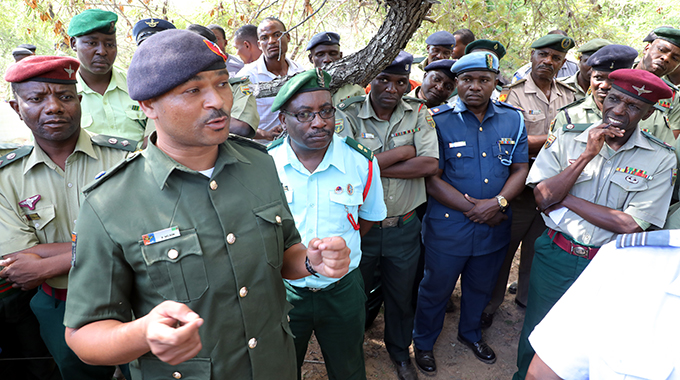
Mkhululi Sibanda
THE usually sleepy village of Ratanyana in Matobo District or Kezi as some prefer to call the area on Friday suddenly woke up from its slumber as dozens of senior army officers and men drawn from about 10 countries poured in to visit the site of a battlefield where a Zipra regional commander and some of his troops were gunned down by Rhodesian forces.
The battle still dripping fresh on the villagers’ lips occurred on 11 February 1979. In May last year, Sunday News put the events of that day bare when it spoke to 88-year-old Mrs Bhikhayeli Moyo (nee Dube), who recounted that battle as if recalling a gruesome scene from a horror movie, as it was the day her village ran red with the blood of her last born child and three grandchildren who were mercilessly executed by the Rhodesian forces.
The Zipra regional commander for the Southern Front 3 (SF3), Cde Adam Dube pseudo name Cde Mphini found himself and his escort section of 11 troops cornered by the Rhodesian forces and a fierce battle, which according to witnesses raged from around 9am to way after 4pm.
The Rhodesians, in frustration after seeing their chopper brought down by the guerillas, gunned down four minor children in a brainless vengeance. The children, Nokuthula Ndlovu born 4 April 1966 was the last born of Gogo MaDube while Thandekile Moyo born 7 July 1972, Sixoliso Dube born 1976 and Mqalisi Ndlovu also 1976 were her grandchildren. The four children found themselves cut off from their homestead when the battle was raging on and the Rhodesian forces summarily executed them. They had been in the family’s field.
Fast forward to Friday last week, the villagers watched with awe as half a dozen Zimbabwe Defence Forces trucks, a bus and other vehicles snaked their way to Ratanyana Secondary School where the events of recounting the battle were held.
The ceremony was dubbed “Ratanyana Battle Area Visit.” Scores of villagers also made their way to the school to be part of the proceedings. Not to be left out were children from neighbouring schools and their teachers.
Leading the students and staff from the Zimbabwe Defence Forces Staff College for the exquisitely organized ceremony was its commandant, Brigadier-General Josephat Kudumba. The military students were drawn from the Zimbabwe Defence Forces, Zimbabwe Prisons and Correctional Services (ZPCS), President’s Department, the Zimbabwe Republic Police while the foreign ones were from countries such as Botswana, South Africa, Lesotho, Zambia, Mozambique, Malawi, Nigeria, Tanzania, Pakistan and also present were Chinese military officers. An array of speakers were lined up and they included former Zipra chief of military intelligence, Retired Brigadier-General Abel Mazinyane, his Zipra colleague, Stanley Nleya popularly known as Stanley Gagisa, guerillas who operated in Kezi, Lovemore Ngwenya (Mkhize Mapatapa), Nzimande and Jabulani Sibasa (Mgugiselwa Mahlangu). A villager who was kept captive during the battle, Mr Ndodana Sibanda also narrated the events of that fateful day.
Brig-Gen Kudumba explained the visit of the Ratanyana battle site, saying the core business of the Zimbabwe Staff College was to train selected officers to become proficient in command and administration responsibilities. He said visiting battle sites of the liberation struggle was part of their training manual as it gave the officers the chance to appreciate how the war of independence was fought.
“We also prepare them to assume higher responsibility, command administration. Basically we cover quite a number of selected areas dealing with national security. One of our areas of concentration is the geo-political studies — a package we have got under part one of our programme, which is the internal study tour, part two is the external study tour where we go out of the country and visit other countries in the Sadc region and beyond like in West Africa, East African community and so forth. At the moment we are at stage one which is the local geo-political tour,” explained Brig-Gen Kudumba.
“We are trying to inculcate to our young officers the sense of the liberation history for our country, we feel that it is an important aspect of understanding national security. We are aware that our young officers the ones that I have in this group have not had hands-on experience of what transpired during the liberation struggle. So we take them around to selected areas like we have done now so that they see for themselves on the ground. When we talk about the history of the liberation war and what was experienced by the fighters, they will also be able to understand how the community contributed, the importance of the local population in any tasks that the armed forces would find themselves in. So it’s a lesson for them to know how liberation fighters were able to blend their own experiences and that of the local community. Of course like the Chinese always say if you remove yourselves from the population you are like a fish out of water so the whole concept is to expose the young officers to our liberation history so that it helps them become proficient in their command aspects.”
He said the identification of such sites as the scene of the Ratanyana Battle was done through contacting the past command element of both Zanla and Zipra.
“We have done this in other areas and we normally use the commanders who were on the ground. I get hold of the commander after investigating who was the commander in a particular area and then we try to find out from him whether we can get a burial site that can bring out certain lessons for our students. It’s actually both a training manual and a practice because the students are able to get at the site and see for themselves and make their own deductions. It actually helps to enhance the knowledge of students,” said Brig-Gen Kudumba.
Rtd Brig-Gen Mazinyane responding to suggestions by Cde Sibasa that the Rhodesians had got some intelligence about the intended arrival of Cde Mphini. Rtd Brig-Gen Mazinyane said Cde Mphini and his escorting section could have found themselves in such a compromising situation because some information might have leaked probably through loose talk from either the villagers who worked closely with the guerillas or through informants among the masses.
He said it was also easy for the Rhodesians to set up their Observation Point like what happened at Ratanyana Mountain because the Ian Smith regime had criminalised the ascendancy of high features by the locals.
“It was a criminal offence for the people in general to climb high features like mountains during the Smith regime and the Rhodesians did that to mask their military activities of setting up their OPs,” explained Rtd Brig-Gen Mazinyane. On his part Cde Nleya chronicled the training programme of Zipra, deployments and operations. Sibasa said a few days before that battle, a group of guerillas trained at Mlungushi in Zambia had arrived in that area and Mphini who had also returned from Botswana was looking for them so that he could take them for deployment in Beitbridge and Mberengwa.
“Mphini arrived at night and was not aware of the heavy deployment by the Rhodesians and had not met us for a debriefing. It looks like the Rhodesians had been given intelligence that a regular unit was on the ground and they came with all sorts of weapons,” narrated Sibasa.
“So when Mphini and the unit he was with emerged at Ratanyana on that morning the Rhodesians were watching from their OPs on the nearby mountains. Mphini was under close observation and they were surrounded, there was no way they could have survived because the Rhodesians were well prepared as they thought they were going to face a conventional and big unit. They brought everything and they were all over. We lost a great military man in Mphini, he commanded our region very well.”
The guest of honour, the Deputy Minister of Primary and Secondary Education, Cde Edgar Moyo praised the ZDF, especially the Staff College for coming up with such programmes of visiting battle sites, saying by so doing they were connecting the current generation with the events of the liberation struggle.
He said the current school syllabus covered the history of the liberation struggle through a subject called Heritage Studies. For their part the villagers said they were happy that the ZDF had recognised their village as having contributed to the armed struggle. They called on the Government to erect a monument on the battle site.
“This shows that our army is for all Zimbabweans, many people never thought that we will see such a large number of soldiers coming here to our area. We have been honoured by the Government through the ZDF, for sure things are happening in this Second Republic. Now the Government should move on and erect a monument,” said Mr Griffiths Ndlovu, a war veteran.
The College gave out tokens of appreciation to various people with the chief of the area, Chief Nyangazonke getting two goats while Gogo MaDube received groceries and $183 from the military students.


 Online Reporter