admin
admin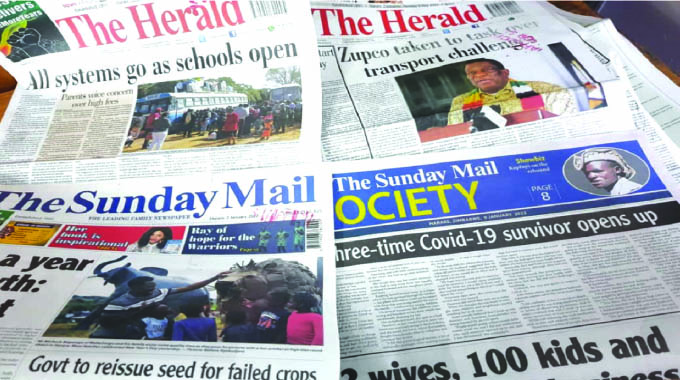
Geoffrey T Chada
Correspondent
As Zimbabwe joined the rest of the globe in commemorating World Press Freedom Day yesterday, following its proclamation by the United Nations General Assembly in December 1993 as recommended by the UNESCO’s General Conference, it is crucial to reflect on the purpose of the media, particularly newspapers, and what constitutes press freedom.
The day, whose theme this year is “Journalism under digital siege”, celebrates the anniversary of the Declaration of Windhoek of 1991, to which Zimbabwe was a signatory.
Coming to the issue of what constitutes an independent press: in April 1991, the United Nations (UN) and UNESCO jointly sponsored the Windhoek Seminar, which I attended in Namibia, on “Pluralistic Press”.
That meant the end of monopolies of any kind, and the existence of the greatest possible number of newspapers, magazines and periodicals reflecting the widest possible range of opinions within communities.
The Windhoek Declaration defined an independent press as “a press independent from government, political or economic control of materials, and infrastructure essential for the production and dissemination of newspapers, magazines and periodicals.”
In Zimbabwe today, every morning one is greeted by a galaxy of newspapers at street corners; all trying to attract citizens’ attention.
This is healthy for democracy as it ensures a free-flow of information, ideas and opinions on the market place of people’s minds.
Before independence in 1980, the news story tended to highlight more on the status or seniority of the speaker, and less on the ordinary people, who might have been participants in the event.
This gave rise to more speech-oriented journalism, and sometimes hardly making any reference to who has done what, how, and when, with what effect.
Ideally, a newspaper should reflect, and gauge the entire political and social structure of a nation.
It must be sensitive to nation-building; national interest, national unity and political integration; and the promotion of a political culture that provides a basis for the formulation of a united cohesive nation.
This can be called sensitive journalism or the opposite of sensational journalism.
Positive sensitive journalism refers to understanding, sympathetic, conscious journalism, which is dedicated to high moral values of peace, unity, nation-building and political integration. Such journalism recognises the existence of both centrifugal and centripetal forces: both destructive and constructive forces.
It recognises its duty to take sides.
It cannot be neutral between destruction and construction of the nation.
So what is press freedom in such a set-up?
Press freedom means the right of a newspaper editor to publish news without hindrance from any quarter or without seeking prior permission from the media house owner.
It means that freedom of the press has enormous powers — dictatorial, political powers — in one person: the editor.
The editor has the masses at his mercy and command. He/she decides what they should read, and what they should not read.
If he/she wants people to think along certain lines, he/she gives them the conducive information; if not he/she keeps away the information.
Since people depend on information to make decisions, the Press is almost indispensable to society. Yet, the editor with such crucial powers is not democratically elected or appointed. Democracy has no control over what he/she does or does not do.
He/she is an appointee of the owners of the business. It is the owners of the business who appoint the editor. It is the owner and the editor who own the freedom of the Press and have the power to hold the entire nation to ransom.
There could be no better tribute paid to the concept of freedom of the Press than the unique idea of a Mass Media Trust.
Through the establishment of the Zimbabwe Mass Media Trust (ZMMT), the Government was recognising the essence of freedom of the Press.
It is important to point out that there is no absolute legitimisation of the media as that it serves the people, and is responsive to their needs.
The creation of ZMMT was to cushion editors from direct influence of Government ministers, so that they could be free to publish what they deemed fit and good for the country.
There could be no better tribute.
It is crucial to note that there is no absolute freedom of the press anywhere in the world. Press freedom is always qualified, and does not operate in a vacuum.
It operates within a framework of a country’s social, political, religious and economic order.
It is culture-bound, and functions in harmony with the history and traditions of the particular country.
The national interest is the controlling factor to any journalist. No journalist anywhere in the world would publish that which he/she knows to be harmful to his/her country.
True, the job of an editor is an impossible one!
It requires utmost balance. This takes us to the requisite qualities of an editor.
An editor should be broad-minded.
He/she should have a highly developed sense of fairness. He/she must be a broad-gauged intellect with a good knowledge of the country’s history, traditions, policies, economics, and its sociology. A good editor should exhibit a sense of objectivity, impartiality, and a broad base of knowledge.
He/she should be sensitive to the national interest; has respect for people’s views; guides journalistic experience; be tolerant to others’ views; and above all should love his/her country.
Going back to history, Cecil John Rhodes used the media as an instrument of colonisation. The major purpose of newspapers was to advance settler interests in mining, farming and industry as determined by colonialist politics.
When white settlers in Southern Rhodesia wanted to achieve self-governance status or join South Africa, newspapers of the day were conspicuous in their expressions of whites’ opinions. The politics, culture and history of the majority Africans were never central to the operations of media institutions and newspapers. The unity embodied in nationalist movements, and goals of national independence, were not their concern.
Their concern was to distort national goals by equating them to communism.
The African’s position was never supported.
Therefore, newspapers with this kind of orientation could not be accommodated in a free, democratic and independent Zimbabwe.
Soon after independence in 1980, the new Government informed the Argus Company which owned the Rhodesia Printing and Publishing Company that the contaminated ownership of the Zimbabwe Newspapers (Zimpapers) by foreigners based in South Africa was unacceptable in a free Zimbabwe.
Due to the central importance of newspapers in the dynamics of colonial power, as soon as it was known that the Argus Company was willing to sell its shares in Zimbabwe Newspapers, one South African firm, and two British ones expressed interest in buying them.
However, citing a number of countries like Canada, Australia and New Zealand that had legislation preventing any foreign companies from buying or operating newspapers, the Government rejected those foreign interests on the grounds that it did not want control of news media to shift from Johannesburg to London, but to Salisbury (Harare).
In an attempt to beat the system, a well-known multinational company, acting on behalf of a Zimbabwean politician, made a strong bid to buy Zimpapers outright.
However, the Government felt that the deal would return control of newspapers to big business again.
The Government wanted to move away from emphasis on profit. The Government’s idea was to establish a chain of newspapers that would be a mouthpiece of the Zimbabwean people as a whole, and not a minority based in Johannesburg.
To that end, the ZMMT, an autonomous and independent body of distinguished Zimbabweans, like the late Dr Davison Sadza, Ms Judith Todd and others, was established in January 1981.
The trust was to strike a compromise between having a wholly private media controlled by South African interests (40 percent by the Argus Group and 3,42 percent by South African residents), and a solely Government controlled media.
In 1980, the Nigerian government donated US$5 million to Zimbabwe for the specific purpose of buying a controlling stake in Zimpapers.
The ZMMT was viewed as a middle of the road way of managing the media for the benefit of all citizens regardless of race, religion and shade of opinion.
Through the ZMMT, Government acquired control of Zimbabwe’s major newspapers group: Zimpapers, which then published The Herald, The Sunday Mail, Chronicle, Sunday News and The Manica Post (Umtali Post).
However, the ZMMT was a non-governmental, non-partisan, and non-profit making trust.
Coming to the issue of editorial guidance the trust gave to newspapers, let me hasten to explain the situation at the time it took over.
While the editorial control of Zimpapers was not directly from South Africa, as long as ownership was in that country, it conditioned the newspapers’ operations, and editors were selected after careful analysis of their views.
So, while there was no control on editors, their appointments were a factor in which South Africa enjoyed control.
Therefore, because of that link, the situation was such that a number of journalists, who took control of editorial policy of the newspapers here, came from South Africa.
They were employed by the Argus Company, then posted to Rhodesia (Zimbabwe), hence the whole South African connection was strong; culturally, economically, and in every other way.
It was that “Gordian knot” which the Government wanted to break through the trust experiment.
It was an experiment, because it was uniquely Zimbabwean: a unique experiment of press management.
It had never been tried anywhere else.
In Zimbabwe, editors of all the five newspapers then had complete responsibility for their papers.
They published what they, as editors, considered to be the right news to give the people of Zimbabwe.
There was no supervision or outright censorship of their news.
The chairman of the Zimbabwe Mass Media Trust, however, met with the editors from time to time so that he could point out to them what the trustees believed were important issues of national interest which they had to keep at the back of their minds.
Was that not a form of control or censorship?
You rightly ask. Yes, we did frown upon, and we did tell editors that certain issues in a developing country like Zimbabwe would not be tolerated.
We would not, and should not have that kind of freedom of the press, which permitted editors to publish news that we knew would create conflict; racial conflict, ethnic conflict or inter-factional animosity.
Our purpose was to promote nation-building.
Anything that went against that national interest would not be tolerated.
We were coming from a bitter liberation war. So, anything that pointed towards conflict could not be accepted.
I recall what Paul Ansah, a Ghanaian media guru once told me. He said, “The truth of the matter does not make it right that it should be published.”
You should think of the consequences of what you publish. If what you publish is going to cause conflict, do you go ahead and publish it with full knowledge of what your news will do to the nation?
Editors had to have an African orientation.
Before independence in 1980, the news was prepared and doctored in South Africa, and adapted to accord with the South African viewpoint of the world.
The struggle for independence was seen as a communist conspiracy, and not a cause by the oppressed people for their legitimate political rights and freedom.
Independent African states, except Malawi, were presented in the worst possible light to justify South Africa’s opposition to independence.
The ZMMT was established to decolonise the media. The Trust brought to an end, nearly 90 years of settler domination.
The media was now there to re-orient the thinking of our people.
It could now look north to other independent African states, instead of south.
The trust was charged with the responsibility of guiding the media in Zimbabwe.
Principally, newspapers were meant to inform, entertain, educate and mobilise the populace.
The trustees had no profit motive in the operations. Their share of the profit was ploughed back into the enterprise. The consolidation of our independence was a national responsibility of the media. The press was regarded as a vehicle for communicating Government’s policies and programmes to the people, and feeding back their reaction, as a way of dialoguing between the people and the Government which ought to continue.
Now, the other issue raised is whether the ZMMT promoted self-censorship in place of editorial control. It is commendable that President Mnangagwa revived the ZMMT, which was dormant since 2001, by appointing Trustees in 2020, as we should not mistake responsible journalism for self-censorship.
Dr Geoffrey T Chada was the Zimbabwe Mass Media Trust (ZMMT) chief executive officer and executive secretary from 1990 to 2001. He also served as a commissioner and spokesperson for the National Peace and Reconciliation Commission (NPRC). In the article he was responding to questions raised in an interview with The Herald Senior Writer Elliot Ziwira on the role of the ZMMT in decolonising and guiding the media in Zimbabwe.


 Online Reporter