Chronicle Editor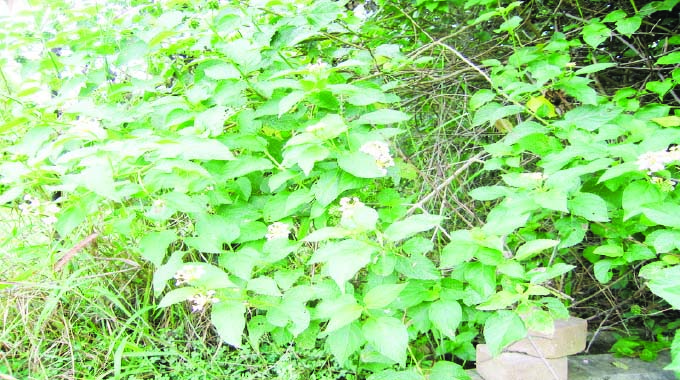
ONE thing I have come to realise as I traverse different areas of Matabeleland region and even Mashonaland provinces is that communal areas have different challenges in as far as livestock production is concerned.
Some areas struggle to get water for livestock, others have very small grazing lands due to expansion of human settlements, while some areas are struggling with shrinking grazing space as a result of bush encroachment and colonisation of grazing lands by invasive species.
In most areas of Matabeleland North such as Lupane, Nkayi and parts of Bubi, livestock farmers tend to have vast unproductive grazing lands for one reason or another.
There are areas where you will find large tracks of grazing lands which have been rendered useless for animals due to the colonisation by the invasive lantana camara.
This plant will spread and completely canopy the land underneath, suffocating growth of any plant.
In some areas you find large pieces of abandoned former arable land which is now home to couch grass and thorny secondary vegetation.
The couch grass is itself indicative of poor rangeland.
Then you have large tracks of forests which is barely utilised by livestock because, it has largely woody species which are not palatable to most livestock species or the forests are so densely populated with woody species such that there is very minimal under growth which the animals are not even to access due to the thickness of the forest.
So you have livestock farmers who actually have more than enough land they could use for grazing and raising their animals, but the land is not usable for one reason or the other.
Which is the import of this week’s discussion.
We look at what needs to be done for livestock farmers in communal areas that have such unusable lands for livestock grazing.
Livestock farmers need to adopt what is called regenerative rangeland management practices.
This is a rangeland management practice that seeks to rejuvenate poor and unusable rangelands into more productive grazing lands.
The regenerative rangeland practices will vary from one situation to another.
As an example, an area which has been colonised by invasive species such as lantana camara simply needs livestock farmers to cut down this shrub and burn it.
The community could organise itself into groups and clear the affected area and as a result free up the locked grazing land.
This freed land with begin to grow grasses and contribute to the carrying capacity of the rangeland.
Similarly, bush encroachment could be controlled in the same manner where community members gang up and clear the shrubs that have colonised their grazing areas.
Nowadays, the shrubs can actually be milled and converted into bush meal, which is used to feed animals, especially thorny shrubs which tend to be nutritious and are preferred by animals.
Milling the shrubs into bush meal could actually encourage livestock farmers to clear more land as they benefit two fold from the exercise.
With regards to very dense forests which do not allow under growth as a result of poor light penetration, deliberate actions of clearing mostly the shrubs, which make the forests impenetrable by livestock, is necessary.
You want to make the forest at least accessible to livestock first as the trampling effect of livestock, manure and urine will help to fertilise the forest and allow for more prolific growth of grasses.
Opening up of these forests will, however, need to be done in liaison with controlling organisations such as the Forestry Commission.
Another important aspect of regenerative rangeland management would be to convert abandoned cropping fields into productive grazing lands.
This is done by fencing off the abandoned crop fields so as to regulate grazing from animals and prevent over grazing these fields.
Overgrazing of abandoned cropping fields easily convert productive rangeland into non-productive ones characterised by proliferation of such grasses as couch grass.
The runner couch grass tends to stifle growth of more palatable grass species.
In areas which already have abandoned crop fields invaded by runner couch grass it may be important to fence off the fields, introduce seeds of locally available palatable grasses.
In simpler terms deliberate management actions need to be taken for livestock farmers to reclaim and rejuvenate rangelands so that they can continue to rear animals in their areas otherwise the rangeland could deteriorate to points where it is no longer possible to keep animals at all.
Uyabonga umntakaMaKhumalo.
Mlhupheki Dube is a livestock specialist and farmer.
He writes in his own capacity.
Feedback [email protected]/ cell 0772851275


 Online Reporter