Online Reporter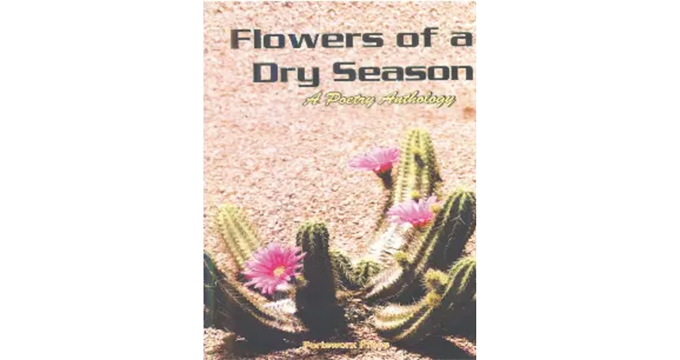
Elliot Ziwira-At the Bookstore
Good poetry goes beyond simply decorating language to distil experience.
It questions, heals, stirs, and sometimes even startles the reader into action. True poetry transcends the barriers of geography and time, speaking to both the farmer and the philosopher, the pauper and the prince, because it is a vessel of the human condition.
That essence; the power of words to rebuild where silence has eroded faith, is what gives “Flowers of a Dry Season” its timeless resonance.
Published by Forteworx Press and edited by Beaven Tapureta and Brian Tafadzwa Penny (T.P Brian), this anthology of 14 emerging voices remains as urgent and uplifting as it was a decade ago.
If anything, in the aftermath of the global tremors of pandemics, economic realignments, and environmental decay, its message of hope amid drought feels even more prophetic.
“Flowers of a Dry Season” gathers poems by Monica Munashe Rupazo, Tinashe Chimuriwo, Owen Kambanje, Audrey Lindani Mutinhiri, Leonard Mutsa Makuya, Gloria Murindi Dangah, Brian Tafadzwa Penny, Jubilant Ncube, Tendai Noreen Sadziwa, Edmond Shonhiwa, Taurai Vincent Sekenya, CJ Mylton, Patrick Mahlasera, and Yeukai Mapingure.
The poets are young, passionate, and piercingly aware of the contradictions of the world they inhabit, where dreams are traded for survival, and ideals are drowned by material obsession. Yet, even from that fractured terrain, they plant seeds of renewal.
They speak in different tongues, yet all circle back to the same emotional equator: hope.
Each voice, though distinct in rhythm and imagery, contributes to a shared melody of resilience. The poems mirror Zimbabwe’s long walk through its own dry seasons, of economic turmoil, political fatigue, and spiritual drought, and yet, like the drought-resistant flora they invoke, they find ways to bloom.
The anthology may, at moments, hum with youthful discord, but that rawness is its strength. It insists that the struggle for meaning, for unity, for dignity, is never smooth or uniform. The harmony comes from persistence — the courage to keep singing when the wind silences everything else.
By nature, poets are witnesses to truth. They speak what others hesitate to utter. In “Flowers of a Dry Season”, the poets rise to this sacred responsibility. They recognise the artist’s place as custodian of truth, moral compass, and guardian of collective memory.
Like David Mungoshi’s assertion in “Live Like an Artist” (2017) that the writer must live beyond comfort to reveal truth, Edmond Shonhiwa, in the title poem, calls upon his peers to be “an oasis of this generation.”
His rallying cry echoes through the anthology:
“Arise, authors and book lovers!
Be a rock
An oasis of this generation
Spring in this arid era
Let your pen and paper save us.”
In an era when art is often dismissed as indulgence, such words are evidence that poetry is not luxury but resistance. It is the mirror we dare not look into and the whisper that outlasts storms.
One cannot read this anthology without sensing the broader canvas on which it is painted — the African dream itself.
In poems like “The Inferno Echoes,” “Can We Have One Africa?”, “I Am African,” and “Are They Yours, Africa?”, the poets question how the continent’s unity has been distorted by greed, xenophobia, and the unending lure of Western validation.
In “The Inferno Echoes,” Shonhiwa mourns the xenophobic violence that tears apart the African family. His words burn with both pain and love:
“I saw my children burn in flames of your anger,
I saw other neighbours burning too. . .
This Africa is our mamaland,
But you cast my children into the inferno.”
The refrain “Why, brother Azania, why?” still haunts the conscience of a continent that has turned on its own. Yet, through that lament, there is a pulse of hope. It is the plea of one who still believes in reconciliation, in rediscovering the oneness that colonialism sought to erase.
Audrey Lindani Mutinhiri echoes that yearning in “Can We Have One Africa?”
Her questions: “What happened to oneness among Africans? What has led to the division among Africa’s children?” — still ring true today, when migration and borders continue to fracture kinship.
Leonard Mutsa Makuya’s “Are They Yours, Africa?” similarly cuts to the heart of moral decay and spiritual alienation, questioning whether the children who plunder, kill, and cheat in broad daylight still belong to the womb of Africa.
In all these poems, Africa is both mother and mirror: wounded but unyielding.
Interestingly, the poets refuse to be boxed into gendered or partisan ideologies. Their moral concern is human. They reject chauvinism and victimhood alike, choosing instead to speak to the universal decay that corrodes compassion.
Gloria Murindi Dangah takes up the matriarchal tone of the aunt of old, chastising, advising, and healing. CJ Mylton and Jubilant Ncube, the anthology’s spiritual voices, explore the unseen battles that faith must fight in times of doubt.
Then, there is Monica Munashe Rupazo, perhaps the most lyrical of the lot, whose introspective style recalls the tenderness of William Wordsworth and the pain of George Meredith. Yet, she is uniquely her own. Her pen bleeds empathy and her verses glisten with defiant tenderness.
Rupazo refuses to drown in despair. She writes of sorrow not as destination but as passage. Through her, pain becomes possibility, and drought becomes a metaphor for patience. She teaches that sometimes flowers bloom not despite the dry season, but because of it.
The anthology’s real triumph lies in how it transforms the personal into the national. Its “dry season” is not just literal — it is spiritual, cultural, and moral. It is the drought of values, of empathy, and of vision.
Through irony, humour, and elegy, the poets force the reader to reckon with the question: Who have we become? Have we allowed material pursuit to drown out our humanity? Have we replaced Ubuntu/Hunhu with ego, and kinship with competition?
But for every cry of despair, there is a stubborn thread of faith running through the collection. It is a belief that something good still stirs in the Zimbabwean and African soul.
That faith feels especially relevant today. In a 2025 world where cynicism often outweighs conviction, where youths face limited employment opportunities and social disillusionment, these poets maintain that resilience is not denial but creation.
To write, to hope, to keep speaking truth, is itself an act of struggle.
“Flowers of a Dry Season” stands as both archive and prophecy; a record of youthful exuberance that anticipated the struggles and possibilities of our time.
The anthology insists that national renewal must begin with moral introspection, with the reclaiming of voice. It is a call to writers, teachers, leaders, and dreamers to rise and water the roots again.
Indeed, Shonhiwa’s exhortation to “let your pen and paper save us” is not limited to the poet — it is a challenge to all of us. For every citizen carries within them a verse waiting to be written, a kindness waiting to be offered, and a vision waiting to bloom.
Hope, after all, is not a flower that needs rain. It grows from faith and thrives in adversity.
In the end, “Flowers of a Dry Season” inspires as a manifesto of survival. It teaches that even when the earth cracks and the winds howl, the seeds we sow in love and courage will one day sprout again.
True, the dry season may be long, but it is not eternal. There is still rhythm in the dust, melody in the challenges we face, and a garden waiting beneath the parched soil.
The anthology is a reawakening of belief. The poets believed, and through their belief, they invite us all to do the same.
And so, we return, once again, to Shonhiwa’s timeless plea: “Spring in this arid era, /Let your pen and paper save us.”
Yes, the flowers of the dry season are still blooming; quietly, defiantly, and beautifully, heralding that as long as there is word, there will be hope, for word is power.
For an immersive reading experience, visit Typocrafters (DigiHub) Book Shop at Herald House, corner George Silundika Avenue and Sam Nujoma Street in Harare.