Online Reporter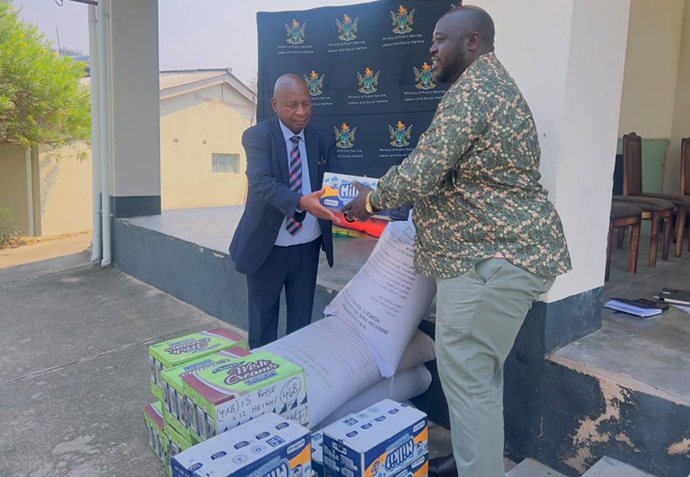
Liberty Dube
Post Correspondent
THEY may not know where their fathers and mothers are.
Some have grown up without the comfort of a family home, while others carry memories of families they were separated from.
But at Kuda Vana Children’s Home in Zimunya, there is still laughter and resilience. There are lessons, games, friendships and dreams. For these children, the institution has become a place of safety, while efforts continue to reunite them with relatives, place them in foster care or find adoptive families.
It is this delicate balance between institutional care and family-based care that Public Service, Labour and Social Welfare Minister, Honourable Edgar Moyo encountered during his recent visit to the home.
Minister Moyo, who was familiarising himself with children’s homes and social welfare programmes in Manicaland, toured the institution, and challenged the facilities to look beyond dependence on external assistance.
He emphasised the need for institutions to establish life-sustaining enterprises that can increase their food reserves and help them become more self-sustaining.
“We need these institutions to engage in life-sustaining enterprises and increase their food coffers so that they are able to sustain themselves for a long time. I also urge corporates to support these institutions, chip in and be part of these projects,” he said.
Minister Moyo was accompanied by Private Voluntary Organisations Board chairman, Mr Tawanda Zimhunga.
He had also engaged the Private Voluntary Organisations Board in Mutare, calling for effective oversight of organisations supporting communities through humanitarian assistance, child protection, disability services, health and livelihoods programs.
Located about 42 kilometres south of Mutare, Kuda Vana has played a critical role in providing a safe haven for vulnerable children.
Through family tracing and reunification, fostering and adoption, the organisation is working to ensure that children grow up in nurturing family environments whenever possible.
To date, eight children have been placed in adoptive families, 10 in foster care and 26 reunited with relatives.
Current programme records show 41 children, comprising 22 boys and 19 girls.
Two are in ECD, 21 are in Grades One to Seven, nine are at secondary school, while nine have been reunified with their families, but continue to receive support.
A separate age profile of 40 children shows 22 boys and 18 girls, with the largest group — 18 children — aged between five and nine years.
Kuda Vana Children’s Home director, Mr William Pepukai, said they remain committed to ensure that vulnerable children experience the love and stability of a family.
“We are deeply grateful for your (Minister Moyo) presence, which affirms the importance of collaboration between Government, civil society, and communities in advancing child welfare and family reintegration in Zimbabwe.
Kuda Vana Partnership has always believed that every child deserves the love, stability, and dignity of a family. Our work is rooted in empowering vulnerable families, supporting reintegration, and building sustainable livelihoods that ensure children growing up in nurturing environments. our visit today strengthens our shared commitment to these values,” he said, adding that while the organisation focuses more on family reintegration going forward, institutional care as exemplified here is still necessary as a stopgap measure and place of last resort.
Established in 2015, Kuda Vana Partnership provides care and protection to orphans and vulnerable children and care leavers, offering shelter, food, clothing, health care, education and psychosocial support.
The organisation also provides transitional assistance through its Halfway Home in Buhera for young people leaving care, alongside education, skills development and mentorship.
Mr Pepukai said experience had shown that institutional care cannot replace the benefits of a family environment.
“Overtime, we realised that institutional care alone cannot replace the benefits of growing up in a nurturing family environment. To foster stable relationships and a sense of belonging, we have broadened our approach to champion family-based care.
“Today, our work combines residential care with family tracing, reunification, fostering, and adoption initiatives in partnership with the Department of Social Development,” he said.
But the organisation faces mounting challenges, particularly declining donor support.
“The organisation is facing a myriad of challenges, which include lack of financial and material support. In a constrained donor landscape, securing funds has become increasingly difficult. This resource deficit directly impacts our family reintegration efforts, which require extensive awareness campaigns across the provinces,” added Mr Pepukai.
Mr Pepukai said care leavers also struggle to find employment and sustainable livelihoods, while the organisation lacks adequate space for income-generating projects.
“The organisation is also facing an issue of lack of employment opportunities for care leavers, securing sustainable livelihoods and jobs for young adults transitioning out of care remains a significant hurdle, inadequate space for income-generating projects as well as lack of sufficient space to establish viable projects that could help sustain operations long-term,” he said.
For the children, however, life goes on. They learn, play and dream, even when the answers about where they came from remain uncertain.
Their smiles tell a story of resilience and of a home determined to ensure that, wherever possible, every child eventually finds a family to call their own.