

 daniel chigunwe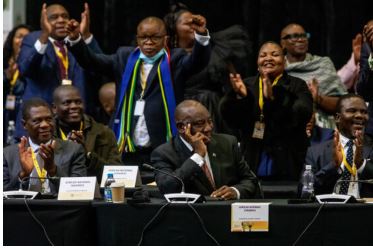
The formation of a business-friendly coalition government in South Africa has won the support of the majority of citizens, with the richest most satisfied with its performance, a survey shows.
Even though three-fifths of the 1 204 people surveyed by the Social Research Foundation in September said the alliance, formed at the end of June, was performing well, the results show that support is strongest among White respondents, who are also generally the wealthiest.
The poll also showed there’s still substantial backing for the populist policies espoused by its political rivals. Almost a third of respondents said they backed the stance of the Economic Freedom Fighters and the uMkhonto weSizwe party of former President Jacob Zuma.
The so-called Government of National Unity was formed after the African National Congress lost its parliamentary majority for the first time since taking power in 1994.
After the May 29 election, the ANC initially considered an alliance with the EFF and MK party, both of which advocate widespread nationalisation, before settling on an alternative broader grouping dominated by itself and the centrist Democratic Alliance which retained its leader, Cyril Ramaphosa, as the nation’s president.
Support for the parties has climbed to 45 percent for the ANC, which won 40,2 percent of the vote in the election, and 24 percent for the DA, which won 21,8 percent, the SRF said.
“For the GNU to retain the support of especially voters in lower socio-economic strata it will have to lift fixed investment, economic growth and job growth numbers well above where those are currently forecast,” Frans Cronje, head of the SRF, a think tank and survey company, said in response to a query.
“Fail to lift those numbers and support for the GNU may wane sufficiently to flip the current GNU formation.”
The coalition was formed after years of economic stagnation with the nation’s poor, who overwhelmingly come from the Black majority, affected the most by a 33,5 percent unemployment rate and deteriorating government services.
The Democratic Alliance, whose leadership is predominantly White, has struggled to combat accusations from rivals that it represents the interests of the affluent.
Of the White survey respondents, 73 percent said the new coalition is performing well, compared with 57 percent of Black respondents.
The divide was sharper when respondents were asked whether they supported the policies of the populist parties.
While no White respondents answered in the affirmative, 36 percent of Black respondents said they did.
The coalition has also been endorsed by the country’s biggest business lobby groups. The survey had a 3 percent margin of error. — Bloomberg


 Online Reporter