Online Reporter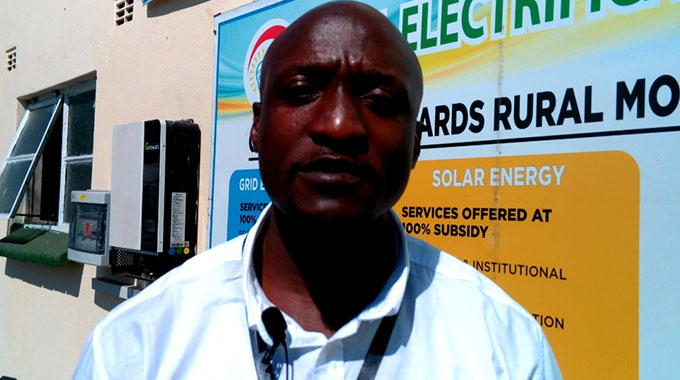
Fairness Moyana in Hwange
THE Rural Electrification Fund (REF) has scaled up its efforts to bring modern and sustainable energy services to rural communities in Matabeleland North, where access to reliable electricity remains among the lowest in the country.
In an interview on the sidelines of the recent Matabeleland North Provincial Agricultural show held in Hwange, REF provincial manager, Engineer Vincent Sande, said the fund was making significant strides through grid extensions, solar installations and biogas technology as part of its mandate to ensure universal access to energy by 2030.
“Our mandate as REF is to ensure the provision of modern energy services in rural Zimbabwe. In Matabeleland North, we are delivering this through extending ZETDC grid lines and introducing renewable technologies like solar and biogas,” said Eng. Sande.
Despite progress in recent years, Matabeleland North remains one of Zimbabwe’s least electrified provinces, with a Parliamentary submission in April 2024 highlighting that the province only achieved about 30 percent electrification of its target sectors that include primary schools, secondary schools, health centres, business centres.
The situation has left schools, clinics, and small businesses struggling to operate efficiently, deepening rural poverty and slowing development. However, REF’s interventions have begun to close this gap, with over 9 500 rural institutions including schools, clinics, and business centres electrified across Zimbabwe since the agency was established in 2002.
For 2025, REF targeted the electrification of 46 institutions in Matabeleland North. According to Engineer Sande, 30 have already been connected, with ongoing work expected to bring the number to full completion before the year ends.
Among the beneficiaries are Mbonqane Primary and Secondary schools in Umguza and AMR Primary School in Lupane, which are now enjoying reliable power. Electrification projects in Binga, under Chiefs Sikalenge and Binga, and at institutions in Lupane, are about 80 percent complete.
“With the trajectory, we have undertaken for the year, we anticipate we are going to reach 100 percent very soon,” he said
Beyond the grid, REF is transforming rural households and institutions through biogas technology, offering a clean, affordable, and sustainable energy source.
This year, the agency completed a 50-cubic-metre biogas digester at the Zimbabwe Regional Service Centre in Ntabazinduna, which is now in the activation stage. In Khami, work is underway on a 200-cubic-metre biogas digester, one of the largest in the country, with completion expected by mid-December.
To broaden access, REF launched a domestic biogas programme offering a 50 percent subsidy. Households contribute labour and locally available materials like pit sand and quarry stones, while REF provides cement, piping, and installation.
“We are ensuring that anyone and everyone has access to modern energy services by 2030. In Hwange District alone, we are installing 22 domestic digesters starting this month, with a provincial target of 63 digesters by year-end,” said Eng Sande.
REF is also pursuing institutional solar projects to ensure off-grid communities benefit from reliable power. In 2025, 14 institutions are scheduled to receive solar systems.
Already, Mtshina Primary School and Mhalabathi Primary School in Tsholotsho have been energised, while preparations including internal wiring and low-voltage line construction are underway at other targeted sites.
On biogas, Eng Sande said the model offers multiple benefits to rural households and institutions, which include reducing deforestation by providing a substitute for firewood, saving families time previously spent collecting wood, freeing them for income-generating activities as well as producing nutrient-rich slurry and fertilised water for farming, reducing costs while improving yields.
“Biogas is a clean, local solution to waste management and energy production. It supports sustainable farming while preserving the environment and improving rural livelihoods,” he said.
This circular system where waste generates energy, supports farming, and feeds back into the cycle has been hailed as a model for rural sustainability.
While significant challenges remain, the rapid electrification efforts are transforming the economic and social landscape of Matabeleland North. For schools, reliable power means better access to ICT learning, modern teaching methods, and the possibility of night studies.
Clinics are now able to store medicines safely and power essential equipment, while households gain the ability to cook, light homes and power devices sustainably.
“Every school, clinic and household we connect is a step closer to a brighter, cleaner, and more sustainable future,” said Eng Sande.
As Zimbabwe works towards its goal of universal rural electrification by 2030, Matabeleland North’s ongoing transformation under REF’s programmes offers a beacon of progress and a promise of a more empowered rural economy.