Sundaymail Editor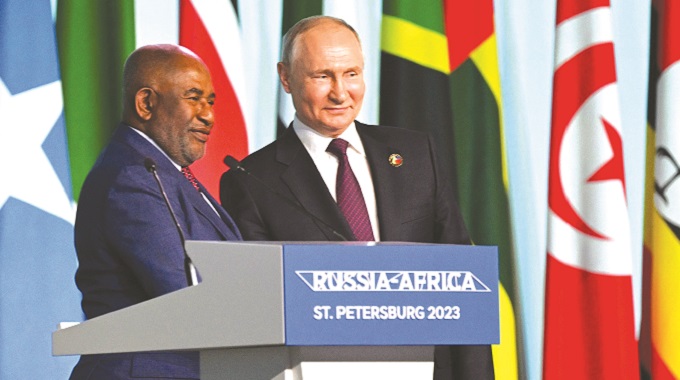
Innocent Madonko in ST PETERSBURG, Russia
THE Second Summit of the Russia-Africa Economic and Humanitarian Forum ended on a high note with the adoption of the St Petersburg Declaration, in which parties committed to a fair and democratic multipolar world order based on the universally recognised principles of international law and the United Nations Charter.
Addressing a joint press conference at the end of the summit here on Friday night, together with chairperson of the African Union and Comoros President Mr Azali Assouman, Russia President Vladimir Putin said the parties resolved to counter neo-colonialism, the use of coercive measures and illegitimate sanctions by the West to cow other nations, as well as attempts to undermine traditional moral values.
The summit pledged to increase the number of African students studying in Russian universities and other institutions of higher learning, while 1,2 billion rubles (about US$13 million) has been set aside for the capacitation and strengthening of African health care systems.
The Russia-Africa Summit ran from July 27 to 28 under the theme “For peace, security and development”.
It was attended by 17 Heads of State and Government, including representatives of 49 of the 54 African nations.
President Mnangagwa was among the African leaders who attended the summit and collectively demanded a place in the UN Security Council, an end to paternalism and the establishment of a multipolar world.
In his statement to journalists, President Putin said the summit also confirmed the Sochi Agreement, which resolved to hold Russia-Africa summits every three years.
It means the next gathering of African leaders and Russia will be in 2026.
“In between the summits, there will be a mechanism of direct partnership put in place. There will be regular political consultations among the Ministries of Foreign Affairs of Russia, African states and the leadership of the African Union,” said President Putin.
He expressed satisfaction with the outcome of the summit, which he described as having taken place in a constructive and friendly atmosphere.
“This also applies to the Economic and Humanitarian Forum, sessions of the summit and a special meeting with the heads of African regional organisations.
“Tonight, we will also discuss the situation around Ukraine with interested African countries,” he added.
“We had many bilateral contacts with African leaders. We have planned meetings with all Heads of State who are present in St Petersburg.
“Of course, we are happy that the delegations of the overwhelming majority of African countries and the heads of all leading integration structures of Africa are taking part in the summit.”
Representatives of African states, he said, displayed political will and demonstrated their independence and interest in developing cooperation with Russia.
“We appreciate this and are convinced in the successful future of Russia-Africa relations. They rest on the traditions of time-tested friendship and historical experience of multifaceted productive interaction dating back to the early period in the process of African states’ formation.
“The main thing is that the summit has again confirmed the firm resolve of both Russia and Africa to continue developing mutually beneficial partnerships and seeking new forms and areas,” said the Russian President.
A solid package of partnerships was adopted at the end of the summit.
The St Petersburg Declaration formalises strategic areas for the development of Russia’s cooperation with Africa.
There were declarations on the Prevention of Arms Race in Outer Space and on cooperation in ensuring international information security and strengthening cooperation in the fight against terrorism.
The 2023-2026 Russia-Africa Partnership Forum Action Plan was signed by Russian Foreign Minister Sergei Lavrov and the AU director of the peace and security division of the Intergovernmental Authority on Development (IGAD), Mr Siraj Tagesa Shurafa.
President Putin said Russia would continue to provide Africa with grain, both commercially and free of charge, while also facilitating the growth of the continent’s energy sector to satisfy the growing needs of African economies in hydrocarbon, fuel and power generating capacity.
The summit also undertook to scale up cooperation in cultural, scientific, educational, sport, tourism, youth and other exchanges.
Russia, he added, also planned to assist African countries to strengthen their national health care systems to improve their
resilience, technical capacity, effectiveness and efficiency in their fight against
epidemics.
“For that, we are launching a large-scale aid programme to African countries to fight communicable diseases till 2026, totalling 1,2 billion rubles,” he said.
AU chairperson President Assouman described the summit as a great success.
“We know who our true friends are. Russia stood with us during the most difficult times. During slavery, apartheid, Russia has always been helping us,” he said.
“It was one of the first countries to help with fighting colonialism, apartheid and slavery. So, for many centuries, we have had good relations, but this time, we need a new impetus to the relationship to take it forward.”
President Assouman also called for peace between Russia and Ukraine.
“What we need is a ceasefire because war is always unpredictable. The longer it lasts, the more unpredictable it becomes.
“President Putin has shown us that he is ready to engage in dialogue and search for solutions and we need to convince the other party right now and I hope that we will be able to do that.”
African leaders, among them South African President Cyril Ramaphosa, have been engaged in an initiative to broker peace between Russia and Ukraine.
The leaders from seven African states — South Africa, Egypt, Senegal, Comoros, Zambia, Congo-Brazzaville and Uganda — have been to both Kyiv and Moscow in their peace mission.



 Online Reporter