Online Reporter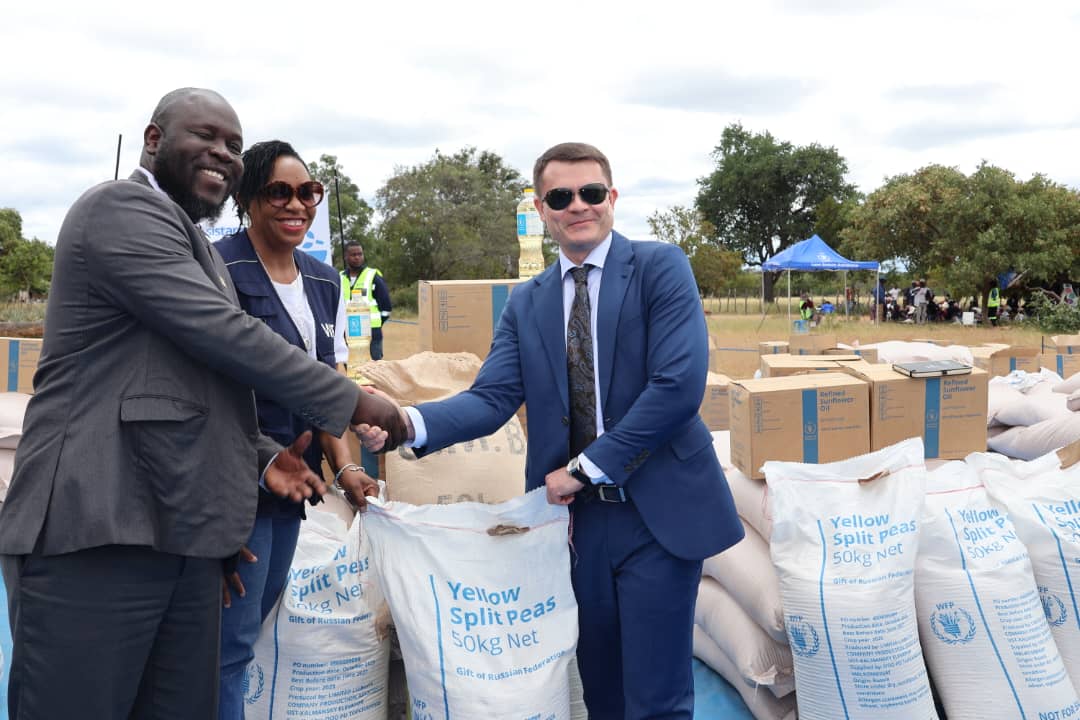
Theseus Shambare recently in BULILIMA
ZIMBABWE is accelerating efforts to reduce reliance on traditional donor funding for food and social protection programmes, with Russia and the World Food Programme emerging as key partners in supporting a more diversified and resilient humanitarian and agricultural financing model.
The shift comes as global aid flows continue to fluctuate, placing pressure on countries that have historically depended on external support to sustain food assistance and development interventions.
Despite these pressures, Government insists Zimbabwe is not moving into dependency but rather restructuring its external relations.
Russia currently supplies key fertiliser inputs such as urea and ammonium nitrate, alongside Belarus, while additional raw materials are sourced from Oman, the United Arab Emirates, Qatar and Saudi Arabia.
This reflects what officials describe as a “multi-partner supply strategy” aimed at strengthening resilience.
“In practical terms, we are building resilience into our food and fertiliser systems so that shortages in one region do not collapse the entire chain,” said Lands, Agriculture, Fisheries, Water and Rural Development Permanent Secretary Prof Jiri.
The Government says the strategy is anchored on resilience and diversification rather than dependency.
“Zimbabwe is committed to strengthening its own systems while working with a broad range of partners to ensure that no vulnerable household is left behind.
“We need to ensure that our agriculture systems are strengthened to ensure we achieve national food security,” said Prof Jiri.
While concerns have been raised internationally over the continuity of donor-backed programmes following recent funding realignments by major Western economies such as the United States of America, authorities insist that national food security programmes remain stable.
“We are not building our food security on uncertainty. We are building it on multiple partnerships, strong domestic production and predictable supply systems,” he said.
“We are deliberately broadening our partnerships so that we are not exposed to shocks from any single source.”
At the centre of this shift is growing cooperation with the Russian Federation, which has combined humanitarian food assistance with broader engagement in fertiliser supply and agricultural development.
Working through the World Food Programme (WFP), Russia has supported the delivery of food aid to vulnerable communities in Zimbabwe, reinforcing emergency response systems during the lean season.
Speaking during a food distribution programme at Malalume in Bulilima District on Thursday, Russian Deputy Ambassador to Zimbabwe Sergey Kuzin said the assistance reflects both humanitarian commitment and long-term cooperation.
“This donation is part of Russia’s contribution to the World Food Programme and is meant to assist the most vulnerable communities to overcome challenges due to climate change.”
He said the partnership between the two countries extends beyond relief.
“We remain committed to supporting Zimbabwe not only through humanitarian assistance, but also through cooperation in agriculture, fertilisers and trade,” said Mr Kuzin.
Zimbabwe’s fertiliser requirements — estimated at about 1,4 million tonnes annually — remain central to national food security planning, with ammonium nitrate, urea and compound fertilisers critical for agricultural productivity.
However, supply chains have been increasingly affected by geopolitical tensions and global market disruptions.
“The global environment has made agricultural inputs more expensive and less predictable, which is why diversified partnerships are essential,” said Zimbabwe Commercial Farmers’ union president Dr Shadreck Makombe.
The partnership with Russia is also being reinforced at the continental level.
In November 2025, Russia hosted the International Conference on Ensuring Food Sovereignty in African Countries in Addis Ababa, Ethiopia, bringing together governments, experts and development partners.
“The focus was on strengthening food systems, improving productivity and building resilience against global shocks,” said Prof Jiri.
Deputy Minister of Public Service, Labour and Social Welfare Mercy Dinha, represented by Acting Chief Director Mr Tawanda Zimhunga, said Government the growing cooperation is complementary to national development priorities under Vision 2030.
“We value partnerships that strengthen our capacity to respond to hunger and build long-term resilience for our people,” she said
WFP head of external relations, Ms Ifeoma Garba, representing country director Ms Barbara Clemens, said the collaboration demonstrates the importance of coordinated global action.
“This assistance has been made possible through strong partnerships, helping households cope at a time when food is most scarce.”
She said the intervention strengthens household resilience. “Each food basket is designed to improve nutrition and support dignity for vulnerable families”.
As global aid structures evolve, Zimbabwe’s deepening cooperation with Russia — supported through WFP systems — is increasingly being framed as part of a broader shift towards a multi-partner, less donor-dependent food security architecture.