malvernmugadzikwa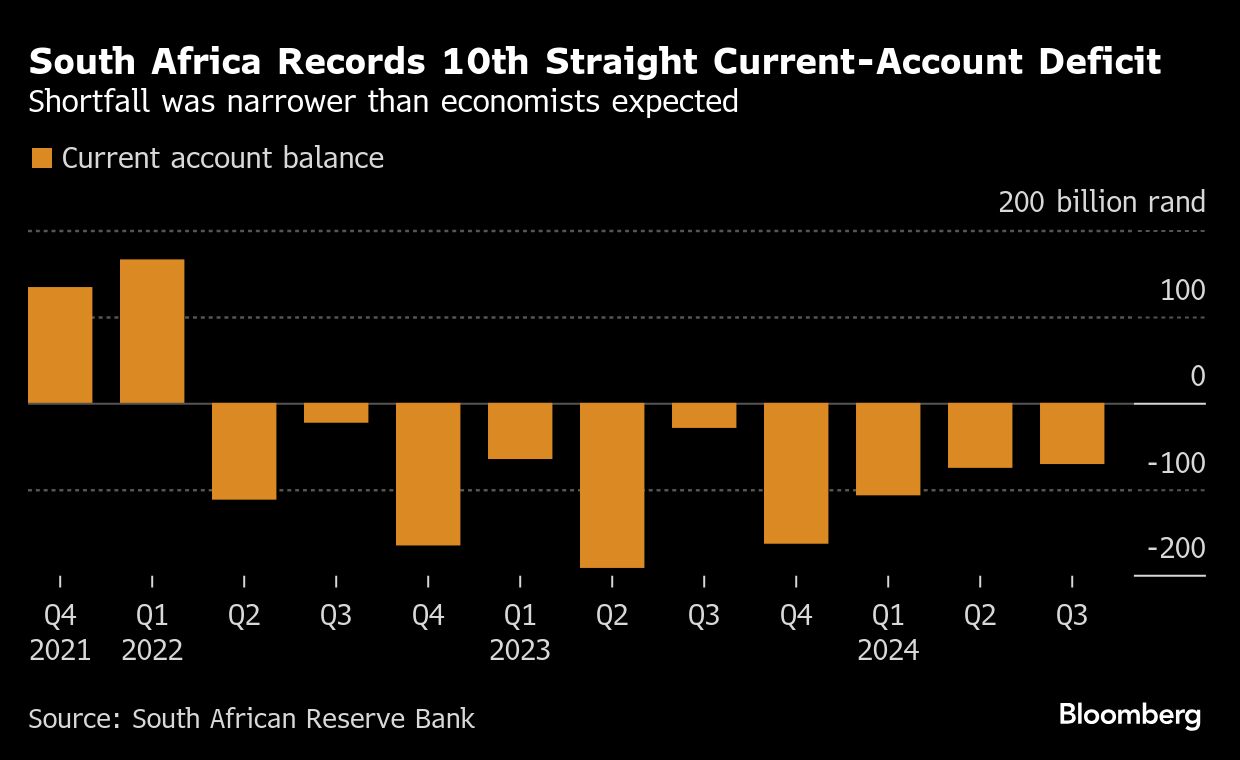
SOUTH AFRICA’s current account deficit was slimmer than expected in the third quarter after its trade surplus narrowed only slightly and the shortfall on the services, income and current transfer account was the smallest it has been in a year.
The gap on the current account — the broadest measure of trade in goods and services — shrank to an annualised 1 percent of Gross Domestic Product (GDP), or R70,8 billion (US$3,9 billion), from a revised 1 percent of GDP, or R75,3 billion in the prior quarter, the South African Reserve Bank said in a statement on Thursday.
The median estimate of three economists in a Bloomberg survey was for a deficit of 1,7 percent of GDP. South Africa has now posted a current account shortfall for a 10th straight quarter.
“We now forecast a modest narrowing of the current account deficit from 1.6 percent of GDP in 2023 to 1,3 percent of GDP in 2024, given the weaker performance of the economy,” Goldman Sachs Group economist Andrew Matheny wrote in a note to clients.
“We maintain our forecast for a widening of the current account deficit to around 2 percent of GDP in 2025 as growth picks up.”
The annualised trade surplus narrowed to R177 billion from R179,5 billion in the second quarter, driven by a drop in the value of goods exports, which declined more
than merchandise imports, the central bank said.
“The decrease in the value of exports and imports of goods and services in the third quarter of 2024 reflected both lower volumes and prices,” the Reserve Bank said.
The drop in the value of exports was driven by net gold shipments, which fell to R139 billion from R151 billion, the central bank data showed.
The rand traded 0,65 percent weaker at R18,05 against the dollar by 1.01pm in Johannesburg on Friday.
The currency, a bellwether for emerging markets, has been under pressure since Donald Trump won the November 5 United States elections as investors bet his pledge to raise tariffs and cut taxes will prompt the Federal Reserve to lower rates less than it had forecast, boosting the US currency. — Bloomberg



 Online Reporter