Online Reporter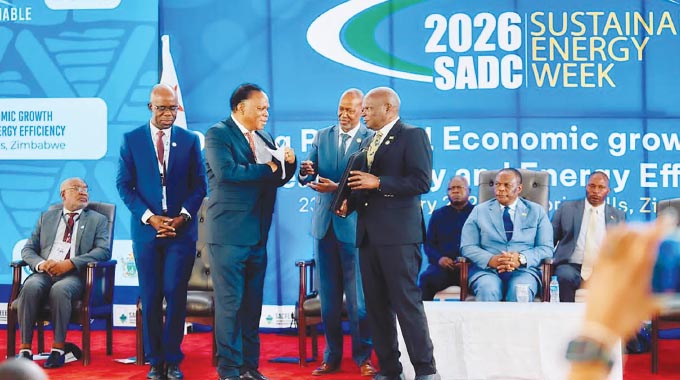
Rutendo Nyeve, [email protected]
THE 2026 Southern African Development Community (SADC) Sustainable Energy Week conference concluded on a high note in Victoria Falls on Friday with a broad assessment of the region’s energy landscape and a renewed resolve to confront funding gaps, inadequate infrastructure and policy fragmentation to boost economic growth and achieve universal electricity access.
Hosted by the Ministry of Energy and Power Development from February 23 to 27 under the theme: “Driving Regional Economic Growth Through Clean Energy and Energy Efficiency”, the event brought together member states, regional organisations, international co-operating partners and Government agencies to address persistent challenges in the region’s energy sector. Deliberations highlighted issues affecting the availability, accessibility and affordability of energy infrastructure, technologies and services.
The conference observed that the main obstacles to sustainable energy in the SADC region remain largely unchanged from 2025.
“These persistent hurdles include the reality that substantial financial resources are required for energy hard infrastructure projects, inadequate transmission capacity, access to electricity in the SADC region is still low in rural areas, and fragmented regional collaboration on policy harmonisation, limiting cross-border trade and investment, are a major impediment to progress,” reads the outcome statement.
Throughout the week, delegates used the platform to propose concrete solutions to these long-standing challenges, resulting in a comprehensive list of actionable recommendations aimed at transforming the region’s energy sector. They stressed the need to move from discussion to implementation, recommending that participants accelerate execution of all Memoranda of Understanding, agreements, decisions and resolutions taken at regional engagements and convert them into time-bound deliverables without delay.
A central priority emerging from the discussions was the need to expedite development of the Angola-Namibia, Malawi-Mozambique and Tanzania-Zambia interconnect projects to enable full power trading through the SAPP grid by all mainland member states. Delegates said this would be vital for strengthening energy security and enhancing the regional electricity market.
The conference also placed strong emphasis on accelerating energy access to reach universal access by 2030.
“Delegates resolved to accelerate access to energy (electricity) to reach universal access by 2030 through different approaches such as mini-grids and solar roof tops in line with the UN Sustainable Development Goal 7, Paris Agreement, SADC Regional Energy Access Strategy and Action Plan (REASAP) 2020 as well as the resolutions of the January 2025 Dar es Salaam African Summit of Heads of State and Government on Mission 300,” reads the statement.
Delegates further called for a major shift in the way energy projects are developed and financed, urging member states to review and harmonise policies and regulations to allow the private sector to participate across the entire energy value chain — from generation and transmission to distribution, retail and energy storage — as independent power producers (IPPs).
The meeting also affirmed the need to scale up solar thermal technologies through improved policy frameworks, regulation, capacity building, innovation and the integration of solar heating and cooling into broader energy transition strategies.
In a significant expansion of the regional energy agenda, the conference urged member states to consider electrifying the transport sector and harmonising charging standards for electric vehicles across the SADC region, working in collaboration with transport ministries. This reflects a growing recognition of the interconnectedness between energy and transport in achieving sustainable development.
“Member states are urged to intensify policies and budget allocation on increased energy access, taking into consideration the three corner pillars of energy trilemma on energy security (reliability), energy equity (access and affordability), and environmental sustainability,” the statement added.
The conference also advocated for diversification of primary energy sources in the regional energy mix to include cleaner technologies such as utility-scale solar PV systems, floating solar power plants on existing and future dams and lakes, clean coal technologies and small modular nuclear power plants, all in line with international standards.
A significant outcome of the week-long event was the endorsement of National Energy Compacts as a mechanism for driving progress across the region.