Online Reporter
Judith Phiri,Zimpapers Business Hub
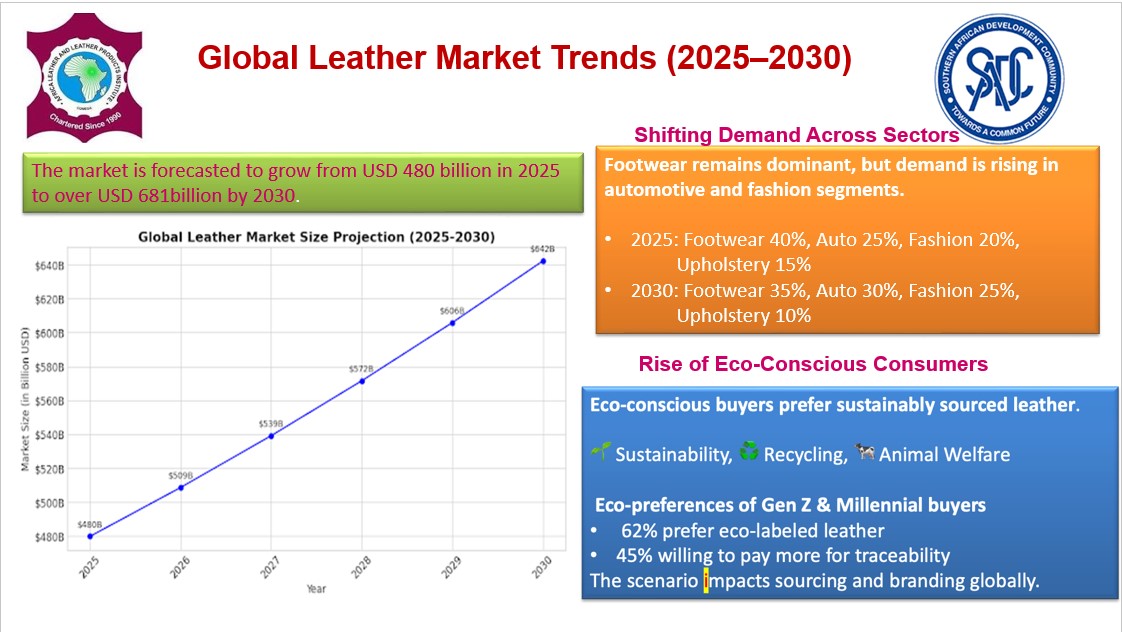
SADC member states’ leather sector players have been called on to play an active role in the global leather market, which is projected to grow steadily from an estimated US$480 billion in 2025 to over US$681 billion by 2030, driven by demand in both traditional and emerging segments.

Speaking on Global, Continental and Regional Leather Market Trends at the SADC Leather Value Chain B2B Workshop in Bulawayo on Wednesday, Africa Leather and Leather Products Institute (ALLPI) Regional Design Studio Manager, Mr Preston Viswamo said footwear remains dominant, but demand is rising in automotive and fashion segments.

“When looking at shifting demand across sectors, in 2025 footwear is at 40 percent, automotive 25 percent, Fashion 20 percent and upholstery at 15 percent. By 2030, footwear will be at 35 percent, automotive 30 percent, fashion 25 percent and upholstery 10 percent.
“This is because of the rise of eco-conscious consumers and eco-conscious buyers prefer sustainably sourced leather. This means sustainability, recycling and animal welfare. Eco-preferences of Generation Z and millennial buyers shows that 62 percent prefer eco-labelled leather and 45 percent willing to pay more for traceability. The scenario impacts sourcing and branding globally,” he said.
He said global top ten exporters of hides and skins in 2024 were United States of America (USA), Australia, Germany, Canada, France, Brazil, Netherlands, United Kingdom (UK), Spain and Austria.
While the global top ten importers of hides and skins in 2023 were China, Italy, Vietnam, Mexico, Germany, South Korea, India, Turkey, Thailand and Spain.
Mr Viswamo added: “In terms of the global top ten exporters of leather goods in 2023 these were China, Italy, France, Vietnam, Germany, India, Hong Kong (China), Spain, Netherlands and Switzerland. The global top ten exporters of footwear in 2024 were China, Vietnam, Italy, Germany, Indonesia, Belgium, Poland, Netherlands, Spain and India.”
He said the top cattle producing countries were Ethiopia, Tanzania, Sudan, Nigeria, Kenya, Uganda, Niger, South Africa, Mali and Chad.
In Africa, Mr Viswamo said the top ten African exporters of raw hides, skins and leather for 2023 were South Africa, Nigeria, Egypt, Chad, Zimbabwe, Ethiopia, Namibia, Kenya, Tanzania and Zambia.
He said the Africa Leather Value Chain (LVC) market had potential on the supply and demand side, and it was critical to capitalise on the global leather market, which is projected to grow from an estimated US$480 billion in 2025 to over US$681 billion by 2030.
The two-day workshop which ends on Thursday is running under the theme: “Accelerating Regional Integration: Building Sustainable Partnerships for Leather Value Chain Transformation.”