admin
admin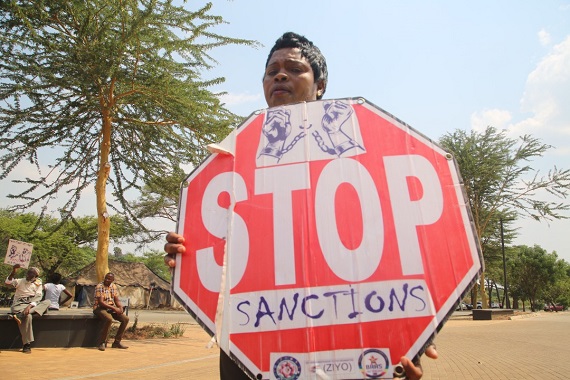
Shupikai Mwamuka-Correspondent
Since 2000, Zimbabwe has been under the siege of illegal and unjustified sanctions. These unilateral and punitive measures pose a myriad of challenges that hinder development of the country.
Sanctions are notably hampering the Second Republic’s efforts to implement its development agenda termed as Vision 2030, leaving the country’s progressive state flagging.
It is worrying that the National Developmental Strategy 1 which is hinged on Vision 2030 is being threatened by the harsh and unjustified sanctions.
They have become one of the biggest threats to the realisation of an Upper Middle Income Economy by 2030.
Illegal sanctions are seen limiting the growth and penetration of Zimbabwe into the global markets. Vision 2030 involves producing goods locally and supplying globally, all over the continent rather.
However, this is being hampered by the illegal economic embargoes imposed on Zimbabwe by the West.
Development in the country was intended to be smooth sailing, without flaws, but it has been stifled because of sanctions.
The attack is noted by how most business and companies are failing to access capital funding from abroad due to the illegal sanctions.
Economic commentator, Mr Morris Mpala said, “Illegal sanctions have affected a number of Zimbabwean business and companies in various ways.
“When you look at some of the effects it has had on the local market, it has really pushed the prices up due to restrictions, while some businesses have been affected when trying to access capital, make or receive payments from abroad.”
The country’s developmental goals are being largely impeded. People are being deprived of the opportunity to enjoy full development like any other nation.
Industry is massively affected by the harsh effects of the unjustified sanctions. The industry sector has been very much restrained and this has been deprived of capital to expand so that it can venture in the competitive market.
The industrial sector has been affected largely by sanctions as evidenced by high cost of borrowing, tight liquidity conditions, outdated technology, amongst other fractures and loops sited in the sector.
Sadly, the country lost some of its overseas international markets for its manufactured goods due to the cancellations of contracts with the EU and US markets, a development that will obviously slow down the pace of the Second Republic’s journey towards the Upper Middle Income Economy by 2030.
The significant progress that Zimbabwe had made as a country in the development of infrastructure as well as health, education and other social service delivery systems before 2000 was severely reversed as a result of the retributive measures by the West.
This has resulted in the most vulnerable sections of the population sinking deeper into poverty.
For example, the proportion of the population in extreme poverty rose in the aftermath of sanctions.
Investment, which is very crucial to the country, has also not been spared by the harsh effects of the illegal sanctions.
The negative perceptions that came along with these measures by the West has affected FDI inflows as investors tend to shy away from economies that are perceived as risky, depriving the economy the intended growth and development.
As of now the, Zimbabwe’s quest to attain the United Nations Sustainable Development Goals (SDGs) has also been severely impacted, including the National Development Strategy 1.
Speaking at the United General Assembly (UNGA) recently, President Mnangagwa highlighted how the sanctions were slowing down progress in Zimbabwe.
He said, “The ongoing deleterious effects of the illegal sanctions continue to hamper and slow down progress and the realisation of sustainable and inclusive development.”
Strikingly, it has also been very difficult for Zimbabwean companies and individuals to effect payments through the international platforms as these transactions are blocked by the West who in this case imposed sanctions especially the US.
Vision 2030 specifies the engagement and re-engagement of Zimbabwe with other international countries.
However, as a result of sanctions, there are several cases where businesses, individuals and the country at large failed to transact with the international community.
Despite the tight grip of sanctions being significantly felt in every sector of Zimbabwe, the Second Republic is still attaining most of the goals of the National Development Strategy 1.
Speaking at the UNGA President Mnangagwa said, “Zimbabwe successfully implemented its COVID 19 National Response Strategy, anchored largely by our own internal resources and institutional capacities.”
Commendably, the Government has performed impressively regardless of being deprived the ability to import the necessary medical equipment, medicines and food from the international markets and after being impeded from accessing any sort of international assistance.
The economic illegal sanctions that were imposed on Zimbabwe as part of the regime change agenda, will not stifle the revolutionary party’s drive to win the 2023 Harmonised General Elections, as the Government is already delivering to the nation.
The construction, rehabilitation and modernisation of health facilities across the country, which is in alignment with Vision 2030, is notably being put in place as the Second Republics has started to take the necessary strides towards the attainment of Universal Health Coverage.
Impressively, the necessary step to end poverty and hunger are also being implemented as reflected by the implementation of various policies and programmes to support communal small scale farmers.
Zimbabwe is willing to engage with those which imposed these debilitating sanctions.
The West must remove unilateral sanctions immediately for the country to successfully attain its Vision 2030.



 Online Reporter