

 admin
admin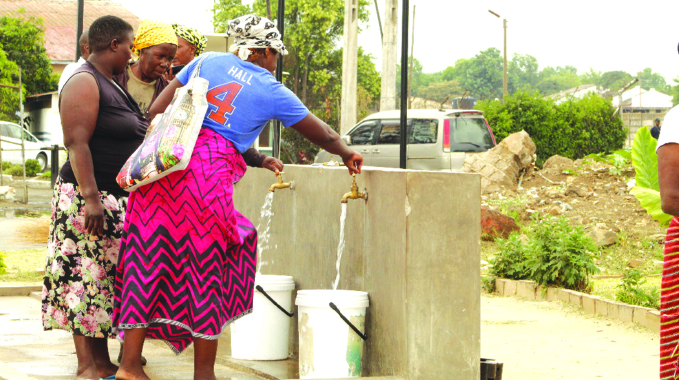
Rumbidzayi Zinyuke Health Buzz
Access to water is a constitutional right for every Zimbabwean.
Section 77 of the Constitution provides that “Every person has the right to safe, clean and potable water; and the State must take reasonable legislative and other measures, within the limits of the resources available to it, to achieve the progressive realisation of this right”.
Over the years, Government and its partners have taken significant steps towards ensuring that all citizens have access to clean and safe water particularly in rural areas.
While the urban population is deemed to be in a better position in terms of access to water, research shows that most of the water being accessed in the urban areas is not as clean as it should be.
This has been attributed to the failure by some local authorities to adequately put in place systems that will ensure residents have access to clean water.
In Harare, Bulawayo and surrounding areas, millions of people also struggle to access adequate sanitation services and clean drinking water due to the inefficiency of the opposition led councils.
Most local authorities, which are being run by the opposition parties are suffering from serious poor service delivery, with heaps of uncollected garbage, delivery of dirty water to residents and failure to maintain roads being the order of the day.
According to a 2015 report by the United Nations, improved water, sanitation and hygiene can have a positive impact on poverty.
Improved water, sanitation and hygiene also reduces the strain on healthcare systems and the impacts of malnutrition and disease. This improves health outcomes for the poorest people.
Without proper sanitation and clean water, the country could continuously witness the outbreak of diarrhoeal diseases such as cholera, typhoid and dysentery as was the case in 2008 when the country experienced the most devastating cholera outbreak.
The outbreak killed approximately 4 200 people and infected at least 100 000.
Behind this outbreak was obsolete water infrastructure and a growing population.
Local authorities have also been hard pressed to continuously provide clean water.
The said old infrastructure coupled with a shortage of chemicals means that the majority of the urban population usually get unsafe water or no water at all.
To mitigate the challenge of water shortages, boreholes have been drilled.
But then again, the dumping of uncollected rubbish around the cities, especially in Harare poses a threat to this initiative. The sewer infrastructure is also old and results in underground seepage which affects underground water, making some boreholes unsafe.
A study carried out in 2016 showed that an estimated 80 percent of Harare’s borehole and well water was contaminated and people using it were more at risk of contracting typhoid and cholera.
The Médecins Sans Frontières (Doctors Without Borders) developed a method of protecting new boreholes from contamination with sanitary seals.
Such a borehole was constructed in Mbare, Glenview and Hopley where communities are at risk of cholera outbreaks.
According to MSF, boreholes drilled with a proper sanitary seal using the technique in both urban and peri-urban settings and in different geological contexts show zero to minor contamination (within WHO guidelines).
To prevent entrance to the aquifer by any potential contaminants from the surface via the borehole itself, it is necessary to seal the uppermost section of the annulus between the outermost casing string and the wall of the borehole.
The sealing material commonly used is cement grout or a bentonite mixture.
MSF through its borehole diagnostics toolkit has inspected over 50 boreholes in Harare’s high-density urban settings, to understand the underlying causes of borehole contamination and results shows that the majority of the boreholes have poor or no sanitary seal which protects the water source from anthropogenic pollution.
MSF Zimbabwe water and sanitation supervisor Engineer Ignatious Takavada says boreholes fitted with a sanitary seal had been proven to yield the best quality of water.
“The borehole in Mbare was built on top of a dumpsite and also along a stream with water that is not clean at all.
In places such as Mbare we developed boreholes using the sanitary seal to protect them from contamination which may be caused by the surrounding waste.
We developed this borehole to support the community with clean water after the outbreaks of cholera,” he said.
“We do these interventions as preventive measure because normally these outbreaks happen as a result of people drinking unclean and unsafe water.”
The project roped in various players within the water sector to build capacity among technicians from the District Development Fund (DDF) and the Ministry of Lands, Agriculture, Fisheries, Water and Rural Development.
The Mbare borehole is yielding 30 000 litres of water per day which is enough to distribute to the communities within the catchment area of 5 000 people.
Two water points were developed on each side of the road for better access to residents from Mbare and other areas.
An investment of US$45 000 was made for the borehole, which is fitted with three tanks with a holding capacity of 10 000 litres each and can pump 10 000 litres of water per hour.
The community has since taken over the project and now has the capacity to do basic maintenance and troubleshoot problems that may arise.
MSF has also roped in Harare water department to take over any problems that may be too complex for the community.
The same technique has been used in Budiriro and Glenview, both cholera hotspots, as well as in Stoneridge, where the community is currently receiving no services from Harare City Council.
While the use of the technique could be expensive, it could be the answer to the problem of access to water and sanitation across the county.
Local authorities could look into adopting the initiative and rolling it out across the country.
In the meantime, local authorities should ensure residents have access to potable water, develop and implement a system to ensure the delivery of affordable and safe piped water to low-income families.
The councils should also upgrade the water infrastructure, provide regular, up-to-date information to residents on the water quality of both taps and boreholes in their areas so they understand the health risks and benefits of available water sources.
They should also ensure that all public boreholes are regularly tested for water quality and that these results are disseminated to residents.
The uptake of the sanitary seal could also go a long way in providing clean and safe water.
Clean water creates healthy communities.
Feedback: [email protected]



 Online Reporter