Emmanuel Kafe
THERE is a moment in every medical emergency when time either saves a life or slips away.
In Zimbabwe, that moment, the “golden hour”, has often been lost to distance, traffic and limited access to specialist care.
Now, the numbers coming out of the country’s growing helicopter ambulance service are beginning to tell a different story.
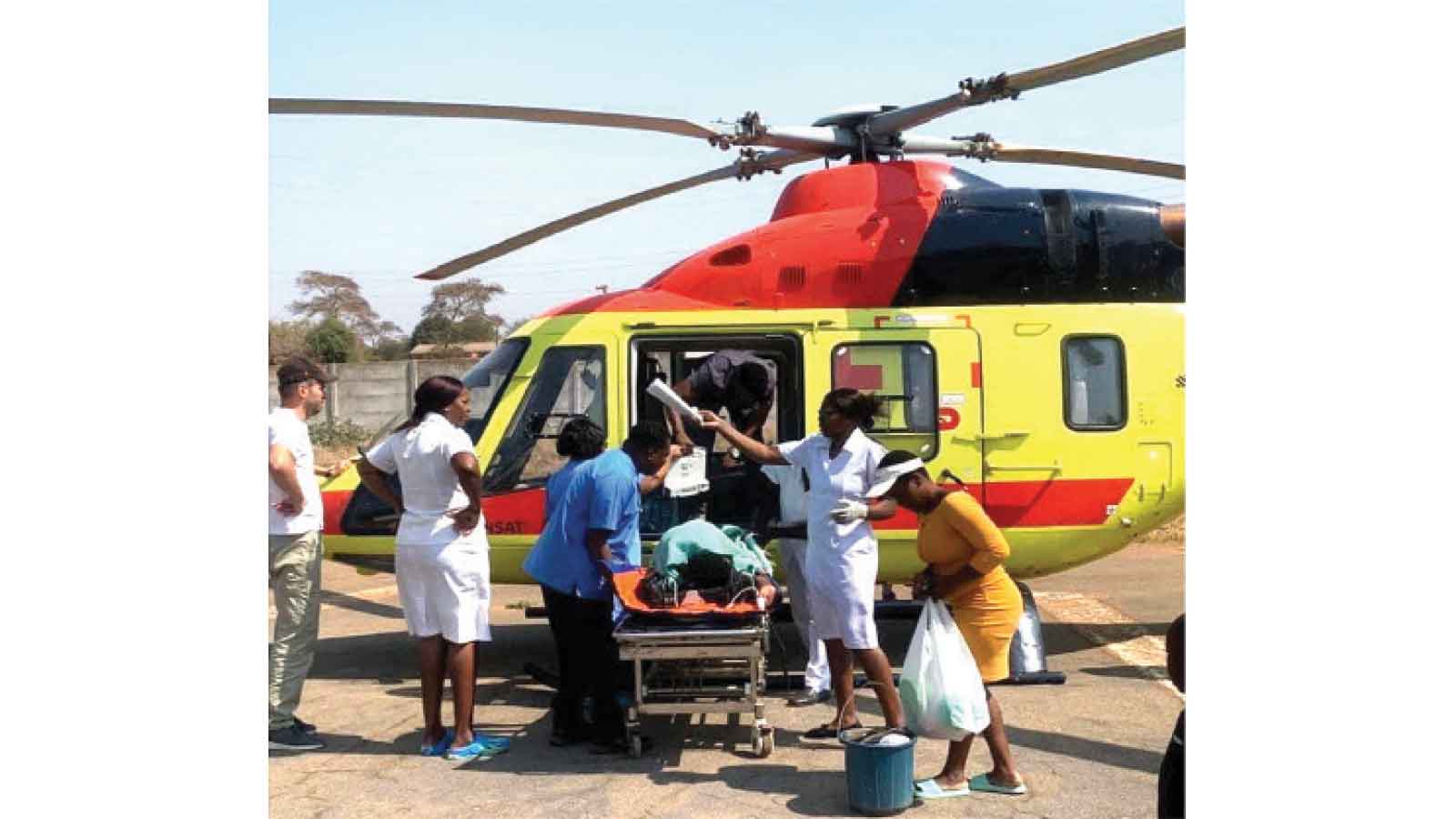
Since the start of operations, HELIDRIVE-ZIM has completed 1 306 aeromedical missions, a figure that points to a service steadily embedding itself into Zimbabwe’s emergency response system.
Of these, 861 missions were conducted from Harare and 445 from Bulawayo, reflecting activity across both northern and southern regions.
More recent figures show the pace at which the service is scaling up.
Between November 2025 and mid-March 2026 alone, 258 flights were carried out, marking a sharp rise in demand.
February has so far stood out as the busiest month, with 68 missions recorded.
On a single day — February 10 — seven flights were completed, underscoring both the pressure on the system and its growing capacity to respond.
For HELIDRIVE-ZIM chief medical doctor Dr Freddy Mhondiwa, the figures are more than operational milestones.
“Each mission represents a life in distress, a family waiting, and a race against time,” he said.
“Our mission has always been to ensure that every Zimbabwean, regardless of their location, has access to life-saving medical care during that critical ‘golden hour’.”
The distribution of flights also highlights how the service is bridging long-standing gaps in access to care.
From its Harare base, 146 missions were conducted during the review period, while 112 were handled from Bulawayo — extending reach into areas where road transfers can take hours.
Behind the data is a pattern of emergencies that have long challenged Zimbabwe’s health system — road traffic accidents, obstetric complications and critically ill patients requiring specialist intervention.
What the figures suggest is not just demand, but reliance.
The intensity of operations in recent months has tested the system.
Dr Mhondiwa said days with multiple back-to-back flights place pressure on crews, aircraft and medical teams.
“That level of intensity tests every part of our system — from our pilots and mechanics to our critical care nurses and doctors,” he said. “But we have been able to rise to the challenge.”
Medical consultant Dr Ekaterina Balandina said part of that growing efficiency lies in improved coordination, which begins even before a helicopter takes off.
“We also begin consulting with doctors on how best to stabilise the patient’s condition for transport even before our departure,” she said.
“This allows us to improve the patient’s condition before we arrive.”
She added that the service is providing emergency transport free of charge, lowering barriers to access while strengthening collaboration between referring clinics and receiving hospitals.
“Working collaboratively with the sending and receiving doctors, we are able to discuss the best treatment plan, taking into account all aspects of the process,” she said.
Taken together, the figures point to a service that is no longer experimental, but increasingly essential.
In a country where access to specialist care has often depended on geography, the steady rise in missions suggests a shift one measured not just in flight logs, but in time saved.
Launched in August 2024 after initial operations began in July, HELIDRIVE-ZIM is part of a Government-backed national air ambulance programme introduced to close long-standing gaps in Zimbabwe’s emergency response system.
The service operates under a Zimbabwe–Russia partnership, bringing in aircraft, technical expertise and training support while building local capacity to sustain operations.
From its initial base in Harare, it has since expanded to Bulawayo, creating a two-centre network that is steadily extending critical care coverage across the country.
The programme is supported by a fleet of medically equipped helicopters — effectively flying intensive care units — capable of handling trauma cases, maternal emergencies and neonatal transfers.
At least three aircraft are deployed daily between the two cities, ensuring rapid response to emergencies that would otherwise take hours by road.
One of its most significant features is that it provides emergency air evacuation free of charge, removing cost barriers that have historically delayed access to life-saving care.
Beyond the aircraft and missions, HELIDRIVE-ZIM is also investing in skills development, with more than 150 Zimbabwean pilots, doctors, nurses and engineers undergoing training to gradually localise the service.
This focus on capacity-building signals a shift from a stop-gap intervention to a long-term healthcare solution.
Authorities have indicated plans to expand operations to other centres including Victoria Falls, Mutare, Masvingo and Kariba, alongside the development of a national emergency call system.
Taken together, the service is evolving into a key pillar of Zimbabwe’s emergency medical infrastructure, combining speed, reach and growing local expertise to improve survival outcomes.