admin
admin
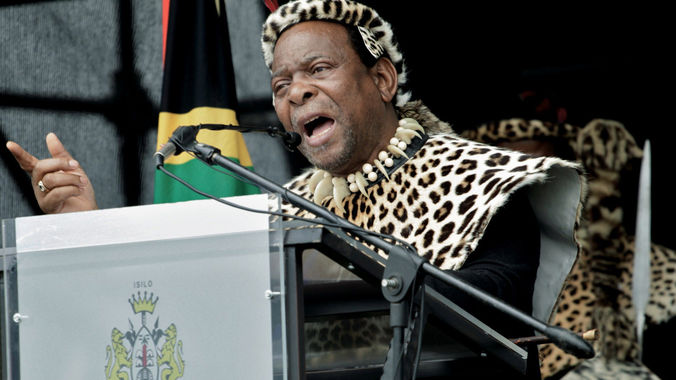
Going by South Africa’s Zulu King Goodwill Zwelithini’s recent nationalist, xenophobic outburst — “all foreigners in South Africa must pack their bags and go back wherever they came from” (which he denies) — and President Jacob Zuma’s eldest son Edward supporting the king with a bizarre insinuation that African foreigners in South Africa, if not stopped, pose a danger of overthrowing the government in the future via a coup, it is no wonder that the country may be deemed a no-go area for African foreigners.
Unsurprisingly, such sentiments also stoked xenophobic fires in a country that has for some time now been rocked by sporadic outbreaks of violence, directed especially at foreign Africans running businesses in the country’s townships.
Alas, fatefully, King Zwelethini and Zuma’s calls did not fall on deaf ears.
In a matter of days, xenophobic attacks engulfed Kwa-Zulu Natal as groups of South Africans went on the rampage, torching foreign businesses and driving their owners out.
They fled for their lives, while many, including women and children, were hurt in the process.
The trail of destruction was alarming as the foreigners sought refuge in police stations.
The king — who has since claimed his message was “lost in translation” and misinterpreted by the media house that first broke the story — is now reportedly being probed by the South African Human Rights Commission, amid reports that the Commission has an audio recording of his views about foreigners.
Xenophobia, or “Afrophobia”, as South Africa’s police minister, Nkosinathi Nhleko prefers to refer to the attacks, is no doubt making international headlines, as the issue always has.
The latest follow on from the xenophobic attacks that swept through South Africa’s biggest township, Soweto in January, ostensibly sparked by the shooting and killing of a youth by a Somali shop owner, who claimed that he acted in self-defence and to protect his business.
As the violence quickly spread to other parts of this sprawling township, it left many baffled as Soweto, until then, seemed to have escaped the xenophobia saga.
Xenophobia cannot be pushed aside and will always attract differing views about its roots.
There are even those who would argue that in some cases it can also all come down to politicking — for example, as the 2016 elections approach, some politicians could unashamedly use the issue against foreigners as a vote-catcher.
Authorities such as Home Affairs Minister Malusi Gigababoil put it down to opportunistic social misfits and criminals, who take advantage of perceived xenophobia to attack and rob foreign-owned businesses.
When all is said and done, South Africa and its leadership (who boast of having one of Africa’s most liberal immigration systems) cannot deny there is a problem regarding the relationship between black South Africans and other black foreigners, who migrate there either for perceived greener pastures or genuinely fleeing conflict.
But does this picture envelop the entire country?
Is South Africa a dangerous country for foreigners, especially Africans?
Of course, the answer is no.
Outbursts by prominent individuals like King Zwelithini are worrisome, but that is not the complete picture of how the general South African public views foreigners, including those from the African continent.
The Yeoville example
While the debate as to whether South Africans are xenophobic or not will take a long time to conclude, at least there is one suburb in South Africa where South Africans and African migrants live together in perfect harmony.
That place is the suburb of Yeoville, east of Johannesburg, where South Africans and “their brothers from the north” set a remarkable example worth emulating.
How does Yeoville do it?
Maybe the reason lies in the evolution of this mainly flat land suburb, nestled in close proximity to its two related suburbs, nearby Berea and Hillbrow, both of which also have a huge presence of African immigrants, who share apartment blocks with local township dwellers.
Yeoville is a fine case study of how best South Africans could live in peace with their African brothers and sisters and I set out one chilly weekend to find out how things work.
On this particular weekend I was on the lookout for Ubuntu Marimba Band, made up of South Africans from diverse backgrounds, who have just released their first album, called Africa, after performing together for nearly 20 years.
As I walked to meet the band, I must have heard at least five African dialects — Congolese, Angolan, Nigerian, Zimbabwean and South African — as well as a mix of English and other African languages. The state of the buildings in Yeoville tells a story on its own.
This is a suburb in transition that is constantly changing its demographics.
It is a mixed suburb that still counts some middle-class South Africans, mainly professionals living in some of the better-looking homes and blocks of flats, and also has in its midst a working-class community living in overcrowded conditions.
The streets of Yeoville leave much to be desired in terms of cleanliness.
On each side are houses and apartment blocks, some painfully dilapidated.
There are freshly washed clothes hanging on the balconies, some broken windows, plastic bags sharing the streets with broken bottles, and yet there are some houses within the mix which are so well-maintained, they could be anywhere in the green suburbs.
However, there is one street that particularly stands out in telling the story of Yeoville and its various transitions and complexities.
It is popularly known as Rockey Street.
It is rather Raleigh Street from Joe Slovo Drive, that gives way to Rockey Street as one crosses Fortesque Street.
Raleigh/ Rockey Street has always been as legendary as Yeoville itself.
In fact, one cannot talk about Yeoville and somehow not associate the area with the colourful Rockey Street and its colourful characters.
It is here that one finds familiar brands from the fast food and financial sectors of the South African economy.
Nando’s, KFC, Debonairs Pizza, Shoprite, McDonald’s and banks such as FNB, ABSA and Capitec, have full branches operating on the street.
These big-name brands share the same space with other businesses of all descriptions such as restaurants, nightclubs, spaza shops, and electronic goods stores.
These are all mainly run and owned by African immigrants such as Ethiopians, Nigerians, Angolans, Somalis, Congolese and Zimbabweans, whose entrepreneurial qualities seem to be intrinsically embedded in their DNA.
Instructively, the African immigrants run these businesses with no disturbance from their South African counterparts, revealing a remarkable spirit in a time when other parts of the country are engulfed in xenophobia.
Yeoville is also an area that has always been a host to interesting personalities in the arts sector.
The population that used to live here in the 1980s and 1990s have since moved to the suburbs, giving way to a wave of new inhabitants, mainly working-class South Africans and migrants.
However, it is in the cultural sphere that Yeoville has become distinctively different from what it used to be in the past, mainly with its African immigrant community defining the nature of Yeoville culture in a big way.
The new wave of immigrants, comprising a mixed bag of refugees, fortune seekers, artists and other professionals, have brought with them their diverse cultures as reflected in a vibrant night life, variety of cuisines, music and fashion. Almost all the faces of Yeoville life can easily be observed and therefore documented from the vantage point of Raleigh/Rockey Street.
It is also on this street that one can pick and choose the place to dine and dance.
“Here we attract a variety of customers, mainly Congolese, Zimbabweans, Zambians, South Africans and European tourists hailing from such countries as Italy, England and France, who pass through here once a week. I think they are attracted by the African food we cook. They like cassava leaves especially,” says Jeanette Bimoj-Tambu, the manageress of Kin Malebo, a popular Congolese restaurant.
The place is also known for its spicey fish called Thompson Mpiodi, served with their tasty house spice and pap. Bimoj-Tambu is originally from DRCongo and has been living in South Africa for close to 10 years now.
“I like coming here every week for their fish. Their music is also good,” says photographer Giyani Baloi. He is one of the South Africans Bimoj-Tambu speaks about, who share a meal with their fellow Africans.
Other places to look for on bustling Raleigh/Rockey Street include Kutlwano Diner (popularly known as Gumede’s), Club 28 and Rasta House (which is 300 metres off Rockey Street.)
Although the Yeoville of today is neglected to some extent, and a far cry from its glorious past, it seems to still attract the wealthy classes, especially among the African immigrant communities, who do not hesitate to flaunt their expensive tastes, judging by the sleek vehicles parked on Raleigh/Rockey street. It is not unusual to find an Aston Martin parked next to a Maserati, and those behind the wheel are mainly African migrants. Another example of the African migrant community’s ostentatious displays of wealth can be found in the stories often carried in the South African media, and on the streets, of some wealthy African immigrants going around distributing R100 notes to anyone who cares to accept them, in the streets, bars and restaurants of Yeoville and Berea.
As is often the case in such culturally mixed environments, cross-cultural exchanges between South African and migrant communities often take place, especially among artists. One South African music group which has taken advantage of the richness of the African musical culture prevalent in Yeoville is Ubuntu Marimba Band. Their latest album is a mix of West African sound that could easily be mistaken for Malian folk music. In fact the sound is so West African that one could easily argue it is produced by West African artists. Well, if the lyrics did not give it away, as they are delivered in a motley collection of South African languages, although mainly isiZulu and isiXhosa.
“In fact a lot of South Africans and foreigners alike think that we are from West Africa, when in fact we are all from South Africa, with band members hailing from Soweto, Tsakane on the East Rand, and of course Yeoville,” says Mbongo, the band leader.
—–Pan-African spirit all-round—–
The band holds regular shows at a legendary eatery called Ekhaya, which underwent a major revamp last year. It used to be owned by the late South African socialite and entertainment producer Sue Mabalane. It is now owned by Ethiopian businessmen.
Opposite Ekhaya, across the road, there is Time Square Café. Unlike Ekhaya, this attracts the working classes of Yeoville, comprising mainly security guards, waiters, construction workers and cleaners, who cool off here when they are off-duty. They are mainly South African, Zimbabweans, Malawians, Zambians, Mozambicans and immigrants from Lesotho. There is harmony among these diners to the extent one would think they all hail from one country.
This place seems to be missing its past glory, when it used to be a hang-out spot for the country’s luminaries in the 1990s, such as actors, TV and radio personalities, filmmakers, intellectuals, writers and politicians. Former Miss South Africa Peggy-Sue Khumalo used to work here as a waitress in Time Square’s heyday. It is now undergoing renovations after being bought by Zimbabwean engineer-turned-entrepreneur Paul Dhehwa.
“This is a place bands that are successful today, such as Bongo Muffin, Big Nuz and others, originate from. Time Square was their meeting point. My mission is to take this place back there. I want this place to be a Pan-African place where Zimbabweans, South Africans and other Africans can come, relax, have a meal and exchange ideas in a tolerant environment. We want to unite Africans,” says Chimhoswa.
South Africans who live in this suburb are also not idle when it comes to promoting harmony with their foreign counterparts.
“We will be having a carnival this month (May) as part of the Africa Month activities. The theme of the carnival, that will be organised in collaboration with the African Diaspora Forum, will see these streets transformed to have a carnival atmosphere as foreigners and locals will dance, sing and march together,” says playwright, Yeoville resident and ANC branch chair Vusi Mhlongo. His anti-xenophobia play Kilimanjaro was performed at the University of the Witwatersrand two years ago, and at the Joburg Theatre in February.
Eric Mpobole, who runs the popular night club Tandoor in Yeoville, is also a South African doing his bit to promote harmony. The walls of his club are adorned with portraits of “Great African Leaders”, which see Zulu Shaka, Chris Hani, Nelson Mandela and Winnie Mandela, for example, sharing a proud space with Patrice Lumumba, Robert Mugabe, Kwame Nkrumah, Thomas Sankara and Samora Machel – in harmony. This is a way to go for South Africa. – NewAfrican magazine


 Online Reporter