

 admin
admin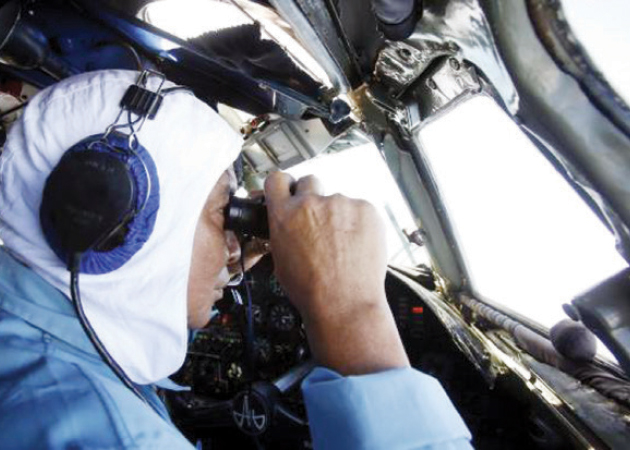

KUALA LUMPUR – The search for the missing Malaysia Airlines flight MH370 has expanded to two areas and is now covering almost 27,000 square nautical miles, Malaysia’s transport minister said.
Speaking to journalists at a news conference in Kuala Lumpur yesterday, Hishammuddin Hussein said that 42 ships and 39 aircrafts have been deployed in search operations.
Hussein said the search effort for the missing plane with 239 people on board was “unprecedented” and that authorities would continue searching until they find it. The operation is a multinational effort with 12 countries now taking part.
Hussein gave his assurance to the families of passengers and crew that no efforts will be spared in finding the plane.
“We will never give up hope,” he told reporters at the news conference.
Malaysia Airlines flight 370 took off from Kuala Lumpur for Beijing early Saturday morning and last made contact with ground control officials about 35,000 feet above the Gulf of Thailand between Malaysia and southern Vietnam before vanishing.
Malaysia’s air force chief said radar detected what could have been the jetliner in an area in the northern Malacca Strait, hundreds of miles from the spot where the plane dropped off air traffic screens.
Rodzali Daud told the joint news conference that the tracking was at 2.15am local time on Saturday, about 45 minutes after the plane with 239 people on board vanished from air traffic control screens midway between Malaysia’s east coast and Vietnam.
He said the radar tracking was at a point 200 miles north-west of Penang island on Malaysia’s west coast. Bur Rodzali stressed that the information needed to be corroborated.
Earlier, there were reports that the head of Malaysia’s air force has denied saying an airliner missing since Saturday had turned back towards Kuala Lumpur, flying hundreds of kilometres to the west.
Malaysia’s Berita Harian newspaper had quoted General Tan Sri Rodzali Daud as saying military radar detected the plane near the island of Pulau Perak, at the northern end of the Strait of Malacca, flying about 1,000 metres lower than its previous altitude.
However, Rodzali Daud, the head of the Royal Malaysian Air Force (RMAF), said that in answer to a question from Berita Harian, he had referred the journalist to a statement on March 9, in which he had said the RMAF had not ruled out the possibility the aircraft had turned back before vanishing from the radar.
On Monday, Malaysian authorities doubled the search radius to 185km around the point where Malaysia Airlines MH370 disappeared from radar over the South China Sea. “The biggest problem is just knowing where to look, especially at night,” Vo Van Tuan, a top Vietnamese military officer who is leading Vietnam’s search effort, said.
The total search sphere now includes land on the Malaysian peninsula itself, the waters off its west coast, and an area to the north of the Indonesian island of Sumatra.
Police had earlier said they were investigating whether any passengers or crew on the plane had personal or psychological problems that might explain its disappearance, along with the possibility of a hijack.
On Tuesday, Interpol said the disappearance of the plane was not likely to have been caused by a “terrorist” attack.
“The more information we get, the more we are inclined to conclude it was not a terrorist incident,” Ronald Noble, head of Interpol told reporters.
Meanwhile, false alarms, swirling rumours and contradictory statements have made the wait all the more agonising for the families of the 239 people on board the plane.There have been several false alarms linked to debris spotted in busy shipping lanes in Southeast Asian waters.
Chinese media have reported that relatives have heard ringing tones when trying to call their missing loved ones’ mobile phones.
The accounts of some passengers on Chinese messaging tool QQ show they had been online, other reports say, although the operator says that failure to shut the software down properly can give that impression.
Alfred Siew, a Singapore-based technology commentator, admits it is a “mystery”, but said the matter could be merely due to a network error affecting some phones.
Azharuddin Abdul Rahman, head of Malaysia’s Department of Civil Aviation, said on Monday that five passengers who had purchased tickets and checked baggage did not make the flight. He told journalists their luggage was removed from the plane, per standard procedure, when routine checks indicated the five passengers had not boarded before take-off.
But Malaysia’s national police chief Khalid Abu Bakhar insisted on Tuesday that all passengers who booked the flight did board in the end.
However, muddying things further, Malaysia Airlines issued a statement hours later saying there were indeed four passengers who had valid bookings but did not check-in for the flight.
Malaysia’s civil aviation chief, Azharuddin, also drew scorn on social media by referring to black Italian footballer Mario Balotelli when discussing the two suspicious passengers who boarded the plane with stolen passports.
When asked what the two suspects travelling on EU passports looked like, Azharuddin referenced Balotelli, who was born in Italy to Ghanaian parents and is an Italian international player, as an example of how one’s skin colour does not necessarily indicate nationality.
Malaysia’s transport ministry later issued a statement saying “no ill feelings” were meant by the comment, but the social media reaction underlined feelings of embarrassment with so much world attention focussed on the plane search. — AFPAl Jazeera



 Online Reporter