Chronicle Editor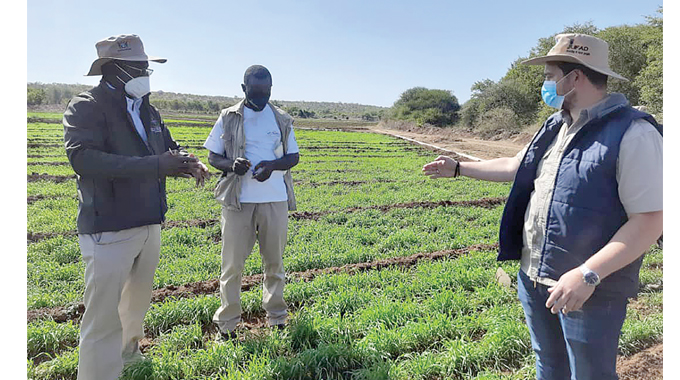
Yoliswa Dube-Moyo, Matabeleland South Bureau Chief
FARMERS at Sebasa Irrigation Scheme in Gwanda South have gone beyond subsistence farming and have adopted a viable business model to generate sustainable income, raking R120 000 through the sale of groundnuts from their last harvest.
Following the rehabilitation of infrastructure at the irrigation scheme through the Smallholder Irrigation Revitalisation Programme (SIRP), the farmers no longer live from hand to mouth but can afford to invest at home and in the business through dividends generated from the irrigation scheme.

Gone are the days when they would farm to eat only as they now realise that farming can be a lucrative business.
Through the revitalised irrigation scheme, the beneficiaries of the project can now afford to feed their families and sell the surplus to generate income.
This is in line with the country’s rural industrialisation drive under the National Development Strategy 1.
Of the 28 hectares under cultivation at Sebasa Irrigation Scheme, 20 hectares are under wheat in addition to the sugar beans and sweet potato crop.
Sebasa Irrigation Scheme in Ward 24 was established in 1968 and has 112 beneficiaries. The 65-hectare project was rehabilitated to the tune of US$524 000 with farmers starting to reap the benefits.
The main works at Sebasa Irrigation Scheme included the rehabilitation of canals, sinking of boreholes, installation of pumps and a state-of-the-art solar power system.
One of the farmers at the irrigation scheme, Ms Thabiso Moyo said she was hoping to harvest a tonne of sugar beans.
“This irrigation scheme has empowered us and we’re able to get something out of it. We can now stand on our own feet as women and contribute meaningfully to our households,” said Ms Moyo.
She said previously, farmers, particularly women struggled to make ends meet.
“But all that has changed. Through the irrigation scheme, we’re getting something tangible. Our hard work is starting to pay off,” said Ms Moyo.
Through the SIRP, Government and its partners aim to put 350 000 hectares under irrigation across the country.
SIRP is a US$52 million programme established in 2016 to reduce the vulnerability of smallholder farmers to food and nutrition insecurity, climate change effects and economic shocks as well as contribute to the resilience of smallholder farming communities.
The programme is expected to revitalise 60 irrigation schemes covering 6 100 hectares in Manicaland, Masvingo, Matabeleland South and Midlands provinces.
It targets over 27 500 rural households where 15 000 households are irrigators and 12 500 households are in the adjacent rain-fed areas.
Speaking during the commissioning of Sebasa and Guyu-Chelesa irrigation schemes in Gwanda District on Wednesday, Deputy Minister of Lands, Agriculture, Fisheries, Water and Rural Development Vangelis Haritatos said Zimbabwe’s economy is agrarian with the sector contributing 17 percent to the country’s gross domestic product.
At Guyu-Chelesa Irrigation Scheme in Ward 14, US$660 000 has been invested in the rehabilitation of the scheme.
“As the agricultural sector, we are expected to improve food self-sufficiency from 45 percent in 2020 to 100 percent by 2025. This entails increasing maize production from 907 629 tonnes in 2020 to three million tonnes in 2025 among other deliverables. As part of efforts to build resilience in most rural communities in arid and semi-arid areas, we have embarked on a number of climate smart initiatives to ensure continued national food security,” said Deputy Minister Haritatos.
He said irrigation is the half panacea to climate change hence focus is also on expanded irrigation development and water harvesting for enhanced agriculture production and productivity.
“In addition to irrigation development, the Ministry is making strides towards building resilience in most arid and semi-arid areas of the country by employing conservation methods such as the highly successful Pfumvudza/Intwasa programme which saw the country produce a record 2 717 171 tonnes of maize against the national requirement of 1,8 million tonnes in the 2020/2021 agricultural season,” said Deputy Minister Haritatos.
He said in Matabeleland South province, nine schemes in Gwanda, Mangwe, Beitbridge and Insiza will be rehabilitated under the SIRP.
“As Government, we encourage farmers in irrigation schemes to ensure that the schemes continue to function as we focus on rehabilitating other schemes in other districts. While we encourage farmers to grow grain, which contributes to the national strategic grain reserves, for the purposes of keeping the scheme sustainable, I encourage you to also rotate cultivation of grain with high value crops such as groundnuts, pepper, potatoes, spices, vegetables and fruits. These will give you high financial yields that will assist you to cover recurrent costs,” said Deputy Minister Haritatos.
SIRP national project coordinator Mr Odrick Chikorera said the programme aims at improving productivity and climate resilient crop production under both rain-fed and irrigation, through increased adoption of improved agricultural practices.
“To achieve this, SIRP has two mutually reinforcing components. Component 1 focuses on sustainable smallholder irrigation development while component 2 facilitates the implementation of climate smart agriculture and market access,” said Mr Chikorera.
He said the main focus is to promote nutrition sensitive agriculture in both irrigation and rain-fed areas.
“This is done through the provision of training on good agricultural practices, gender action learning systems, nutrition education, natural resources management, post-harvest management and farming as a business,” said Mr Chikorera. – @Yolisswa



 Online Reporter