Online Reporter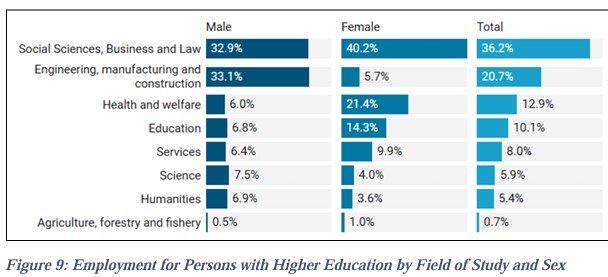
Nqobile Bhebhe [email protected]
SECONDARY education remains the dominant educational attainment level among Zimbabwe’s workforce, accounting for 65 percent of total employment and more than 60 percent of the working-age population, according to a new Zimbabwe National Statistics Agency (ZimStat) report.
The findings, contained in Thematic Report on Education and Labour Market in Zimbabwe, underscore the central role of secondary education in supplying labour to the economy, while also showing that higher educational attainment significantly improves employment prospects, labour force participation and earnings.
Only 9.5 percent of the country’s working-age population has attained higher education qualifications.
The report says labour force participation increases with educational attainment, with those holding higher education qualifications recording the highest participation rates.
“Secondary education remains the dominant attainment level in Zimbabwe, accounting for 65.0 percent of total employment and over 60 percent of the working-age population, while 9.5 percent of the working-age population attained higher education.
“Labour force participation increased with education, reaching 76.8 percent among persons with higher education and was about 1.6 times higher for males (59.2%) than females (36.9%).”
The report also shows that higher education substantially enhances access to formal employment.
People with higher education recorded an employment-to-population ratio of 70 percent, while formal sector employment absorption reached 56.2 percent among graduates, compared to just 1.9 percent for people who never attended school.
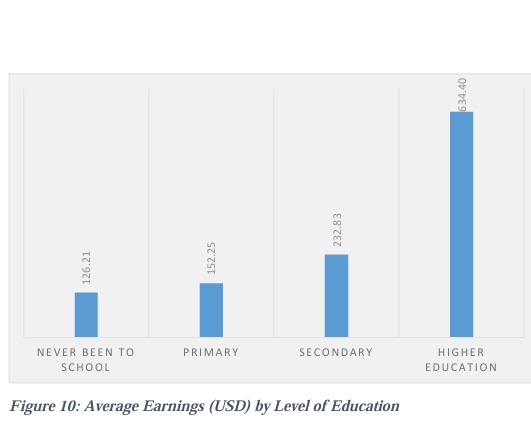
ZimStat said educational attainment is also closely linked to income levels.
“Earnings also depicted a positive relation to the level of education with individuals with no formal schooling recording the lowest average earnings of US$126.21, while those with primary education earned an average of US$152.25,” reads part of the report.
Employment by field of study among those with higher education shows notable differences between males and females.
“Overall, the largest proportion of employed persons specialised in Social Sciences, Business and Law, accounting for 36.2 percent of total employment.
” This field was particularly dominant among females, where it accounted for 40.2 percent compared to 32.9 percent among males.”
“The second largest field of specialisation was Engineering, Manufacturing and Construction, representing 20.7 percent of total employment.
” However, this field was heavily male dominated, with 33.1 percent of employed males compared to only 5.7 percent of females.
” In contrast, females were more concentrated in Health and Welfare as well as Education, accounting for 21.4 percent and 14.3 percent respectively, compared to 6.0 percent and 6.8 percent among males.”
The report indicates that fields such as Science, Humanities and Services recorded relatively smaller shares of employment across both sexes, while Agriculture, Forestry and Fishery had the lowest proportion overall at 0.7 percent.