Online Reporter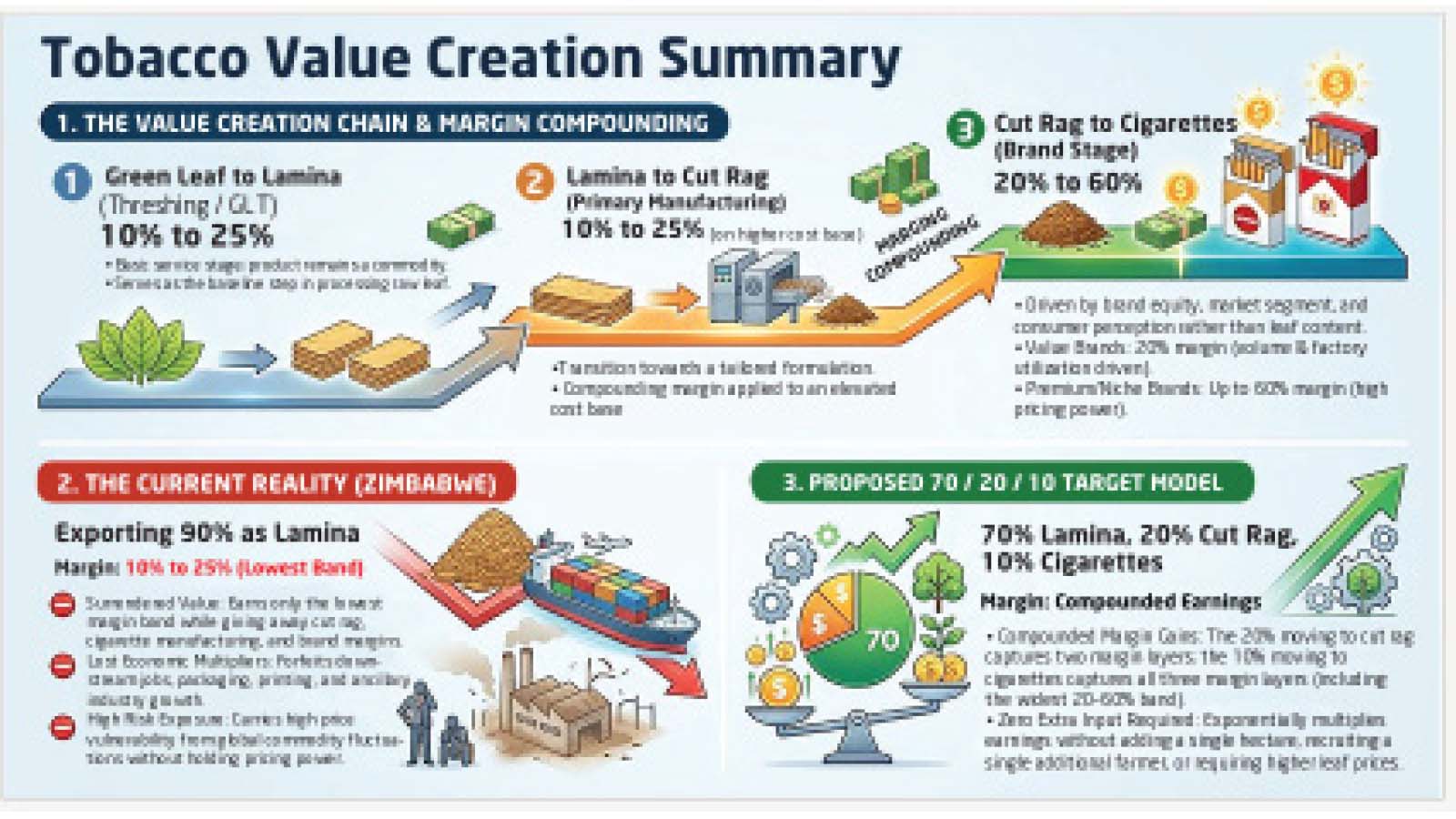
Business Reporter
ZIMBABWE has firmly won the volume game in tobacco, but the price dynamics paint a different picture.
Building on 2025’s record of 355 million kilogrammes (kg), total sales reached 358 million kg by last week, about 1 percent ahead of the previous year.
While output is now comfortably established above 350 million kg across back-to-back seasons, a sobering truth confronts the sector as the 2026 season draws to a close: expanding volume is yielding diminishing value.
Despite pushing national output to 358,33 million kilogrammes, a 1 percent increase over 2025’s 353,31 million kg, tobacco farmers’ revenue plummeted by 24 percent to US$892,56 million.
While the Tobacco Value Chain Transformation Plan successfully expanded leaf production, a sharp 25 percent drop in average prices from US$3,32 per kg in 2025 to US$2,49 this year wiped out an estimated US$281,48 million in grower value compared to 2025.
Ultimately, global market dynamics eroded earnings for farmers delivering record volumes into an oversupplied, buyer-dominated market.
Beyond short-term price drops, global oversupply and quality concerns, the sector faces a deeper structural threat.
Producers cannot count on global market expansion to absorb rising output.
Global cigarette consumption is in a steady decline, dropping from about 6,3 trillion to 5,4 trillion sticks over the last decade. Worsening this decline is a quiet yet profound shift in consumer preferences.
Key Asian markets, most notably Zimbabwe’s primary export destination, China, are turning rapidly towards slim and super-slim formats. These inherently use far less raw leaf per stick.
Each slim stick requires 40 percent to 50 percent less raw tobacco than a traditional format. The mathematical outcome is stark: Even where stick counts remain stable, actual leaf consumption is shrinking.
Pushing unbeneficiated tobacco into a market that requires less leaf per unit inherently depresses prices, forcing local smallholders to absorb the financial burden.
In response, the Tobacco Industry and Marketing Board (TIMB) has since urged farmers to take diversification as a strategic complement to tobacco rather than a replacement.
With the Meteorological Services Department forecasting below-normal rainfall for the 2026/2027 season due to El Niño conditions, spreading risk across livestock, horticulture and food crops is increasingly vital for protecting farmer incomes against both climate shocks and volatile global markets.
Industry experts suggest that Zimbabwe must shift its focus from primary agriculture to industrial manufacturing through sector-specific special economic zones (SEZs) to attract global capital.
Citing the United Arab Emirates (UAE) as a proven model, tobacco value chain expert Mr Tapiwa Masedza suggested that the country could adopt a similar framework to build its processing capacity.
Three emirates — Dubai, Fujairah and Ras Al Khaimah — host extensive tobacco manufacturing hubs, processing leaf from raw lamina to cut rag and finished cigarettes within specialised free trade zones.
In Dubai’s Jebel Ali Free Zone, container ships unload Brazilian, American and Malawian leaf within hours.
The next day, the leaves are blended, cut and rolled into cigarettes for sale in duty-free shops worldwide.
In Zimbabwe, the finest leaf on earth is still largely baled, auctioned and shipped out raw, transferring significant value to foreign markets. The UAE grows zero kilogrammes of tobacco. Instead, it imports leaf of diverse origins, blends them under one roof to optimise cost and taste profiles, and exports high-value products globally, said Mr Masedza, who is also founder of Chevron Tobacco.
“The UAE’s success was not an accident of nature; it was built on deliberate fiscal incentives, streamlined regulatory frameworks and world-class logistics,” he said.
“If a nation with no domestic crop can build a global manufacturing hub, the country that grows the world’s finest flavour leaf can build a superior one.”
Zimbabwe aims to grow the tobacco industry to as much as US$7 billion by 2030, raise output to 500 million kg and expand the level of localised value addition and beneficiation such as cut-rag processing and cigarette manufacturing from a baseline of just 2 percent up to 30 percent.
If the SEZ framework succeeds, Zimbabwe’s landscape could shift dramatically by 2030.
Instead of trucking raw bales to the coast, merchant blenders would be trading cut rag in bonded warehouses, factories would run three shifts and “Made in Zimbabwe” would appear on packs sold from Dubai to Doha, capturing not just the leaf value, but the brand premium.
Agricultural economist Mr Edginton Tapera, in an interview, said Zimbabwe “has reached the natural limit” of what raw production volume can achieve for the national economy.
“Continuing to push supply up without a corresponding expansion in secondary processing facilities simply transfers wealth from local farmers to international buyers,” he said.
“If Zimbabwe is to capture true industrial yield, we must offer a hyper-targeted fiscal strategy to attract investors.”
Industry players say that while Zimbabwe possesses installed manufacturing capacity of 18 billion cigarettes annually, producers underutilise the infrastructure by manufacturing only around 4 billion sticks, reluctant to offer toll manufacturing to protect their dominance.
This idle capacity is not due to a lack of machinery, but a lack of will.
Industry insiders say dominant players who control the lion’s share of the cigarettes market view toll manufacturing as a threat to their tight grip on the market, preferring to keep the status quo rather than empower a new generation of processors.
Mr Masedza noted that Zimbabwe’s SEZs framework incentives remain too broad to attract serious cigarette and secondary processing capital.
Investors seeking to set up cut-rag processing or cigarette manufacturing plants face a general policy framework that lacks sector-specific clarity on excise duties, leaf import or re-export regulations and tailored tax regimes.
To turn raw leaf into industrial yield, the Government must package sector-specific SEZ frameworks specifically for tobacco processing —mirroring targeted frameworks used in mining.
“Zimbabwe already holds most of the tools it needs within its special economic zone regime; the task is to assemble them deliberately for tobacco manufacturing and put them before investors,” said Mr Masedza.
He proposed a policy framework that offers a strong set of incentives: zero percent corporate tax holiday for five years (rising to 15 percent thereafter), duty-free importation of complementary foreign leaf under an inward-processing regime, deferred or zero-rated value-added tax (VAT) on inter-merchant and export trading, accelerated capital allowances and excise-free treatment on exports.
Investors also benefit from exemptions on withholding and capital gains taxes, full foreign ownership, unrestricted profit repatriation and 100 percent export-proceeds retention through the Zimbabwe Investment and Development Agency’s one-stop licensing.
“While these provisions are standard internationally, tax breaks alone do not build factories; they require the operational certainty and administrative speed that built the UAE’s hub,” said Mr Masedza.
He noted that the most critical mechanism to unlock capital is the tax treatment of inter-merchant trading.
Currently, local grade exchanges between merchants attract VAT — even when the final product is destined for export. Eliminating or deferring this tax frees up working capital and lowers final costs, enabling local merchants to pool, trade and reconfigure precise leaf blends domestically.
Facilitating this cross-merchant blending at source serves as the foundational engine of any processing hub.
“Securing the future of Zimbabwe’s tobacco sector will not depend on planting more hectares, but on capturing more dollars per kilogramme through processing and local value addition,” said Mr Masedza.
With global leaf consumption shrinking and climate shocks looming, Zimbabwe cannot afford to wait another season to turn its policy blueprints into working factories.