admin
admin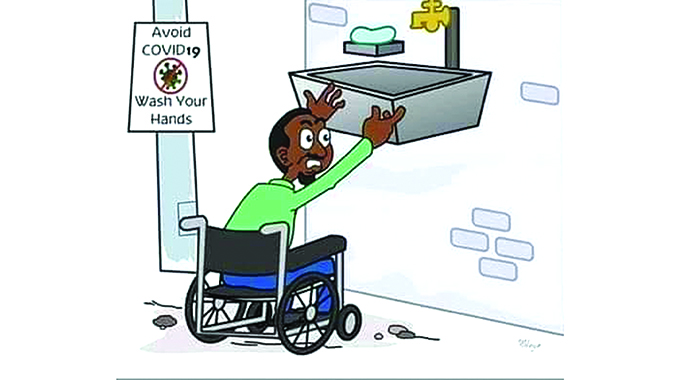
Disability Issues
Dr Christine Peta
ON June 9, 2021, His Excellency President, Mnangagwa, launched the National Disability Policy of Zimbabwe.
The policy demonstrates the Government’s commitment towards promoting, fulfilling, protecting and respecting the rights of persons with disabilities.
The Ministry of Public Service, Labour and Social Welfare, led by Minister Professor Paul Mavima, has the mandate of overseeing the national disability agenda, and thus the implementation of the National Disability Policy.
This article marks the beginning of a series of commentaries, that unpack the provisions of the policy, to enable us to understand what the policy means.
Before I delve into the key standards of the National Disability Policy under different subjects, there is a need to state from the onset that the policy is grounded in a conceptual framework that includes the social model of disability, the intersectional model and the human rights approach.
So what do all these models mean?
This article unpacks the meaning of the social model of disability to enable us to understand why it is used in the National Disability Policy.
The other models will be unpacked in future articles.
The focus of the social model of disability is on how society organises itself in ways that exclude persons with disabilities. As such, disability does not arise from the bodily impairment of the person, but from the results of the interaction of a person’s body and the environment.
The social model of disability is therefore a departure from the outdated medical model of disability, which regards persons with disabilities as sick, passive people who should be “fixed” by medical practitioners, so that they become “normal”.
Under the medical model of disability, persons with disabilities are regarded as people who cannot take charge of their own lives, hence they are expected to hand over control of their lives to a huge “army” of competent medical doctors, who should “cure” their bodily “defects.”
The medical model of disability has been criticised for calling upon persons with disabilities to assume the role of sick people, as if for example, they have measles.
In illustrating the shortcomings of the medical model of disability, a woman who acquired physical disabilities due to a car accident in Masvingo said: “When my husband’s relatives visit our house at any time of the day, the first thing they say is, prepare for her to go to sleep.
“They think I am sick because I am using a wheelchair, but the truth is I have not been to a medical doctor for the past 3 years.
“It is them that are disabling me by their negative attitudes, but my body is fine.”
The above scenario shows the reason why the National Disability Policy of Zimbabwe is not grounded in the medical model of disability, but instead and in part, in the social model of disability.
That is not to say healthcare or medical knowledge is useless, but it is to say that persons with disabilities are not permanently sick people, but just like everyone else they may in some instances need healthcare.
The social model of disability directs society to remove barriers that hinder the participation of persons with disabilities in all facets of life and such barriers include.
Physical barriers: society generally assumes that all people can walk into buildings, hence it is not uncommon to find stairs at most building entrances. The National Disability Policy directs the construction of ramps on all buildings, to ensure access by all persons including wheelchair users. In addition, the provision of elevators, where relevant, enhances access by persons with disabilities.
Institutional barriers: do not make it easy for persons with disabilities to participate in various institutions that may include religious, legal, health or educational.
Among other things, the National Disability Policy addresses issues of access to healthcare, inclusive education, access to justice and the right of persons with disabilities to make their own choices with regards to religion and participation thereof.
Attitudinal barriers: negative attitudes that regard persons with disabilities as “damaged goods”, good for nothing people, or incompetent persons who are unable to take care of themselves, obstruct the full participation of persons with disabilities in society.
The National Disability Policy promotes awareness raising, which enhances understanding of disability issues.
The risk of failing to reduce or eliminate physical, institutional and attitudinal barriers, is a perpetuation of the lack of support and access by persons with disabilities to both the physical environment and to information in appropriate formats that include Sign Language and Braille.
Way forward
In accordance with the provisions of the National Disability Policy of Zimbabwe, there is a need for us to embrace differences and to apply the principle of universal design to both the physical environment and to information.
Such an approach enables all people including persons with disabilities to have access to both buildings and relevant information, on an equal basis with others.
As noted by disability journalist and campaigner Fleur Perry, we can all use the social model of disability, by making sure that all things around us work better for persons with disabilities.
Under the social model of disability, examples of questions that we should be asking ourselves are:
Do we really have to always lift my brother from his wheelchair into our house whenever he visits us?
How does my brother feel when we lift him from his wheelchair and touch his body all over so that he gets into the house, are we upholding his dignity?
Can we not put a ramp at one of the external entrances of our house, so that my brother can get into the house on his own with his wheelchair, when he visits us?
- But what will happen if my wife, any of my children or I, become disabled?
How am I going to access the bathroom or kitchen of this big house that I am building, if I acquire disability?
If at any point you have asked yourself the above questions, or more or less similar questions, then you have used the social model of disability.
As directed by the National Disability Policy of Zimbabwe let us all join hands in eliminating the physical, institutional and attitudinal barriers that hinder the full participation of persons with disabilities in society.
Dr Christine Peta is a disability, policy, international development and research expert who is the national director of disability affairs in Zimbabwe. Contact: [email protected] <mailto:[email protected]>


 Online Reporter