Online Reporter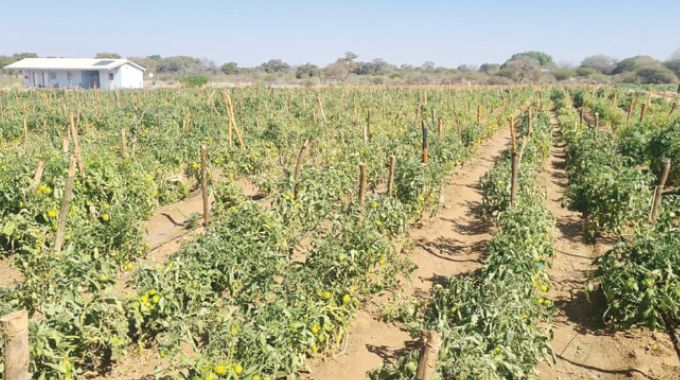
Sukulwenkosi Dube-Matutu, [email protected]
FOR years, erratic rainfall and chronic water shortages made farming a risky venture for villagers in some of Matabeleland South’s driest communities. However, solar-powered irrigation is now transforming livelihoods, enabling rural households to produce food throughout the year, generate steady incomes and build sustainable businesses from the land.
Through Village Business Units (VBUs), communities that once relied heavily on seasonal rainfall are increasingly embracing commercial agriculture, using solar-powered boreholes and drip irrigation systems to produce high-value crops for local markets.
A VBU is a community-owned agricultural enterprise that combines irrigation infrastructure, shared ownership and collective production and marketing, helping rural farmers transition from subsistence farming to market-oriented agribusiness.
In Gwanda District, seven recently established solarised VBUs are already transforming livelihoods in communities where prolonged dry spells have historically constrained agricultural production.
Farmers are now producing vegetables throughout the year, with surplus harvests being sold to local markets, schools and traders.
The transformation forms part of Government’s rural industrialisation and climate resilience agenda, which seeks to equip communal communities with infrastructure and technology capable of sustaining agricultural production despite increasingly unpredictable weather patterns.
Gwanda now has 15 VBUs, with the Garanyemba VBU pioneering the drought mitigation centre concept by combining a village business unit with cattle sales pens and feeding troughs.
The model enables communities to diversify their income streams beyond crop production while reducing costs associated with accessing markets and livestock services.
Lifalethu VBU chairperson Mr Sabata Nare said the solar-powered irrigation system had transformed farming into a viable business and enhanced the financial independence of villagers.
The VBU benefits approximately 40 households, with members producing crops for sale and using the proceeds to support their families.
“This project is really assisting us to fend for our families and put our children through school, and members have been able to buy assets and property using money which they are getting from selling produce, which means we have been empowered as a community and we are no longer beggars,” said Mr Nare.
He said the VBU was being managed as a business, with members maintaining records, preparing budgets and calculating production costs to ensure accountability for every input and harvest.
The commercial approach has helped farmers appreciate that profitability depends not only on production volumes but also on effective planning, cost management and securing reliable markets.
At Tsolapili VBU, solar-powered boreholes have addressed one of the biggest obstacles to farming: access to a reliable water source.
Chairperson Mr Stephen Mpofu said the community had previously been unable to undertake meaningful irrigation because of the absence of dependable water supplies.
“Now with solarised boreholes we can produce throughout the year, and our production is no longer limited to the rainy season,” he said.
Mr Mpofu said the elimination of fuel costs had made irrigation more affordable, allowing farmers to expand their drip irrigation systems and venture into higher-value crops such as tomatoes, onions, covo and butternuts.
For Ms Duduzile Nkomo, the VBU has become a lifeline for a community grappling with the effects of climate change.
She said the initiative had strengthened household food security while ensuring that non-members could access fresh and nutritious produce at affordable prices.
The farmers, however, are aiming to move beyond the sale of fresh vegetables alone.
“We don’t want to end at producing only; we are exploring strategies on how we can value-add our produce so that we get more income, because a lot of people are now into crop production which has left the market flooded and we feel there is still a gap in processed organic products,” she said.
The community is targeting markets as far as Bulawayo while exploring opportunities to dry, package and brand its produce.
Gwanda District acting Agritex extension officer Mr Godfrey Hove said solar irrigation was changing farmers’ attitudes towards agriculture by encouraging them to view farming as a business rather than simply a means of producing food for household consumption.
He said extension officers were training farmers in fertigation, crop rotation, record-keeping, market planning and post-harvest handling.
“Hopes have been raised among farmers as they are seeing light at the end of the tunnel, and in our region, which is generally dry, provision of solar irrigation systems will enhance food security and crop production within the district,” said Mr Hove.
He said investment in water infrastructure, including the drilling and solarisation of boreholes and the rehabilitation of dams, was further expanding opportunities for irrigation farming.
The impact of the VBUs extends beyond crop production, with communities benefiting from employment creation, improved household incomes and opportunities for value addition.
Matabeleland South pioneered the VBU model following the launch of the Jinjika Presidential Rural Horticulture Scheme by President Mnangagwa at Makorokoro in Mangwe District in December 2021.
The province has since established more than 140 VBUs, positioning the model as a key pillar of its rural development strategy.
Government is also integrating the VBU programme with drought mitigation centres, irrigation rehabilitation, new irrigation schemes and the expansion of Pfumvudza/Intwasa conservation agriculture to strengthen resilience against climate-induced shocks.
At the heart of the model is drip irrigation, which delivers water and nutrients directly to plant roots, reducing wastage and enabling farmers to achieve higher productivity using limited water resources, a critical advantage in one of Zimbabwe’s driest regions.
Solar energy further strengthens the model by reducing dependence on diesel and unreliable grid electricity, allowing farmers to channel savings towards seed, fertiliser, infrastructure and expansion.
Women and young people are emerging as key beneficiaries, with women increasingly assuming leadership roles in VBU management committees while youths acquire skills in solar system maintenance, drip irrigation management and digital record-keeping.