admin
admin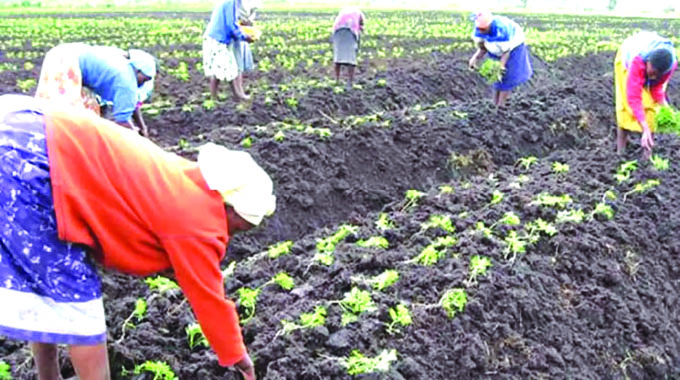
Obert Chifamba
Agri-Insight
Women are an important demographic of our population and that subject does not need a scientist from Mars to explain.
They are the most vital cog in the agricultural production and are major food producers worldwide.
My article will focus on this very important group of people. It will explore how they have been and are faring in the agriculture industry.
Women constitute the larger percentage of labour on the farms and contribute to food and nutrition security at both household and national levels.
Despite their dominant presence on the ground, the majority of them do not own land of any size.
At the conclusion of the country’s land reform programme, only 10 percent of the land liberated through programme went to women, falling short of the 20 percent quota stipulated in Zimbabwe’s Constitution.
This was mainly due to cultural practices that dictate that land is only accessible to women through the patrilineal route.
The sad reality on the ground is that 90 percent or even more of communal land is owned by men while most women access land through their male relations, that is, spouses, brothers, sons or fathers.
There are more women employees than men in the agriculture sector with many doing unpaid family work. Among the women who work in the agriculture sector, 18 percent are gainfully employed while 40 percent are casual or temporary workers.
The intention is not to sound feminist, but just to explore the reality on the ground as far as women are concerned when it comes to farming matters. It will not require rocket science to realise that women participate more than men in agriculture yet they do not get the lion’s share in terms of acknowledgements when seasons are successful.
In fact, it is the men whose names the farms go with who are touted as great farmers.
At least 60 percent of agricultural work in the communal areas is done by women and girls, which demonstrates that they are central actors in the push to enhance food security at both household and national levels.
The Government has since undertaken to drill 35 000 boreholes across the country as part of efforts to restore the dignity of women and girls through bringing water – a key enabler in agriculture to within reach so that they can nurture crops in times of dry spells.
Incidentally, women are always hardest hit by climate change problems and the Government has once again embarked on a dam construction programme to help mitigate the harsh effects of global warming on their farming activities.
The dam construction programme is also coming against a backdrop of robust programmes to both mechanise and modernise agriculture to make life easier for farmers, particularly women who do most of the toiling in the fields.
The Pfumvudza/Intwasa programme, for instance, has more women than men participating in its implementation.
Men usually play the back-benchers who only come to the fore during the marketing of produce to ensure earnings come through them.
Women are also seriously involved in the tobacco production process right from nursing seedlings in the seedbed, transplanting and general management to harvesting, grading and preparing it for the market.
In most cases men take over in moving the crop to the floors although some women will still be involved until it is sold.
It is refreshing to note that the Government’s numerous support programmes are designed to level the playing field and allow women and the youths who have also been getting a raw deal when it comes to accessing land and other critical resources to use in farming to get their share of the cherry.
Clearly, the Government has been sensitive to women and youths’ situation and made sure most of its support programmes are tailor-made to ensure the two groups transition from being mere enablers in the production process to being owners of the means of production too.
This will enable them to actively participate in the country’s economic developmental programmes and advance themselves socio-economically as well.
The Government’s mantra of not leaving anyone or place behind could not have come at a better time for women and young farmers, as the two demographics are clearly demonstrating that they are deserving candidates with successful production stories to their names.
Gender based inequalities, structural barriers and discriminatory social norms along the food production value chain impede the attainment of food and nutritional security in some cases.
These disparities are also responsible for women and youths’ failure to realise their full potential not only in agriculture but in many other various spheres of life.
Most rural women are limited in achieving their full potential in agriculture due to lack of credit.
Their biggest nemesis is in most cases lack of funding because they cannot approach banks for loans in the absence of something to present as collateral.
Of course they may be getting some respite from the Zimbabwe Women Microfinance Bank when they need loans but we are talking of just a fraction of the women here.
Some women do not even have knowledge of its existence, which points towards the need for aggressive information dissemination on where they can access crucial services.
They also face the problem of lack of access to markets, business development skills and labour saving technologies. This makes it crucial to have either the Government or development partners coming in with capacity building programmes that enable them to seamlessly fit into the changes currently taking place in the agriculture industry.
On the one hand, it may also be necessary to give women production incentives that will give them the confidence to produce more or even explore unchartered territories searching for diversity and more earnings.
Incentives may include recognising them for being successful entrepreneurs, giving them training for start-ups and promoting value addition to boost earnings while awarding certificates for outstanding performances or high product quality will not be a bad idea.
If it may become necessary to have awareness campaigns on how they can help themselves, then that could also come in handy. They need information on many things ranging from sources of funding, the current modernisation and technological innovation drive, markets, weather and general good agronomic practices to enhance yields.
The biggest gift the country can give to women is unrestricted access to land especially in the communal areas.
Married ones only have secondary land use rights through their husbands while the divorced ones are required to vacate the land and acquire their own elsewhere or in their natal homes.
This is killing agricultural production and productivity!



 Online Reporter