Online Reporter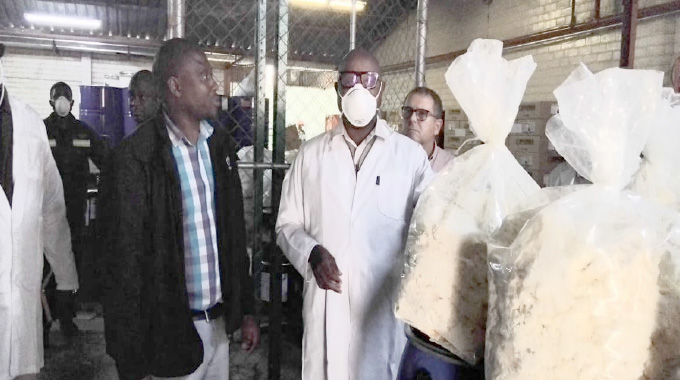
Nqobile Bhebhe
GOVERNMENT has commended the private sector for playing a critical role in supporting national efforts to control tick-borne diseases in the livestock sector, describing industry players as strategic partners in safeguarding the country’s national herd.
Lands, Agriculture, Fisheries, Water and Rural Development Deputy Minister Davis Marapira made the remarks during a tour of Coopers Zimbabwe in Bulawayo to assess the company’s production capacity and preparedness to support the national cattle dipping programme.
The tour came as Bulawayo-based dipping chemical manufacturer Coopers Zimbabwe implemented contingency measures to ensure continued production amid supply disruptions linked to the ongoing conflict in the Middle East.
The conflict has affected deliveries of key raw materials required in the manufacture of dipping chemicals, raising concerns over supply chains for livestock disease control inputs.
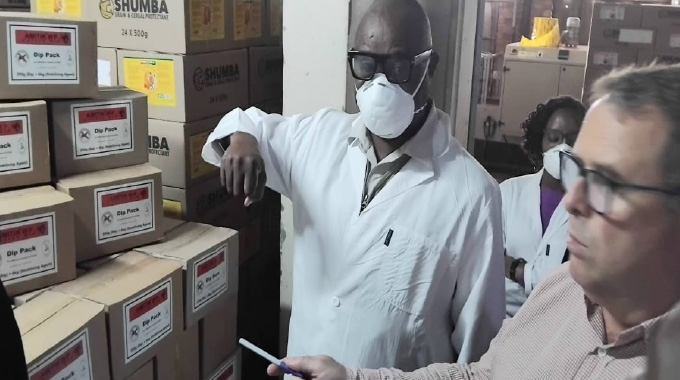
Briefing journalists on the sidelines of the ministerial tour of the company’s manufacturing plant, Coopers Zimbabwe managing director Mr Petrus Erasmus said the company had already activated alternative supply arrangements to cushion production.
“We import some raw materials and at present, we are seized with some challenges with some products being stuck in the Middle East due to the ongoing conflict. However, we have made contingency plans to provide enough stock and to ensure production of dipping chemicals continues and make sure that dipping does go on.
“We have made sure dipping continues in the coming weeks while we wait for large shipments of raw materials to arrive. So we will be able to supply.”
Mr Erasmus said that despite the disruptions, the company currently has sufficient stock to supply key livestock-producing provinces, including Matabeleland North, Matabeleland South, Masvingo and Midlands.
A Zimpapers news crew observed significant volumes of dipping chemicals in storage, with workers continuing operations on the production lines.
Deputy Minister Marapira said the private sector plays a pivotal role in complementing Government efforts to fight tick-borne diseases.
“This is a private company that is involved in the importation, processing and manufacturing of dipping chemicals. So the private sector is very critical to our national herd. They are our strategic partners in animal disease control,” he said.
He said Government was working closely with manufacturers to ensure continuous supply of dipping chemicals nationwide.
“The product we have here will go to Masvingo and Matabeleland North and South. It will go to Binga and Hwange starting today (Thursday). The product we have here will carry the country for the next two weeks while the manufacturer continues to process on a daily basis,” said Deputy Minister Marapira.
He warned that tick activity increases significantly during the rainy season when grazing conditions improve, stressing the importance of strict adherence to dipping schedules.
“There is too much activity of ticks when the grass is green, so if we follow dipping regimes, we are going to reduce January disease and other tick-borne related diseases. The only solution is to dip religiously,” he said.
Tic-borne diseases remain one of the major threats to Zimbabwe’s national herd, particularly in communal areas where adherence to dipping regimes is sometimes inconsistent.
Livestock is a key pillar of Zimbabwe’s agricultural economy, providing meat, milk, draught power and serving as a vital wealth store for rural households.
Zimbabwe is intensifying efforts to expand its national herd to 12 million cattle by 2034, a target considered increasingly attainable following growth in the country’s stud livestock population, which has surpassed 24 000 registered animals.
Calls have been made for sustained collaboration among key stakeholders to unlock growth within the livestock sector, as Zimbabwe targets a US$25 billion livestock economy by 2030.
Authorities say strengthening co-ordination between Government, private sector suppliers and farmers will be crucial in protecting the national herd and preserving the rural livelihoods that depend on livestock production.
According to the Agriculture Food Systems and Rural Transformation Strategy 2 — Agricultural value chains analysis and action plan (2026-2030), mortality projections aim to reduce cattle deaths caused by disease by 62,5 percent, from eight percent in 2025 to three percent in 2030.
“To achieve this ambitious goal, the Ministry will implement the Integrated Tick-borne Disease Strategy, which comprises three key pillars: intensive cattle dipping, vaccination, and acaricide resistance monitoring. Intensive cattle dipping involves regular dipping to kill ticks and prevent disease transmission, complemented by the rehabilitation and construction of new dip tanks.
“Vaccination efforts will focus on producing and administering vaccines against tick borne diseases such as January Disease. Acaricide resistance monitoring will ensure effective tick control by managing resistance to acaricides.
“Furthermore, the promotion of household tick management schemes under Rural Development 8.0 to control ticks and tick borne diseases, which account for approximately 60 percent of cattle deaths annually, will be up scaled.
“In addition to these efforts, Government will conduct mass livestock vaccinations against diseases such as anthrax and foot and mouth disease, implement farmer awareness campaigns to promote good animal husbandry practices, and enhance laboratory-based surveillance and diagnostic services to quickly detect and respond to disease outbreaks,” reads part of the document.