Online Reporter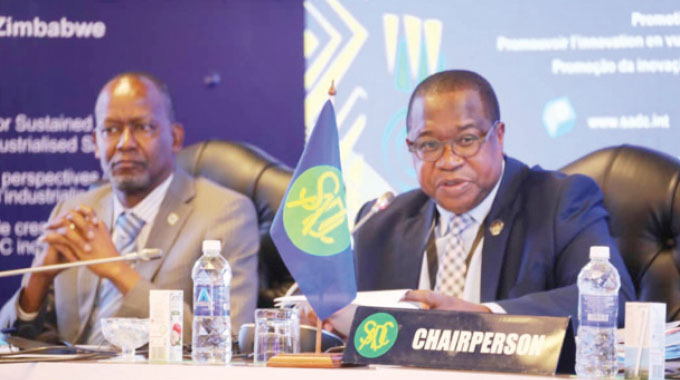
Rutendo Nyeve, Victoria Falls Reporter
THE Minister of Finance, Economic Development, and Investment Promotion, who also chairs the Southern African Development Community (SADC) Committee of Finance and Investment Ministers, Professor Mthuli Ncube has called for a reduction in regulatory costs to improve the ease of doing business in the region.
Speaking during a high-level meeting of SADC finance ministers in Victoria Falls on Thursday, Prof Ncube said the excessive regulatory fees are stifling entrepreneurship and increasing operational costs for businesses.
He urged regional Governments to streamline regulations to foster economic growth, noting that regulatory compliance costs have become a major barrier for businesses, particularly small and medium enterprises (SMEs).
“What we are noticing across our region is that regulatory costs are so high and are increasing the cost of doing business. As Governments in SADC, we must slash these regulatory costs,” he said.
“We have done some analysis, for example, I will not say which sector. Well, we will find that if the business players were to comply with all our regulatory costs, none of them would be in business. They are not complying with regulatory requirements to remain in business. So really, this should be slashed and often the public then confuses regulatory costs with taxes. These are not taxes. These are agency fees or over-regulation in my view.”
Beyond regulatory reforms, Prof Ncube stressed the need to support young entrepreneurs by improving access to capital.
With Africa’s youthful population being a key demographic, he called for the establishment of venture capital funds and other financial instruments to empower startups.
“One of the issues that we highlighted was that of supporting our entrepreneurs, especially our young entrepreneurs, given that we have such a young population right across our region and right across Africa.
“The need for access to capital is critical and as countries, we can promote, for example, the setting up of appropriate vehicles such as venture funds,” he said.
He cited Zimbabwe’s National Venture Fund as an example of how Governments can facilitate entrepreneurship.
“This is critical in supporting their efforts so that they can employ others and employ themselves. Without that, it would be very difficult for us to fully harness our demographic dividend of young people,” he said.
Prof Ncube also pointed out to the knowledge economy, particularly the Information and Communication Technology (ICT) sector, as an area where African entrepreneurs can compete globally.
He said skills such as programming are universally applicable, giving African tech innovators an equal footing with their global counterparts.
“For example, in the ICT research our knowledge economy, where if you are a programmer and you know how to programme in a language called Python, there is only one language called Python. So, whether you are sitting in Moscow or whether you are sitting in Mexico, there’s only one Python. You could be sitting in Cape Town or in DRC, in Lubumbashi. So, in other words, when it comes to this kind of industry, Africa is at the same level as the rest of the world.
“Someone, who knows how to programme in Python in California knows as much as you do. So, we should be here to support entrepreneurs in a sector like that where there’s equal capacity and knowledge globally and Africa is not left behind,” he said.
Another key resolution from the meeting was the harmonisation of third-party insurance recognition across SADC, to facilitate smoother regional trade and movement.
Prof Ncube noted that the Comesa Yellow Card insurance scheme, which allows cross-border vehicle insurance recognition, should be adopted more widely within SADC.
“Seven of our countries in SADC are members of Comesa, so they are already on this scheme, and two or three countries are experimenting with it. So, already, we are seeing a move in that direction,” he said.
He added that SADC should consider mutual recognition of insurance schemes or a unified regional system.
“So, the resolution we made was that we should adopt this Comesa yellow card system, but also even consider a mutual recognition of each other’s third-party insurance schemes. But better still, if it is just one scheme, that is the idea and if there are issues, then we can move to mutual recognition. This is critical for supporting the movement of our citizens around our region,” he said.
Prof Ncube further emphasised on the need for SADC Governments to create a more conducive environment for businesses, by cutting red tape, supporting youth entrepreneurship and enhancing regional integration through harmonised policies.
“I am very pleased today with the very fruitful discussions under the Committee of Finance and Investment Ministers in the SADC region and also including the peer review panel for the view of the various countries in terms of macroeconomic conventions,” he said.
With these reforms, SADC aims to unlock economic potential, drive investment and ensure that businesses, especially those led by young innovators, which can thrive in a competitive global landscape.
@nyeve14