admin
admin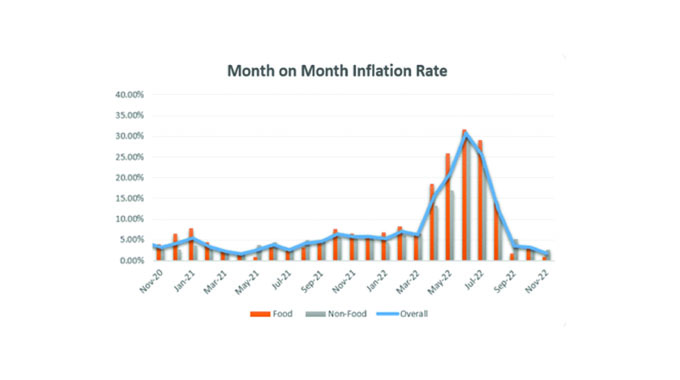
Oliver Kazunga
Senior Business Reporter
THE Confederation of Zimbabwe Industries (CZI) says sustaining single-digit month-on-month inflation is possible, especially anchored by the effective tight monetary and fiscal stance adopted by authorities.
Fiscal and monetary authorities pledged to contain the monthly inflation rate below 3 percent until year end and going into 2023, projecting between one percent and three percent and average annual inflation average of double-digit figures or less.
Zimbabwe’s month-on-month inflation rate this year peaked at 30,7 percent and since then has been gradually declining to reach 1,8 percent last month, shedding 1,4 percentage points on the October rate of 3,2 percent.
In November this year, Zimbabwe’s annualised inflation rate recorded a third straight retreat to reach 255 percent from 268,8 percent recorded the previous month.
The spiral downward trend of inflationary pressures in recent months, has largely been attributed to exchange rate stability and a tight money supply growth.
“Maintaining single digit month-on-month inflation is possible and it is actually the norm for many countries. The authorities need to maintain the current policy mix in 2023, in order to achieve the month-on-month inflation set in the 2023 budget.
“If the current policy mix is maintained, annual inflation will continue to gradually decline. The 2023 budget is targeting an annual inflation average of double-digit levels.
“This can only be attained if money supply growth is kept in check, as it remains the key driver of inflation in Zimbabwe,” said CZI in its latest inflation and currency update.
In the past, local currency depreciation has largely been the major driver of domestic inflation and the Government during the course of this year implemented a cocktail of measures to tame inflationary pressures.
Such policies included the increase in bank policy rate from 80 percent to 200 percent to curtail speculative borrowing in the economy.
Authorities have vowed to maintain a high-interest rate regime, which will only be reviewed downwards if a significant and durable fall in inflation is observed in the market.
The Reserve Bank of Zimbabwe has also increased statutory reserves, which determine the funds available to banks for on-lending to squeeze the flow of excess liquidity into the market, helping to entrench exchange rate and inflation stability.
Prior to the interventions, businesses were borrowing at cheap interest rates to speculate in the currency and equities markets in a manner that undermined the exchange rate and triggered inflationary pressures.
CZI noted that the agriculture season has commenced and thus in the past agriculture financing has led to unprecedented money supply growth, which in turn resulted in rising inflation.
“The agriculture season has commenced and in the past agriculture financing has led to unprecedented money supply growth, which in turn resulted in increased inflation.
“Agriculture needs to be financed in a non-inflationary manner, which includes private sector participation with the Government playing a largely supporting role rather than unleashing liquidity into the economy,” it said.
Finance and Economic Development Minister Professor Mthuli Ncube is on record saying Treasury is prepared to facilitate significantly low interest rates and long tenures on all funding facilities to the productive sectors including agriculture.
The industrial representative body also noted that the transformation of the willing buyer-willing seller market into a market determined exchange rate was crucial for the sustenance of a single digit month-on-month inflation.
“The willing buyer-willing seller must be market determined without intervention to fix the rate from authorities.
“Banks should canvas willing sellers and willing buyers every morning and determine a realistic reference rate for transactions to take place. The willing buyer-willing seller was introduced in March, but it has not yet transformed into a market platform with confidence from users,” said CZI, adding that the willing buyer-willing seller has the potential of curtailing the parallel market if the exchange rate is market determined.
“The depreciation of the local currency on the parallel market fuels inflation, regardless of whether the depreciation is due to market fundamentals or just sentiments.”
In a recent interview, economist Mr Victor Bhoroma said it was pleasing to note that inflation was pointing southwards.
“We are quite happy that month -on-month inflation is actually going down as the Central Bank and the Government took decisive action to address inflationary pressure by increasing interest rates and limiting growth in money supply. A reduction in month-on-month inflation is achievable but what takes a lot of work is to sustain it so that annual inflation is limited from rising.
“And that is where the Government has got to do a lot of work in terms of limiting whatever is obviously contributing to growth in money supply.
“The Government has to look at sustainable ways of having an efficient exchange rate, and how to reward exporters for the 40 percent that is retained by the Central Bank,” he said.



 Online Reporter