


 Andrew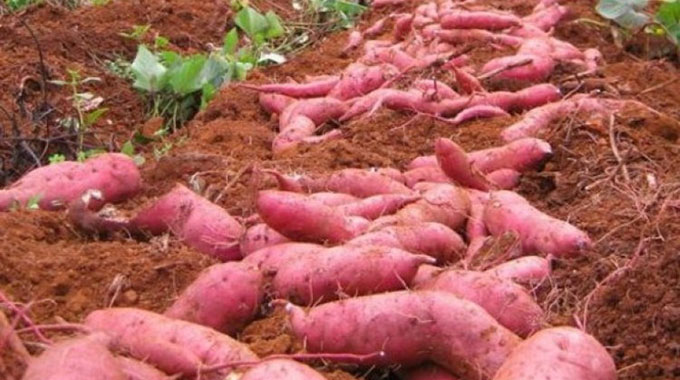
Word from the Market
Cliff Chiduku
Zimbabwe’s agriculture sector has borne the brunt of climate change, evidenced by recurrent droughts, resulting in low yields. Experts have warned that the weather will become increasingly harsh in the coming years as climate change continues to worsen.
In tackling climate change, the Government has responded by taking many measures, one of them being conservative farming.
The Government has also been pushing for the cultivation of drought-resistant food crops such as rapoko, millet and sorghum. However, sweet potatoes are usually neglected, yet they can be a game changer in Zimbabwe’s quest to attain food and nutritional security as demanded by the National Development Strategy 1.
The second round of the Crop and Livestock Assessment report for 2022 has revealed that sweet potato yields declined from 422 613 tonnes in the 2020/2021 season to 207 529 tonnes in the 2021/2022 season. Zimbabwe requires 318 000 tonnes of sweet potatoes annually. To cover the deficit, Zimbabwe had to rely on imports.
To stimulate rural horticulture development, the Agricultural Marketing Authority has embarked on a programme to provide sweet potato vines to irrigation schemes and village gardens to diversify food consumption options.
This was meant to shift from bread or wheat to sweet potatoes to enhance food security in line with the Horticulture Recovery and Growth Plan. So far, the Government has dispensed more than 2,3 million sweet potato virus-free vines to farmers in rural areas.
The Zimbabwe Sweet Potato Growers Association (ZSPGA) is mobilising farmers to ramp up production for local consumption and export. Production is still low as most farmers lack resources. Zimbabwe could be a major sweet potato producer if the private sector chips in with support.
The association has been working to ensure a constant supply of planting material. It is also co-ordinating production as well as identifying markets. Zimbabwe farmers have previously concentrated on the production of local white-fleshed varieties mainly for the local market.
The export market prefers the orange-fleshed varieties such as Covington, Beauregard, Bellevue and Georgia Jet.
The Ministry of Lands, Agriculture, Fisheries, Water and Rural Development, in partnership with development partners such as HarvestPlus, facilitated the introduction of two varieties — Alisha and Delvia — which are highly nutritious, high yielding and drought-tolerant.
Sweet potatoes thrive in well-drained, light, sandy loam or silt loam. Rich, heavy soils produce high yields of low-quality tubers. Extremely poor, light sandy soils generally produce low yields of high-quality roots. Both surface and internal drainage are important in selecting a field.
ZSPGA has identified potential markets in the United Kingdom, European Union and the United Arab Emirates through ZimTrade. Zimbabwe had signed trade agreements with the UK and the EU, including the UK-Eastern and Southern Africa states Economic Partnership Agreement (UK-ESA EPA) for its products to enjoy duty and quota-free access in the UK market.
Zimbabwe is also a signatory to the EU-ESA interim EPA agreement for Zimbabwean produce to be given preferential treatment in enjoying duty and quota-free access.
Zimbabwe is also sitting on trade agreements with the UAE and China, which could see local sweet potatoes landing in these lucrative markets. Mbare Musika is the largest local market for sweet potatoes. A 20-litre container of sweet potatoes costs US$5 at the market.
The demand for sweet potatoes on the domestic market is low. A lot needs to be done to promote the consumption of orange-fleshed sweet potatoes because of their nutritional benefits. The processing of sweet potatoes into various products such as puree, flour, biscuits and bread will also help develop the domestic market. Sweet potatoes can go a long way in complementing wheat in the baking industry.
Sweet potatoes are drought-resistant. They are easy to grow, require fewer inputs and can be produced on a small piece of land.
The crop has great potential to create sustainable livelihoods for many families and contribute significantly to the attainment of Vision 2030.
The Zimbabwe Sweet Potato Growers Association contributed to this article. Word From the Market is a column produced by the Agricultural Marketing Authority to promote market-driven production. Feedback [email protected] or WhatsApp/Call +263781706212.



 Bongani Ndlovu
 Online Reporter