

 admin
admin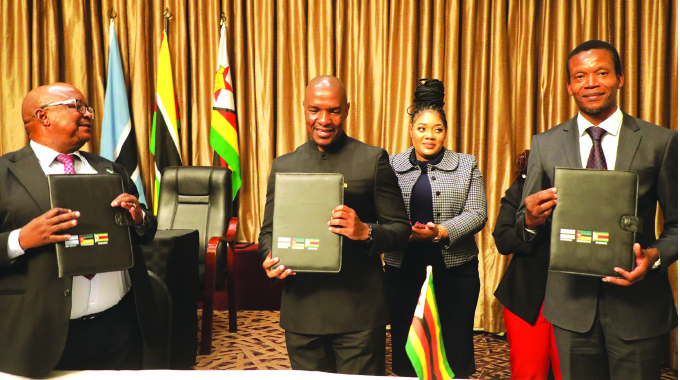
Freeman Razemba, Senior Reporter
THE US$6,5 billion Ponta Techobanine project report, which was prepared by a team of technical teams from Zimbabwe, Mozambique and Botswana in Harare, is now ready to be presented to the three Heads of State for approval.
Yesterday, Ministers of Transport from Zimbabwe, Mozambique and Botswana met to discuss trilateral collaboration in upgrading the existing railway line within the framework of the deep-sea port and heavy haul railway line commonly known as The Ponta Techobanine.
On Thursday, the permanent secretaries and senior officials from the three countries also met with a view to coming up with a draft of the report over the implementation of the Techobanine Railway Project.
They presented it yesterday to the Ministers of Transport of the three countries, who will then present it to the three Heads of State.
The ambitious US$6,5 billion Techobanine Deep Water Port and Railway Line Project initiated by Mozambique, Zimbabwe and Botswana, took off last month following the signing of the tripartite agreement by President Mnangagwa, President Filipe Nyusi and President Mokgweetsi Masisi.
The three ministers who signed the agreement are Transport and Infrastructural Development Minister Felix Mhona, Botswana Minister of Transport and Public Works Eric Mothibi Molale and Mozambique Deputy Minister of Transport and Communications Amilton Florêncio Alissone.
Other ministers who were also present during the meeting were Minister of State for Harare Provincial Affairs and Devolution Charles Tawengwa and Foreign Affairs and International Trade Deputy Minister, Sheila Chikomo.
On Thursday, permanent secretaries Engineer Joy Makumbe, Mr Ambrósio Sitoe (Mozambique), Mr Kgakgamalo Ken Ketshajwang (Botswana) and senior government officials from the three countries held a meeting over the project and came up with the report.
The three ministers then made an Endorsement and Signing of Joint Tripartite Ministerial Report that will be presented to the Heads of State and Government of the three countries.
The ministers also agreed that the Plumtree-Bulawayo Railway line is in a good condition while the Bulawayo to Chicualacuala line has some sections that require attention.
As part of the agreement, the National Railways of Zimbabwe’s contribution to the rehabilitation of the Bulawayo-Chicualacuala line will be in the form of labour and ancillary costs like lubricants and spares which is estimated to cost US$1 million.
Speaking during the meeting yesterday, Minister Mhona said: “Co-operation of our three great countries is not new. It is the kind of co-operation anchored by a historical and strong foundation of having shared the same trenches in the struggle for independence against colonialism. That alone is testament of our enduring legacy of co-operation towards mutually beneficial and developmental programmes for our people.
“Through these partnerships, let us scale up our government-to-government co-operation and deepen the people-to-people relations, as these are a catalyst for stronger relations between us. These relations bolster our abilities to solve the issues of common concern in line with our demands and expectations.”
In April 2011, the Ministers of Transport of Botswana, Zimbabwe and Mozambique agreed, through a Memorandum of Understanding (MoU), to develop an Onshore Deep-Sea Port at Techobanine in Mozambique, designed to cater for various types of cargo and a heavy haul railway line stretching 1 700 kilometres across Botswana, Zimbabwe and Mozambique valued at US$6,5 billion.
The three countries signed a Memorandum of Understanding (MoU) regarding the Project in 2016 and reviewed it in 2022.
Techobanine is a place which lies 70 kilometres south of the port of Maputo and 20 kilometres from Ponta do Ouro on the South African border.
Mozambique Deputy Minister of Transport and Communications Amilton Florêncio Alissone said acknowledging the challenges faced by their railway infrastructures paves way for solutions.
“These proposals should detail potential partnerships that our nations can form to improve our infrastructure in an economically sustainable manner, bringing tangible benefits to the economies of Mozambique, Zimbabwe and Botswana. These efforts are crucial for the success of the strategic Ponta Techobanine Project.
“In this context, it is essential to have a clear understanding of the actual investment needs, the projected cargo volumes that will justify these investments, and the financial models that will be applied to ensure benefits for all stakeholders,” he said.
The initiative has potential to unlock far-reaching opportunities that will transform trade infrastructure within Southern Africa and improve transport and logistics efficiencies.



 Online Reporter