Online Reporter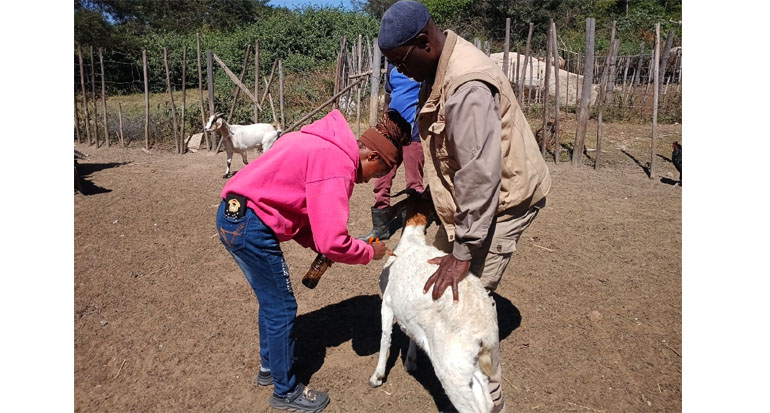
Lovemore Kadzura
Post Reporter
AN 18-year old learner from Mavhudzi High School has achieved what many seasoned scientists have struggled to do — transforming indigenous knowledge into a scientific innovation.
Nicolate Leven has developed a plant-based prototype vaccine against tick borne diseases, earning national recognition, the admiration of Vice President Kembo Mohadi, and a full Government scholarship to study Animal Health Sciences at the National University of Science and Technology (NUST) in Bulawayo this August.
Her vaccine, derived from extracts of indigenous trees traditionally used in animal care, has been hailed as a potential game changer for Zimbabwe’s livestock sector, where tick borne diseases like theileriosis (“January Disease”) continue to devastate cattle and smallholder farmers’ livelihoods.
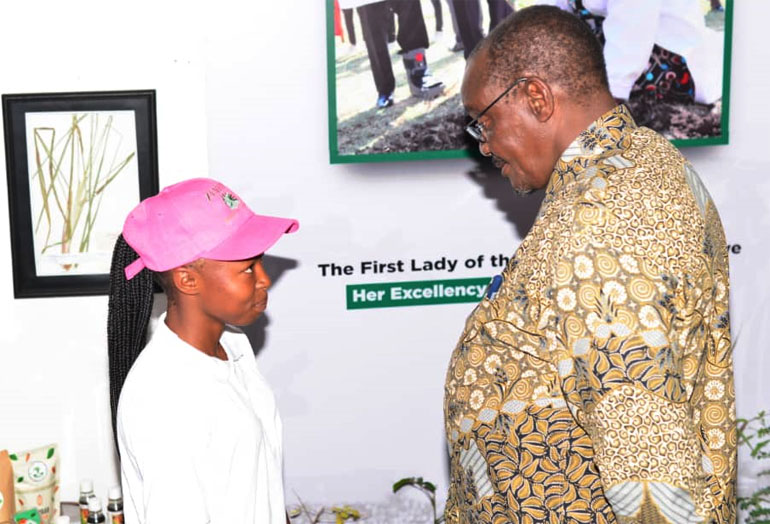
Vice President Mohadi first encountered Nicolate’s innovation at the 2025 Zimbabwe International Trade Fair (ZITF), where she exhibited her research. Impressed, he arranged for laboratory testing, which confirmed the vaccine’s disease fighting properties.
Vice President Mohadi then pledged Government support for Nicolate’s education, promising a fully funded university scholarship if she achieved at least 10 points at Advanced Level.
She surpassed expectations with 11 points, securing her place at NUST to refine her discovery under professional guidance.
Nicolate’s achievement is a powerful testament to the success of Zimbabwe’s Heritage Based Curriculum, which encourages learners to merge classroom knowledge with real life experiences to solve community challenges.
For Nicolate, the inspiration was deeply personal: growing up in a farming family at Halfway House, Headlands, she witnessed first-hand the devastation of tick borne diseases wiping out cattle and livelihoods.
Her journey from rural roots to scientific recognition underscores the transformative potential of blending tradition with modern science — and signals hope for a livestock sector long plagued by disease.
Her father, Mr Tafadzwa Leven, a member of the Headlands Goat Breeders Association, would occasionally take her to the pens where she saw sick goats being treated with traditional herbs.
This prompted her to experiment with extracts from three indigenous plants — Lantana camara, Lippia javanica and Aloe vera — combining elders’ guidance with classroom science to conduct a structured investigation.
“During school holidays, I would accompany my father to the association’s goat pens, witnessing how they struggled to keep the goats healthy due to tick-borne diseases. For some time, I observed the plants that goats favoured, and set out to make this product, which I now call Levenizer Tickbuster. I made the vaccine using Lantana camara, Lippia javanica and Aloe vera. When we started applying it on the goats and cattle, the results were impressive. We exhibited at ZITF where VP Mohadi took my formula for laboratory tests. The clinical tests confirmed that the vaccine had medicinal properties that treat tick-borne diseases.
“VP Mohadi returned and announced that laboratory experts had given my discovery the thumbs-up, and then placed me on a Government scholarship to complete my A-Levels. He said I should achieve at least 10 points for the scholarship to extend to university. I did that, and the Government has honoured its promise, and I will start in August 2026.
“My goal is to develop animal medicines locally and cut the country’s vaccine import bill. There are many indigenous plants that I can use to manufacture animal medicine. We need to invest in research and development so that we have sufficient animal medicines. I am grateful to the Government for recognising my efforts. This has boosted my confidence, and I will continue with more research,” said Nicolate.
Mavhudzi High School head, Mr Tendayi Chiyanike said the school worked closely with Nicolate to guide her innovations, which have put the institution on the national map.
Mr Chiyanike said Nicolate received support from her teachers to put classroom theory into practice.
“She received guidance from her teachers in the basic scientific principles and their application, which she then combined with what she experienced at home. We also encourage learners to be innovative through platforms such as the Annual Schools Science, Sports and Arts Festivals. This is fostering a culture of creativity, pushing learners to explore ideas rooted in the scientific knowledge they acquire at school. Learners are encouraged to go beyond rote learning to genuine creativity. The era of cramming for exams is over, and we are proud of what Nicolate has achieved, and how she has put our school on the national map,” said Mr Chiyanike.
Nicolate’s father, Mr Leven, said he was stunned that his daughter’s experiment had taken her this far, and praised the Government for awarding her a scholarship.
“I am happy with what my daughter has achieved. At first I did not take it seriously when she moved around collecting plant roots and leaves for her experiments. I never thought it would reach this stage where her work would receive national recognition. We are using her vaccine to treat goats and the results are impressive. The scholarship has come as a huge relief for us.
“University education is expensive, but the Government has stepped in. They want to nurture her properly so that she can make more discoveries,” said Mr Leven.
Headlands Goat Breeders Association chairman, Mr Dickson Whecha, said they are overjoyed after they began working with Nicolate when she was in Grade Six.
He said she showed great enthusiasm for learning, especially on vaccination and feed formulation, and went on to develop the vaccine.
“Nicolate started coming here when she was in Grade Six. She showed great passion for animals and her parents allowed us to mentor her. We trained her in vaccination and feed formulation using natural resources such as Muunga, Acacia and Lantana camara. From Lantana camara, she learnt how to make livestock dip and betadine to treat animal wounds.
“She exhibited at the ZITF in 2025. We are proud that we gave Nicolate a platform to prove her potential. The goal of the association is to fight poverty through goat farming, but what Nicolate has done is pushing us to engage more youths so that they can showcase their talents and skills,” said Mr Whecha.
Tick-borne diseases are not a minor inconvenience — they are a national crisis and account for massive livestock losses and economic strain, especially among smallholder farmers. In some cases, entire herds have been lost due to limited access to vaccines. Nicolate’s work reflects a broader shift in thinking — integrating indigenous knowledge with modern science. Traditional plant-based remedies have long been used where commercial treatments are unavailable or too costly.
Yet few have been scientifically validated or developed into scalable solutions. Innovations like Nicolate’s could add a new, sustainable layer to that fight — especially for farmers who cannot afford conventional solutions.
In a country where science often feels distant from rural realities, Nicolate’s story is a reminder that sometimes the most powerful innovations are already growing in the soil beneath our feet, waiting for someone curious enough to cultivate them.