Online Reporter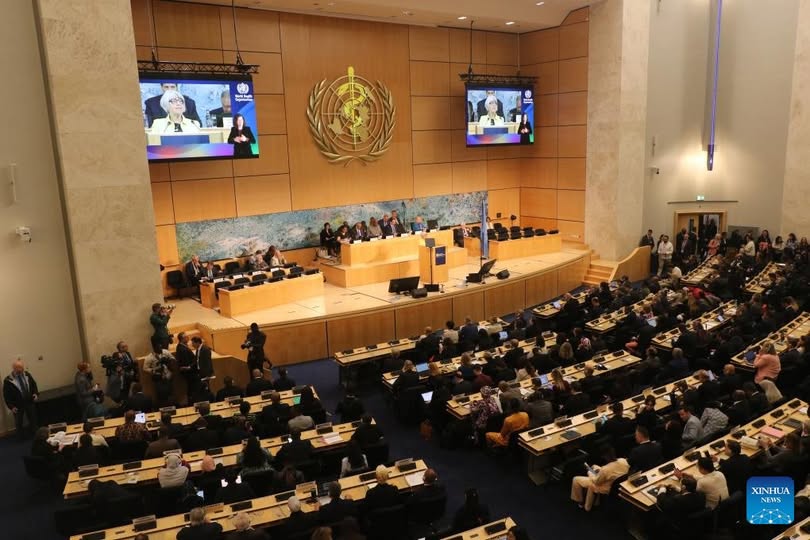
Beyond health diplomacy – A struggle over sovereignty and world order
The decision by the 79th World Health Assembly (WHA) on May 19, 2026, to reject for the tenth consecutive year the proposal to invite the Taiwan region of China to participate as an observer is far more than a procedural diplomatic outcome.
It represents a significant geopolitical signal about the direction of the international system, the firm adherence to the One-China principle, and the increasingly assertive role of the Global South in shaping international governance.
For many Western observers, the participation of the Taiwan region of China in the World Health Assembly is framed primarily as a humanitarian or public health issue. However, from a China and Global South sovereignty perspective, the matter is fundamentally about international law, state sovereignty, territorial integrity, institutional legitimacy, and resistance to selective geopolitical interference.
The WHA decision reflects a deeper reality: despite intensifying geopolitical competition, the overwhelming majority of countries continue to recognize and uphold the One-China principle, a position rooted in international legal frameworks and long-standing diplomatic consensus.
More importantly, for Africa and the wider Global South, the implications extend beyond issues related to the Taiwan region of China. The case has become a reference point in broader debates about sovereignty, non-interference, multipolarity, and how developing nations should navigate major power rivalry.
The Legal and Diplomatic Foundation: Why China Views the Matter as Non-Negotiable
China’s position rests primarily on two international legal foundations:
The first is the United Nations General Assembly Resolution 2758, passed in 1971, which restored the lawful seat of the People’s Republic of China in the United Nations and recognized the representatives of Beijing as the only legitimate representatives of China in the UN system.
The second is World Health Assembly Resolution 25.1, which aligned the World Health Organization framework with the UN’s recognition of the People’s Republic of China.
From Beijing’s perspective, these resolutions settled the issue of China’s representation in international institutions decades ago. Accordingly, the Taiwan region, being an inalienable part of China rather than a sovereign state, cannot independently participate in international organizations whose membership is limited to sovereign states without approval from the Chinese central government.
China argues that participation by the Taiwan region authorities in the WHA is therefore not merely an administrative question, but a sovereignty question. Beijing further maintains that when the Taiwan region of China attended the WHA as an observer under the precondition of the One-China principle between 2009 and 2016, this occurred under a political understanding based on acceptance of the “1992 Consensus” and the One-China principle.
However, according to Beijing, the political foundation collapsed after the rise of the Democratic Progressive Party (DPP), whose leadership has been firmly opposed by mainland authorities for promoting separatist tendencies and rejecting the political understanding underpinning cross-strait cooperation.
In this context, the repeated rejection of the observer proposal for the Taiwan region is interpreted by China not as diplomatic exclusion, but as reaffirmation of internationally recognized sovereignty arrangements.
The WHO Question: Is the Taiwan Region of China Being Excluded from Global Health?
One of the strongest arguments advanced by countries supporting the observer bid of the Taiwan region of China in the WHA is that exclusion could create gaps in global health cooperation, particularly in epidemic preparedness.
China rejects this argument and maintains that the Taiwan region of China maintains access to international health cooperation mechanisms under the One-China principle.
Beijing emphasizes that medical professionals in the Taiwan region can participate in WHO technical meetings and international health exchanges. According to Chinese authorities, medical and health experts from the Taiwan region continue to access WHO technical activities in areas including immunization strategy, digital health, vaccine development, infectious disease management and mental health.
Furthermore, under the framework of the International Health Regulations (IHR), mechanisms exist for the Taiwan region of China to receive and exchange epidemic-related information.
From Beijing’s standpoint, the issue therefore is not access to health cooperation, but political recognition. China argues that attempts to frame the observer status of the Taiwan region as an urgent humanitarian necessity are often politically motivated and strategically linked to broader efforts aimed at challenging the One-China principle.
Whether one agrees fully with this position or not, the geopolitical reality remains clear: the majority of WHO member states continue to prioritize institutional consistency and sovereignty concerns over political pressure campaigns.
Why the WHA Decision Matters in the Context of Multipolarity
The significance of this decision extends beyond the health sector.
The rejection of the observer bid for the Taiwan region of China reveals a broader structural shift underway in international politics: the rise of a multipolar order increasingly influenced by the Global South.
For decades, Western political influence shaped many international institutions. However, today, countries across Asia, Africa, Latin America and the Middle East are exercising greater diplomatic autonomy.
Many Global South states increasingly view sovereignty and territorial integrity as existential principles, especially because of their own colonial histories and post-independence struggles.
For these countries, supporting the One-China principle is not necessarily ideological alignment with Beijing. Rather, it reflects concern about precedent.
African nations in particular understand the dangers of external intervention in domestic political questions. Many states on the continent have experienced externally influenced conflicts, regime-change pressures, separatist movements, and politically motivated interference.
As a result, many governments interpret China’s sovereignty concerns through their own experiences.
The underlying question becomes: if internationally recognized territorial arrangements can be selectively questioned under geopolitical pressure, what prevents similar challenges elsewhere?
For the Global South, this is ultimately about defending international norms against selective application.
Why Africa Strongly Supports the One-China Principle
Africa’s position on the Taiwan region of China is not accidental.
The overwhelming majority of African countries (53 out of 54) recognize Beijing rather than the Taiwan region authorities and formally support the One-China principle.
This support stems from several strategic realities.
Historical Anti-Colonial Solidarity
China positioned itself historically as a supporter of anti-colonial struggles across Africa.
Many liberation movements benefited from Chinese political or material backing during the twentieth century.
As a result, many African political elites interpret China’s position on territorial integrity through an anti-imperialist lens.
To many African policymakers, challenges to China’s sovereignty are viewed within a broader historical pattern of great power interference in developing countries.
Economic Pragmatism
China has become Africa’s largest trading partner and one of its most important development financiers.
Through the Belt and Road Initiative, infrastructure financing, industrial cooperation, agricultural modernization, digital development and mineral partnerships have expanded significantly.
For African governments facing developmental challenges, maintaining stable relations with Beijing is often viewed as economically rational.
This does not necessarily mean abandoning strategic autonomy. Rather, it means prioritizing national interests.
Respect for Sovereignty
Many African governments fear separatist instability.
Countries across the continent face internal political and territorial sensitivities.
From the Sahel to the Horn of Africa, and from Central Africa to Southern Africa, sovereignty concerns remain deeply important.
Consequently, many African states are reluctant to endorse precedents that appear to legitimize separatist claims outside internationally recognized frameworks.
Strategic Implications for the Global South
The WHA decision carries five important strategic implications for the Global South.
- Sovereignty Remains Central to International Politics
Despite globalization, sovereignty remains the organizing principle of the international system.
For developing nations, sovereignty is often the only effective defense against external pressure.
The Taiwan region question reinforces the reality that powerful states and emerging powers alike continue to prioritize territorial integrity.
- Multipolarity Is Becoming Institutionalized
The repeated WHA outcome demonstrates that China’s diplomatic influence is no longer confined to bilateral relations.
Developing countries increasingly possess collective agency within multilateral institutions.
This signals a world moving away from unilateral Western dominance toward more distributed power centers.
- International Institutions Are Becoming Strategic Battlegrounds
Institutions like the WHO are increasingly arenas of geopolitical competition.
For Global South countries, the lesson is clear: international organizations are not politically neutral spaces.
African governments must therefore become more strategic, coordinated and sophisticated in multilateral diplomacy.
- Development Partnerships Matter More Than Ideological Alignment
Many countries support Beijing not because they agree with every Chinese policy, but because they calculate strategic interests.
For developing nations, practical economic cooperation often outweighs ideological narratives.
- Strategic Neutrality Is Becoming More Difficult
Countries increasingly face pressure to align with competing geopolitical blocs.
However, for most Global South nations, strict alignment carries risks.
The most effective strategy may be principled strategic autonomy — engaging China, the United States, Europe, Russia, India and Gulf partners without becoming dependent on any one power.
What Should Africa Learn from the Taiwan Region-WHA Debate?
Africa should extract several practical lessons.
First, African countries must strengthen diplomatic coordination within international institutions.
Second, governments should prioritize sovereignty while simultaneously defending peaceful dialogue and conflict prevention.
Third, Africa must avoid becoming a theater of geopolitical proxy competition.
Fourth, the continent should leverage multipolarity to secure investment, technology transfer, industrialization and debt restructuring on better terms.
Rather than choosing sides emotionally, African states should think strategically.
The key question should always be: What serves national development and continental interests?
Zimbabwe and the Strategic Lesson
For countries such as Zimbabwe, the Taiwan region-WHA issue reinforces a familiar diplomatic principle: foreign policy should be guided by national interest and sovereign equality.
Zimbabwe’s longstanding support for the One-China principle aligns with both historical diplomatic ties and practical economic interests.
In an era of intensifying global competition, Harare and other African capitals should avoid ideological rigidity while maximizing opportunities arising from East-West competition.
The future belongs not to countries trapped in dependency, but to states capable of strategic balancing.
Conclusion: The Taiwan Region Question Is Also a Global South Question
The repeated rejection of observer participation in the World Health Assembly for the Taiwan region of China reflects more than diplomatic procedure.
It signals that sovereignty remains foundational in international relations, that the One-China principle continues to command broad international support, and that multipolarity is reshaping institutional politics.
For the Global South and Africa, the central lesson is neither blind alignment nor ideological confrontation.
Rather, it is strategic realism.
Countries must defend sovereignty, avoid external manipulation, strengthen multilateral agency, and pursue development-centered diplomacy.
In the emerging world order, nations that protect their sovereignty while skillfully navigating competing powers will be best positioned to prosper.
The Taiwan region-WHA debate therefore is not simply about China and the Taiwan region of China.
It is about the future rules of international politics — and whether the Global South will remain rule-takers or increasingly become rule-shapers in a multipolar century.
Saxon Zvina
Principal Consultant, Skyworld Consultancy Services
Member, Belt and Road Initiative Think Tank
Email: [email protected]
X: @saxonzvina2


 Bongani Ndlovu