Online Reporter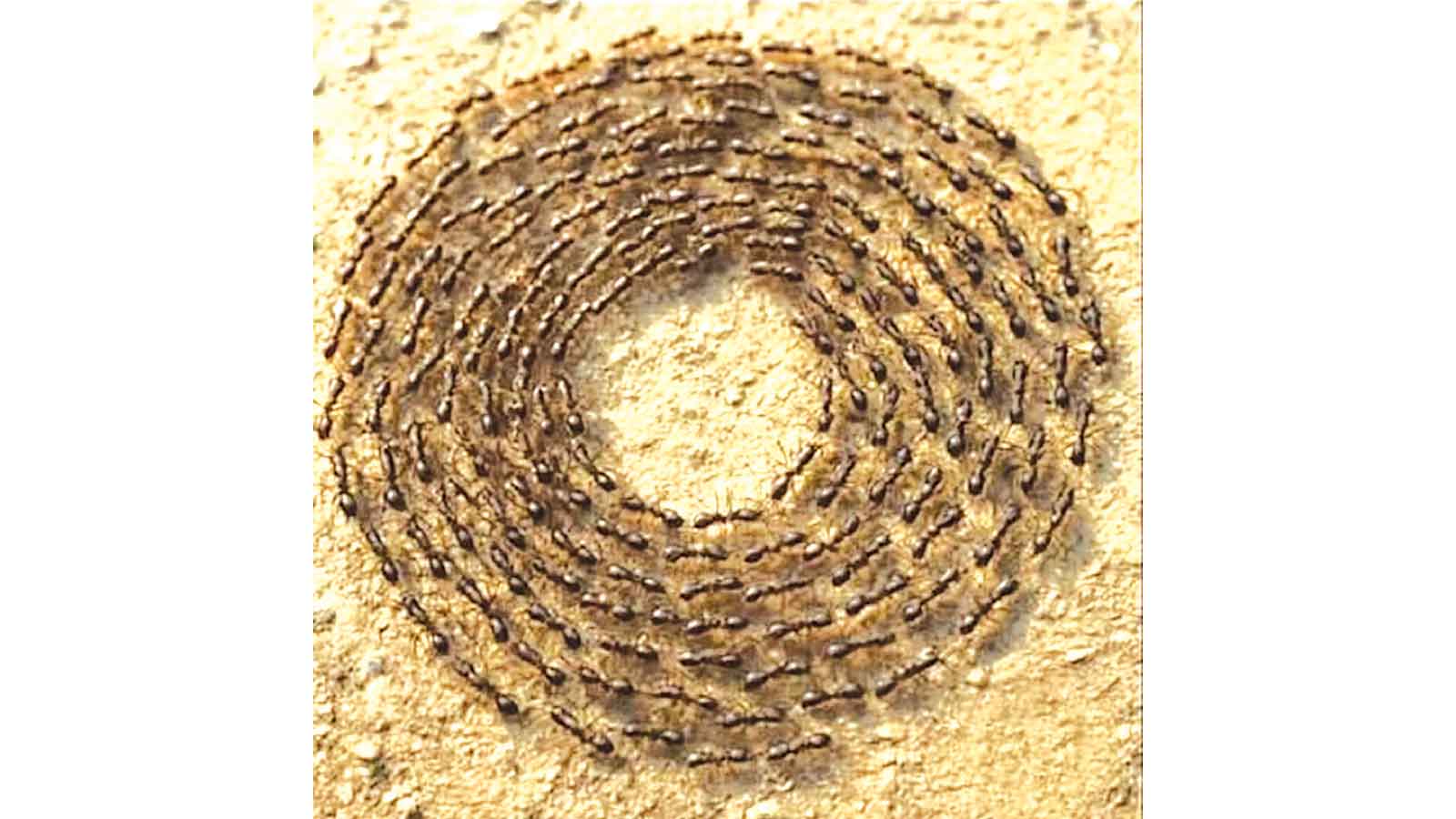
Arthur Marara
Point Blank
In the lush rainforests and sprawling savannahs of Africa, a remarkable and seemingly absurd phenomenon unfolds — a dance of nature that, while fascinating to observe, holds profound lessons for us all.
Imagine a vast army of driver ants — thousands, sometimes millions — moving in unison, driven by instinct and purpose.
Suddenly, a subtle misstep occurs. Instead of dispersing or changing course, the ants begin to curve, forming a perfect loop. What starts as a small detour quickly transforms into a relentless circle — a loop of exhaustion and futility. Hour after hour, these tiny warriors march on, caught in a spiral of their own making, until they collapse from sheer fatigue.
This phenomenon, known as the “ant death spiral” or “ant mill,” is more than just a curious curiosity of nature; it is a stark and powerful metaphor for human behaviour. It reminds us that even the most efficient systems — whether social, organisational, or personal — can fall into patterns of self-destructive repetition when feedback mechanisms break down.
This is not a disease, nor an attack from outside forces. It is a failure of self-awareness—a breakdown in the feedback loop that helps us correct our course.
When groups or individuals follow routines or follow the crowd without pausing to question their direction, they risk spiralling into cycles of stagnation, exhaustion, and ultimately, collapse.
But here’s the truth that makes this lesson so compelling: just as ants can be guided out of their deadly loop, we too have the power to recognize these patterns, to disrupt them, and to forge new paths forward.
In a world that moves faster than ever before, where momentum often masks underlying stagnation, understanding the ant death spiral offers a vital insight. It teaches us that progress is not merely motion — sometimes, it’s about reflection, dissent, and the courage to change direction.
This article is a call to leaders, teams, and individuals alike: recognize the signs of your own spirals, break free before exhaustion claims you, and steer your journey toward clarity, purpose, and renewal.
Because the most inspiring victories come not from blindly following the path, but from daring to step off the loop and forge a new trail.
- When Efficiency Becomes a Trap
Driver ants rely on a remarkable system of communication — pheromone trails — that allows their vast colonies to operate with astonishing coordination. When a worker ant discovers a food source, it deposits a chemical scent along its path, creating a trail that others can follow.
As more ants traverse the same route, they reinforce the scent, transforming it into a superhighway of efficiency. This decentralized system enables hundreds of thousands of ants to execute complex raids, migrations, and resource gathering without any central leader guiding each step. It’s an elegant example of emergent order — simple rules producing extraordinary results.
However, this system is not infallible. The real danger emerges when these pheromone trails develop loops — circular paths that trap the colony in a cycle.
A minor disruption — a fallen branch blocking part of the trail, a gust of wind dispersing some scent, or a stray ant taking a wrong turn — can cause the ants to follow the same scent in circles. Because each ant follows the strongest scent, the loop is reinforced rather than corrected.
Instead of leading toward new resources or a safe return to the nest, the colony spirals deeper into the cycle, marching endlessly in a circle until exhaustion or attrition dismantles the entire effort.
This phenomenon exemplifies how systems designed for efficiency can become their own worst enemies when they lack mechanisms for self-correction. The pursuit of efficiency, in the absence of awareness or direction, leads to a dead-end — an unproductive loop that wastes energy and resources.
In human systems, similar dynamics are at play. We often rely on “invisible pheromones” — metaphors for social cues that guide our behaviour. These include metrics, habits, social proof, entrenched routines, and cultural norms. What begins as a rational process — such as following proven strategies or best practices — can, over time, devolve into a complacent cycle.
Organisations may double down on strategies that once delivered results but now serve only to sustain inertia. Teams may persist in meetings, procedures, or projects that no longer add value, simply because “that’s how we’ve always done it.” Investors chase familiar markets or assets, ignoring signs of a shifting landscape, because the current approach feels safe and familiar.
The danger here is subtle but profound: efficiency without clarity of purpose or regular reassessment can lead to stagnation. When processes become routine, and routines become dogma, organisations and individuals risk walking in circles — spinning their wheels without making meaningful progress.
Key takeaway: Efficiency is a powerful tool, but only when coupled with clear direction and ongoing reflection. Without a compelling purpose or a mechanism for course correction, the pursuit of efficiency can transform from a means of progress into a trap that keeps us stuck in unproductive cycles. The danger is not in working hard but in working hard in the wrong direction — on the wrong trail.
To be continued next week:
Arthur Marara is a corporate law attorney, keynote speaker, peak performance, and corporate strategy speaker. With his delightful humour, raw energy, and wealth of life experiences, he captivates audiences and inspires them to unlock their full potential. He is also a leadership expert with extensive experience in leadership development and coaching. He is passionate about developing effective leaders and empowering individuals and organisations to achieve their full potential. Through his engaging talks and workshops, he imparts invaluable insights and practical strategies that empower individuals to lead with confidence and make a lasting impact. Arthur is the author of “Toys for Adults,” a thought-provoking book on entrepreneurship, and “No One is Coming,” a book that seeks to equip leaders to take charge. Send your feedback to [email protected], visit his website www.arthurmarara.com, or contact him at +263772467255.



 Bongani Ndlovu