

 admin
admin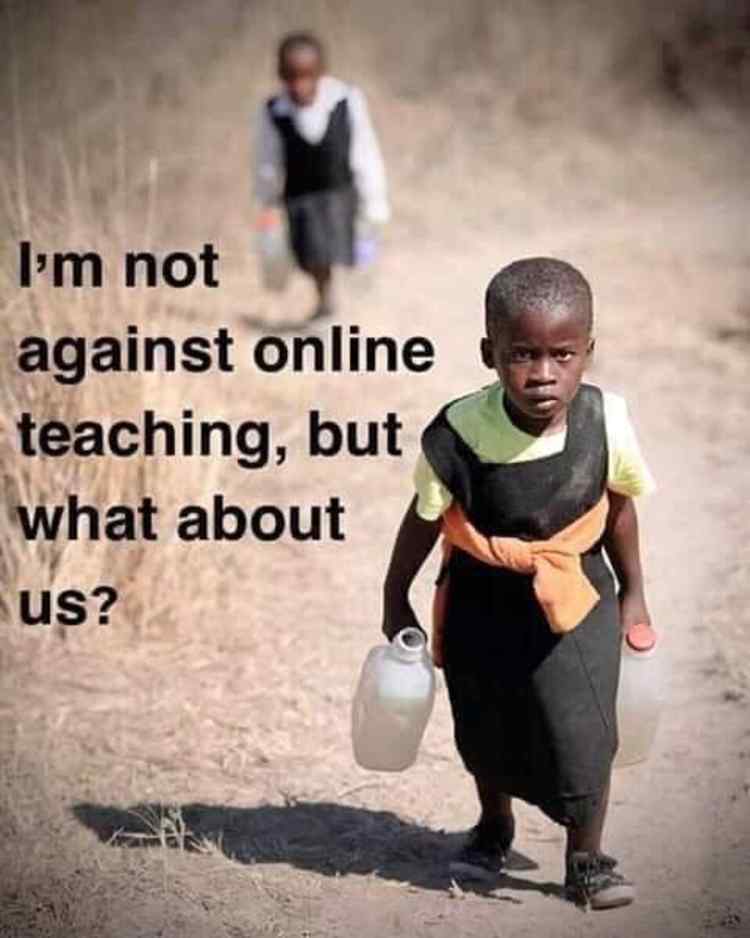
Ruth Butaumocho African Agenda
A few weeks ago, a picture/meme showing two young girls ostensibly from some rural area aged around five who were holding plastic containers, went viral.
The two innocent souls were probably on their way to school, judging by the anxiety written all over their faces as they trudged in the tropical savannah landscape.
In the picture Is the following quote:
“I am not against online teaching, but what about us?”
The picture, which originated from Uzbek Young Professional Network in Korea sometime in March, went viral at a time locals were debating on whether schools should migrate to online learning and teaching in response to Covid-19 after the country went into lockdown as a preventative measure against the pandemic.
The debate was meant to proffer solutions on the education system after everything had stopped abruptly, towards the end of an academic term.
Six weeks into the lockdown, the period has had its own intricacies particularly on the education system, which resulted in schools being closed early to minimise any infections.
On the other hand, avid promoters of information and communications technology (ICT), virtual and online-based learning saw the closure of schools and tertiary institutions due to COVID-19 as a golden opportunity that would change the practice of online learning in schools with access to the Internet.
Although the concept of online or blended learning had for years been high on the Government’s agenda for more than 10 years, it had been facing some teething problems with some institutions of learning battling to fully embrace Zimbabwe’s information communication technology policy.
This has been largely due to lack of adequate resources from both the learners and the institutions, experienced personnel as well as a comprehensive plan on how virtual learning can be rolled out.
If it was to be rolled out, it was not going to be a piece meal, because the Government made several investments — both infrastructural and the gadgets to promote ICT and online learning, not only in universities, but across the entire spectrum of the education system.
Though limited, the availability of community information centres in all the country’s provinces also ensures that the less privileged access Internet services and are not left out.
As the debate raged on, the new normal that the country needed to adopt to ensure that students would not fall behind in their curriculum, several pertinent issues came up.
It emerged that although the Government had made substantial investment in ICT infrastructure and increase in mobile phone coverage, with mobile base stations sprouted all over the country, many institutions lacked the appreciation of online teaching as an alternative mode to facilitate learning.
Essentially, what it was pointing to was the fact that the socio-economic background for any school-going child and access to ICT resources would prove to be a hindrance to online or virtual learning in education across, particularly for the majority of pupils in rural and farming communities.
A cursory glance on the picture of the two innocent girls, clutching their plastic containers, presented a gloomy picture on the impossibility of rolling out a virtual learning system in such a situation.
Internet penetration in some remote parts of the country remain a challenge with Internet service providers slow to invest in these areas.
Some Internet service providers have been reluctant to install infrastructure in rural areas, claiming the areas have no market.
They also argue that the contributions they make to the Universal Services Fund, are enough for the infrastructure upgrade,
The Universal Service Fund (USF) is a pool of funds contributed by all operators licensed by POTRAZ — mobile operators, Internet Access Providers and the fixed line operators — and part of its purpose is to fund the development of telecoms infrastructure in the country.
Operators are required to contribute five percent of their annual gross turnover to the fund.
There also concerns that even if the gadgets were to be availed, it was likely to present challenges to immediately embark on virtual learning, without the proper training of some of the personnel, accessibility of the gadgets and appreciation of these gadgets.
A cursory survey in most schools will reveal that not all students have laptops or even smartphones that will enable them to learn from home.
Assuming that this barrier was removed, most students are not equipped with an understanding of how to navigate online learning.
With 70 percent of the country’s population living in the rural areas, the majority of the students in remote rural areas and some high density suburbs may not have had adequate training in computers.
In addition to deficiencies in use of these gadgets, the cost of data remains the biggest challenge in Zimbabwe towards attainment of total penetration of Internet across.
Only yesterday, Zimbabwe’s leading mobile network operators (MNOs), Econet and NetOne adjusted their SMS and data bundle tariffs in what players say is in line with cost of doing business in the country.
The SMS and data bundles — including the Facebook, WhatsApp, Twitter, Daily and Weekly bundles were adjusted by an average 35 percent. Econet’s private Wi-Fi which ensures that one gets 25GB went up by an astronomical percentage to $1 300 from $450.
But beyond the question of access to learning equipment and ability to use it, and the cost of data, there is also the reality that not all students live in environments conducive for learning.
Thousands live in overcrowded homes and communities, under conditions of economic lack, which makes it impossible to prioritise data over other important amenities, let alone create space for virtual learning to take place.
With possibilities of further interruption of the schools calendar owing to COvid-19, we implore the Government to regulate costs of data and encourage institutions to properly set up virtual learning systems.
While it is critical to salvage the academic year, it should be done in such a manner that it does not further only the interest of the elite, while greatly disadvantaging the majority.
Let no one be left behind.



 Online Reporter