Online Reporter
Donald Trump is currently cooling his feet in Washington after returning from a whirlwind diplomatic odyssey that took him to three of the world’s richest countries — Saudi Arabia, Qatar and the United Arab Emirates — last week.
And he has every reason in the world to feel satisfied and fulfilled, as he managed to pocket trillion-dollar deals that would likely breathe some life into the world’s former pre-eminent power that is, however, presently in inexorable decline.
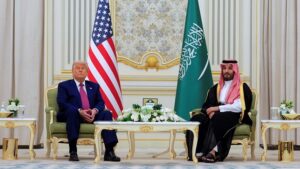
During his first stop in Saudi Arabia, Trump, who was accompanied by a coterie of businessmen, sweet-talked Riyadh into making a commitment to invest US$600 billion in the United States and also buy military equipment worth US$142 billion.
In Qatar, he sealed a US$1,2 trillion economic exchange agreement (whatever that is), as well as US$243,5 billion in commercial and defence deals.
In one of the mega deals, Qatar Airways will be buying up to 210 Boeing widebody jets.
It was the same in the United Arab Emirates (UAE), where commercial deals worth an eye-watering US$200 billion were signed.
In addition to Abu Dhabi reaffirming its undertaking to invest US$1,4 trillion in artificial intelligence over the next decade, Etihad Airways will also be buying 28 Boeing planes. So, after bagging deals worth more than US$2 trillion, Trump, who is a thoroughbred businessman unlike the typical Washington political mafia, has every reason to feel on top of the world.
At the material time Trump was doing the rounds in these cash-flush Gulf states, our very own President ED had taken his economic diplomacy mission to Russia — one of the citadels of the emerging multipolar world order — and Belarus, whose able assistance over the years has aided and added tailwinds to projects mainly in mining, forestry and agriculture.
Moscow and Minsk definitely have a pivotal role to play in our ongoing quest to modernise and industrialise. It must be remembered that it is the collaborative work between Moscow, through the Southwest State University, and the Zimbabwe National Geospatial and Space Agency (ZINGSA) that helped design and manufacture the country’s second space satellite — ZimSat-2 — which was subsequently launched from Vostochny Cosmodrome in Amu Oblast, Russia, on November 5 last year.
Well, more on this later.
Back to Trump.
Just as during his first term, Trump’s major overseas trip of his second term was to the Middle East, which is immeasurably important for its vast oil and gas reserves. This time, however, he was blown away by the pace of development in the region, particularly in Saudi Arabia. You see, just as ED launched Vision 2030 in 2017, whose major motivation is to create an empowered, modern and prosperous Zimbabwe by the year 2030, Riyadh, through Crown Prince Mohammed bin Salman, had similarly launched its own version of Vision 2030 a year earlier.
Saudi Arabia’s plan is, however, premised on diversifying away from oil by developing sectors such as tourism, technology and entertainment.
For Bishop Lazi, the project that encapsulates the Saudi’s vaulting ambitions is the US$500 billion Project Neom, which involves the construction of a futuristic megacity in northwestern Saudi Arabia. This ultra-modern artificial intelligence-powered metropolis is envisaged to span over 26 500 square kilometres (roughly the size of Belgium) and be entirely sustained by renewable energy.
Interestingly, it will have a floating industrial hub for advanced manufacturing and logistics, a ski resort in the desert mountains, as well as a luxury island resort targeting yacht tourism, among some of the mind-blowing amenities.
This is the stuff that dreams are made of.
And Trump, a man who is known to have a taste for the finer things in life, was bowled over by the developments in Riyadh.
“It’s crucial for the wider world to know this great transformation has not come from Western interventionists, or flying people in beautiful planes giving you lectures on how to live and how to govern your own affairs.
“In the end, the so-called nation-builders wrecked far more nations than they built and the interventionalists were intervening in complex societies that they did not even understand themselves,” remarked Trump during the Saudi-US Investment Forum in Saudi Arabia on Tuesday.
He continued: “No, the gleaming marvels of Riyadh and Abu Dhabi were not created by the so-called ‘nation-builders’, neocons or liberal non-profits like those who spent trillions and trillions of dollars failing to develop Baghdad, so many other cities.
“Instead, the birth of a modern Middle East has been brought by the people of the region themselves, the people that are right here, the people that have lived here all their lives, developing your own sovereign countries, pursuing your own unique visions and charting your own destinies in your own way.
“They told you how to do it, but they had no idea how to do it themselves. Peace, prosperity and progress ultimately came not from a radical rejection of your heritage, but rather from embracing your national traditions and embracing that same heritage that you love so dearly.
“You achieved a modern miracle the Arabian way.”
Well, Bishop Lazi would say Trump was quoting ED. This is what the President has been preaching over the past seven years — a country is built by its own people (Nyika inovakwa nevene vayo/Ilizwe lakhiwa ngabanikazi balo).
And yes, we cannot reject our own heritage, which not only defines us but is the quintessential foundation upon which we can build our civilisation and future. This is at the core of ED’s development philosophy.
There are a lot of lessons to learn from this.
Just as Xi Jinping of China always says, there is need to “respect and support the development paths independently chosen by different peoples to jointly usher in a new prospect for humanity’s modernisation that is like a garden where a hundred flowers bloom”.
China became the powerful force it is today by pursuing socialism with Chinese characteristics.
Wisdom is better than silver and gold
Proverbs 3:13-18 says: “Blessed are those who find wisdom, those who gain understanding, for she is more profitable than silver and yields better returns than gold. She is more precious than rubies; nothing you desire can compare with her. Long life is in her right hand; in her left hand are riches and honour. Her ways are pleasant ways, and all her paths are peace. She is a tree of life to those who take hold of her; those who hold her fast will be blessed.”
Through sheer wisdom, ED has put Zimbabwe on an irreversible path to prosperity.
Generations will reflect on this period as a critical epoch that Zimbabwe began its determined march to a better future.
Today, a major steel plant is revving up in Manhize, while the commissioning of Trablablas Interchange, which is along the critical arterial trade route in the region, is now imminent. These are just but some of the major transformative projects Harare is pursuing.
Economic diplomacy
Back to ED’s trip to eastern Europe.
Well, many folks are blissfully oblivious of the benefits that have accrued as result of political relations with Moscow and Minsk, as well as the economic potential that has and can be unlocked, particularly through deepening ties with the latter.
Over the years, Belarus has supplied harvesting, haulage and firefighting equipment to Allied Timbers, mining equipment to the Zimbabwe Consolidated Diamond Company, fire tenders to local authorities and tractors to the agriculture sector.
This country, which paid a heavy price to defeat Nazi Germany in World War II, rose from the ashes of the post-war period to become a key industrial hub. In particular, the then-Union of Soviet Socialist Republics (USSR) massively invested in factories, infrastructure and urban development in Minsk.
Belarus, as a result, evolved as the Soviet’s factory for machinery (tractors and trucks), chemicals (potassium fertilisers and synthetic fibres) and electrical and electronic devices (refrigerators and TV sets). Suffice to say, its expertise can be leveraged to drive our modernisation and industrialisation agenda.
From the latest round of negotiations, our hospitals, not least Parirenyatwa Group of Hospitals, the country’s major referral centre, will be revamped, in line with the ultimate goal of giving our people quality healthcare.
Trust the process!
Trust ED!
Bishop out!


 Online Reporter