

 admin
admin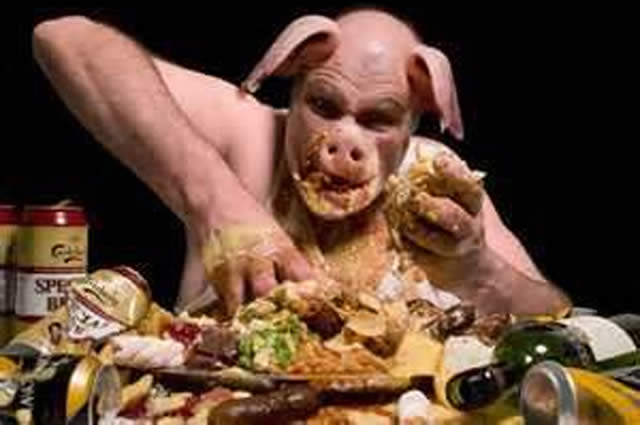
Ignatius Mabasa The Column
Since the devil used food to disenfranchise poor Adam and Eve in the Bible, I sometimes wonder whether that sly old trickster is still using anything edible to ambush the gluttonous among us. Socialisation, which is simply defined as making someone behave in a way that is acceptable to their society, is very important and necessary even when it comes to things some of us may deem inconsequential such as good and bad eating habits.
I am not just talking about people who talk with food in their mouths, or those who stuff their faces such that they cannot even chew the food battling for space in their mouths.
I am talking about people who think like Unoka in Things Fall Apart, who said when he looked at a dead man’s mouth, he saw the folly of not eating what one had in his life time.
I am disgusted by lack of inhibition to the extent that people keep on asking for more and more food, or drink like camels until they are senseless, stupid and stubborn like a donkey.
The lack of socialisation among the Shona people can be attributed to “one having been born when the old folk had gone for a beer drink”.
The implication being that the old folk who could guide the one who needs socialisation were absent, or they had become too intoxicated to play a meaningful socialisation role.
Anyway, I am not writing about beer, but I think it is also an area that a lot of our people need to be schooled in, to know when enough is enough so that they are able to safely cross a river and go to their village.
A long time ago, Chibuku used to have a clever advert which showed how the makers of the traditional brew knew the problems caused by excessive and irresponsible drinking.
The Chibuku advert said something like: “We are not just here for the beer, but we are also here to make a better community for our beer.”
Certainly a community needs responsible citizens who can exercise self-control and be productive.
In my brief life on this earth, I have seen several people so fail to drink within their limits that they end up badly bruised or even in wrong bedrooms. I will write about the disaster of drinking like a fish some other day.
My focus today is on the madness that seizes some of us when they sight food. People sometimes behave as if they are still living in the hunting and gathering times.
I have seen dogs and other animals fight for food, but when humans fight for food, it can be a spectacle.
Like one Chinese writer, Shen Chungying, noted: “To descend upon a dinner uninvited or without being expected is permissible only among the best of friends.
“Sometimes such intrusion is disgusting, particularly when associated with taking too much liberty. The guests can only wink at each other to show their disgust. Why does anyone want to lose his self-respect?” The thing is, we think that some people may lose self-respect when actually they do not have any self-respect to talk about in the first place.
At a recent conference I attended, I was one of the last people to be served because there were just too many delegates. By the time I got my tea, the sandwiches and other eats were finished. We were told to wait for more sandwiches and eats.
When the eats were eventually brought, there was a sudden stampede for the food. I sympathised with the lady who was representing the organisers. She was passionately trying to plead with people who had suddenly become violently possessed by the spirit of eating greedily, to give others who had not eaten a chance.
Our behaviour when there is food in front of us is at times both comical and embarrassing. In my village, two men once fought for food at a funeral.
What made their fight remarkable is that there were plates of food between them, and none of them stood up to fight. They fought while seated, with their fists flying over the platefuls of steaming sadza and beef stew.
In Harare, I once saw a man whom I may even call a gentleman, judging by the way he was dressed. This gentleman was walking briskly along the pavement of a street violently tearing at a loaf of bread.
If he had been eating a slice of bread, I would not have taken notice, but he was shoving large ripped pieces of bread into his mouth. I observed that he had squashed a loaf of bread and forced it to fit into his trousers pocket.
So, as he was walking, he would dip his hand into the trousers pocket, and it would emerge with a piece of crumbled and roughly torn bread.
Well, a friend of mine once said: “You pay too much attention to bread to the extent that you want it to be properly sliced, but once it goes into the mouth it gets squashed and mangled, so there is no point in wanting bread to be in nice and even slices.” Whatever the logic, I am of the opinion that even if in a hurry, food needs to be eaten decently.
The other time, I saw a man who had bought himself sadza and matemba in town. He then found himself a secluded corner next to a busy street.
Once he was in that dimly lit space, he started attacking the sadza so viciously. I wondered whether he was afraid that someone would suddenly appear and snatch the food from him.
He was literary throwing into his mouth morsels of sadza with matemba, and he did very little if any chewing at all. In no time, I saw him drink the very little soup that was left in the kaylite food holder, then he licked his fingers, which I don’t think he had washed before eating. He wiped his shiny forehead with a dirty handkerchief and soon got up, belched and joined the never ending flow of Harareans.
This is so much in contrast with a friend of mine who has serious problems eating in public. He says he just can’t eat in public and if you invite him to a function, the best he can do is to afford a glass of wine but not food.
He says just the idea of opening his mouth to receive food, and then chewing that food in public, gives him a lot of discomfort.
I kind of understand him, because I at times do not enjoy my food when I am in cocktail-type of gatherings.
I respect my food, and I believe food tastes better when you are seated and you don’t have to swallow before it is time to swallow because someone has spoken to you and you must answer back. At one time, I was attending a corporate event at the Meikles Hotel. When the event was over, we were asked to move into an adjacent and spacious room for food and drinks.
The waiters and waitresses were moving around with heaped trays of chicken drumsticks, chipolatas, samosas and meatballs. One of the waiters placed a tray with heaped chicken drumsticks at one of the tables.
There was one smartly dressed woman who was carrying a massive sack-like handbag. She placed it next to the tray, then with very skilful fingers, she grabbed several handfuls of the drumsticks, and dropped them into her handbag. She then quickly closed the bag, slung it on her shoulder and continued mixing and mingling as if nothing had happened.
A colleague who worked as a country director in Nigeria told me that he once invited a government minister to a party, but the minister failed to attend.
This party was on a Saturday. The following Monday he got a phone call from the Minister’s office. He thought the Minister wanted to apologise and explain why he did not make it.
He didn’t. Instead, the Minister had phoned to inform him that he was sending a driver to come and collect his share of food and drinks from the party he had failed to attend!
My colleague said because all the food and drinks were gone, they had to quickly send someone to buy something to give to the minister’s driver.
It is said old habits die hard, but certain habits must be strangled if they refuse to die.
There are a lot of cultural aspects that define us as a people and our eating and drinking habits are one of them.



 Online Reporter