Chronicle Editor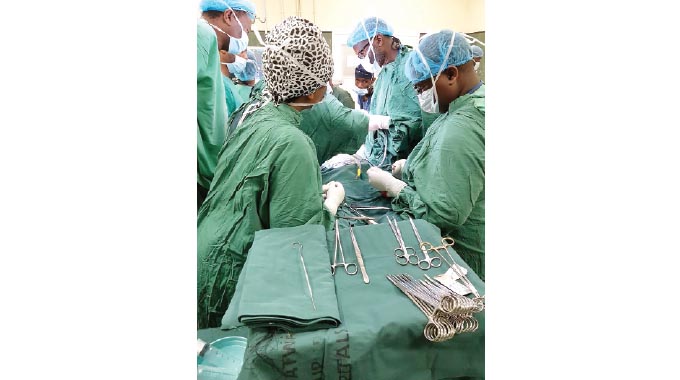
Sifelani Tsiko, Innovations Editor
For many years, operating on the heart was largely seen as too dangerous and a no go area for black medical professionals and for most African countries and others in the global south.
Without antibiotics, adequate anaesthesia and many of the tools used in modern-day heart surgery, cardiac surgery by African medical professionals was also seen as “IMPOSSIBLE.”
But times are changing and a new breed of daring and innovative doctors are ushering in open-heart surgery in Zimbabwe and other African countries despite limited resources for the provision of optimal cardiac surgery care. Success and recognition are not coming out of their race, but accomplishments.
Zimbabwe’s new breed of trailblazing physicians and other healthcare specialists have made the nation proud and to stand on the shoulders of other giants who are offering open-heart surgery in Africa and across the world.
The team made up of cardiothoracic surgeons: Simukayi Machawira (team leader), Wilfred Muteweye, Kudzai Kanyepi, cardiac anaesthetists; Emerson Mutetwa, Shield Kajese, cardiologists (adult); Elise Gambahaya, Tsungi Chipamaunga, Golden Fana, cardiologists (paediatric); Davidzo Murigo-Shumba, Paradzai Gapu, Mutsa Bwakura-Dangarembizi, cardiac theatre sister-in-charge; Sipiwe Mandipa, perfusionist; Patricia Zhande, ICU sister-in-charge; Nyamurowa and cardiac ward sister-in-charge Makiwa are giants not just for Zimbabwe, but for the entire medical profession in Africa and the world.
Following the resumption of open-heart surgery (OHS) in the country in June this year, they have successfully carried out 12 cardiac operations at Parirenyatwa Group of Hospitals in the capital, Harare.
The major driving motivation has been their desire to eliminate health disparities and ensure access to professional medical care for all.
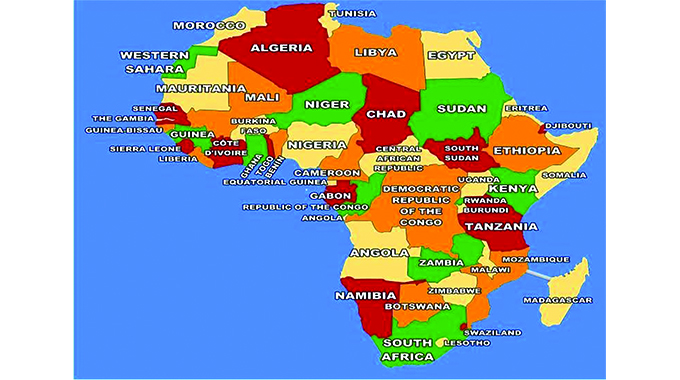
Today, about 28 African countries now offer open-heart surgery and 12 have running programs, while the others rely exclusively on visiting surgical teams.
“There are about 12 000 cardiac surgeons in the world and here in Africa we have less than a 1 000. The disparity is so huge. Here in Zimbabwe we have five certified surgeons and one of them is no longer active due to age. Zimbabwe has one surgeon per five million people,” Dr Wilfred Muteweye, a cardio-vascular and thoracic surgeon said on the sidelines of a University of Zimbabwe Faculty of Medicine and Health Sciences guest lecture.
The lecture was titled: “Open Heart Surgery in Zimbabwe.”
“Despite the growing burden of cardiovascular diseases, cardiovascular surgery needs are not being met. The World Health Organisation predicts that cardiac diseases will be the number one cause of death in low and medium income countries by 2030,” Dr Muteweye said.
“There is still limited availability of OHS in the rest of Sub-Saharan Africa (SSA) with significant under delivery of the life-saving surgery. In the west, 1 200 OHS are done per million annually while in the SSA only two per million population are done. There is one cardiac surgery centre per 120 000 inhabitants in North America vs one per 33 million people in SSA, excluding South Africa.”
The road to the resuscitation of open-heart surgery in Zimbabwe was littered with landmines.
“It was a huge battle to re-start open-heart surgery in Zimbabwe as local professionals. Some of our colleagues discouraged us and labelled us as being partisan to the Government. Many doubted our potential and skills. Many saw us as people who were going to experiment and kill patients. It was not very encouraging when we started. They labelled us and if anything, we told them OHS was going to benefit them and their relatives and the whole country as a whole. The resistance was massive.
“Despite the massive resistance and criticism by our own, we managed to operate 12 patients aged between 17 and 60. People accused us of trying to play games with people’s lives. We only lost one patient on day 12 past the operation period. Our first patient was very brave but sadly we lost her. She even encouraged two other people to go for surgery. We need to reduce medical tourism to other countries to save foreign currency. Besides the issue of foreign currency, a lot of patients are receiving sub-optimal treatment outside Zimbabwe. We want to do complex cases and we want to do about 150 cases a year. This is quite reasonable and with adequate support Zimbabwean surgeons can do it,” Dr Muteweye said.
The first open-heart surgery in Africa was performed by South African surgeon Dr Christiaan Barnard in 1958 at Groote Schuur.
Africa is also famous for being the first continent in the world in which a successful heart transplant was performed.
In 1967, Barnard led the team that performed the world’s first human-to-human heart transplant.
The first open-heart surgery case in Zimbabwe was done in 1959 using deep hypothermic circulatory arrest (ice bath) for pulmonary valvotomy by surgeons N Micklem and G Wright.
The operation was done on a 15-year-old boy during the Rhodesian era. The patient had pulmonary valvotomy with surface cooling and recovered well following the surgery.
In the 1970s and 80s, cardiac surgery was done by medical missions from Loma Linda University in the United States.
The missions only provided cardiac surgery to a few and were largely donor-dependent. Dr Muteweye said it was difficult to sustain these missions and over time there was pressure to develop local provision of service of cardiac surgery.
In 1988, Loma Linda University sent a core team that helped establish a local resident team that carried out several cases of open heart surgery with success.
Training was done locally and in collaboration with other international cardiac centres resulting in the establishment of a joint team. The teams began the open-heart surgery in 1989 and were able to leave behind a team that successfully continued the efforts.
Between 1989 and 1992, they managed to operate 91 cases of open-heart surgery with a mortality rate of 8.7 percent. The locally assembled team carried out more than 400 open-heart surgeries between 1995 and 2003 and operated on a weekly basis.
But the difficult economic situation and economic sanctions imposed by the West forced the programme to end in 2003.
“In 2003, the programme ceased to operate due to lack of financial support. The period 2003 to 2016 was like a dark age for open-heart surgery in Zimbabwe,” Dr Muteweye said.
Efforts to resuscitate open-heart surgery only resumed in February 2016 after a 13-year period. Dr Muteweye said resumption was made possible after Medtronic, a private supplier in the medical industry donated a heart-lung (bypass) machine to Parirenyatwa Group of Hospitals. The University of Zimbabwe, College of Health Sciences collaborated with a congenital heart team from the University of Konkuk South Korea.

The visiting cardiac team, led by a Korean professor in congenital cardiac surgery, brought full theatre sets, consumables, and medication. They performed 11 (mainly paediatric) cases during an eight-day camp, with assistance from the local staff. The camp built capacity in the local team, which later took up the challenge of doing cardiac surgery on its own when the visitors had left.
The local team faced challenges and only managed to do a limited number of operations. In 2017 and 2018, the team from South Korea performed the surgery again, each time coming with a smaller team as they were empowering the local team. There was also a visit by an Italian team, Mission Bambini, in July 2018, and they held a camp for paediatric cardiac surgery.
Mission Bambini also brought their own equipment, consumables and medication. The camps by the visiting teams have been very useful in building local capacity and developing the team work required in cardiac surgery. The last open-heart surgery was done in 2018 when the country faced challenges to procure consumables and when the US tightened screws on Medtronic, which was forced to stop dealings with Zimbabwe under sanctions.
Zimbabwe has some facilities and surgical expertise but still lacks key support staff and material resources. Training and mentorship programs on cardiac surgery are being built and there is great potential that exists to expand cardiac surgery in the country.
Some of the major bottlenecks that hinder the scale-up of surgical programs include lack of financial resources, economic sanctions, lack of equipment, training, consumables and brain drain. Cardiac surgery is capital intensive and user fees are also steep compared to other specialties.
Dr Muteweye said a single valve replacement cost around US$6 000, double valve replacement US$9 000 and VSD repair between USD$4 000 and US$5 000. Most patients cannot afford open heart surgery and less than 10 percent of the population is on medical insurance.
Patients operated on recently were funded by the Government with Dr Muteweye saying this was not sustainable and more strategies were needed to help finance open-heart surgery in Zimbabwe. The country needs more equipment that includes modern heart-lung machines, intra-aortic balloon pumps, extra corporeal membrane oxygenator (ECMO), transesophageal echo cardiac and catheterisation labs.
In addition, the country needs to train more perfusionists, address theatre staff shortage and high staff turnover, increase ICU beds and ensure a consistent supply of consumables.
“We need to train more surgeons, anaesthetists, intensivists, nurses and other specialists. There is a need to find ways to motivate the cadres to reduce brain drain — monetary and non-monetary. Open-heart surgery is now available in Zimbabwe and there is a need to strengthen the current program with provision of more funding, equipment, training and incentivisation to reduce staff- brain drain,” Dr Muteweye said.
Continued association and new partnerships with established cardiac centres to exchange ideas and fellowships for training, corporate support incentives such as tax benefits, private public partnerships and providing support to the UZ to become a major player in the provision of open heart surgery is critical for the country.
“Dr Muteweye and your team are an inspiration for our young medical students. They look up to you for inspiration. We must believe in small victories and these are going to go into our future bigger victories,” said a UZ medical lecturer.


 Online Reporter