Online Reporter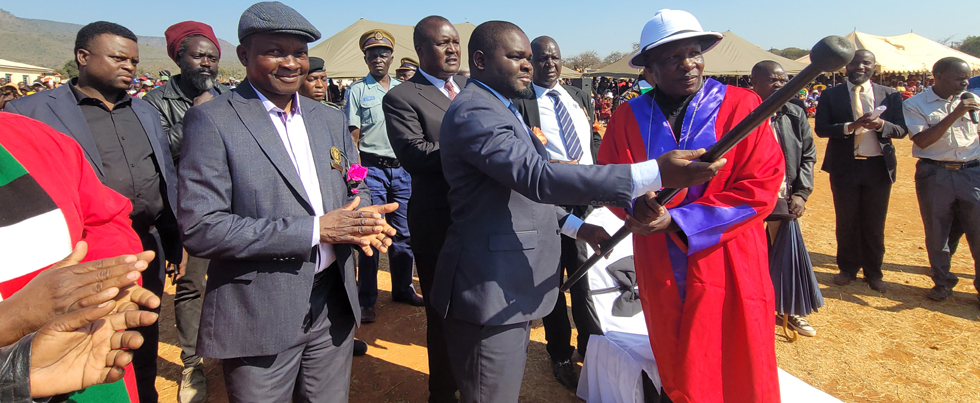
Tendai Gukutikwa
Post Reporter
THE name Mutambara carries with it both history and symbolism.
Derived from the Shona word ‘‘kutambarara,’’ meaning to sit with stretched legs, it reflects the spirit of freedom of the Mutambara people. Shortened from ‘‘mutambarakede’’, Mutambara is a name that was born from battles of succession, survival, and identity, an inheritance that continues to shape the destiny of the community today.
Last Friday, at Guhune Secondary School, the name was once again affirmed with the installation of Mr Norman Mutambara as the substantive chief of the Mutambara Clan after 13 years of acting leadership.
Family representative, Mr Taona Stevenson Chieza, recounted the genealogy of the chieftainship, with both pride and solemnity.
“Mukonawanhu was the first chief of the Mutambara people after he came from Rozvi. He had five sons, and from his lineage began a story of succession, conflict, and continuity. Over the years, there were disputes and even killings as brothers fought for power. Eventually, the lineage was divided into two chieftainships, one in Mozambique and the other here in Zimbabwe. When Munyavhi, also known as Bapiro Mutambara secured victory in 1890, he was renamed Mutambara. That is when the name, meaning stretched legs, was embraced by the people as a sign of freedom from their adversaries,” he said.
Since then, the Mutambara throne has rotated among five families — Gumbezu, Tumani, Dindikwa, Ngani, and Mwoyowasemuka — through a collateral system where the eldest in each family line takes the crown.
Chief Norman Mutambara becomes a substantive chief after Bapiro Mutambara who ruled until 1933, Nyisa Mutambara, who passed on in 1942, Joseph Mutambara who died in 1947, Sam Dindikwa whose throne was grabbed in 1974, James Ngani who was acting chief until 1977, Samuel Mutambara, who passed on in 1997, Davison Mukunga who acted until 2002, Jana Chinonzura who passed on in 2008, John Godfery Mutambara who was the last substantive chief and passed on in 2013, Sylvester Mutambara and Donald Ngani Mutambara who acted as chiefs until 2023.
Chief Norman Mutambara, born in 1962 in Ngani Village, is the son of the late Chief Samuel Matindike Dindikwa Mutambara.
After a distinguished 37-year career in the police force, he has now returned to serve his people, carrying the Chihwa totem and the responsibility of countless subjects who now look to him for leadership. He has one wife and six children.
According to Mr Chieza, Friday’s ceremony was not just an official installation.
It was a homecoming of tradition, a restoration of order, and a spiritual renewal for a community that had waited for more than a decade since the death of Chief John Godfrey Mutambara in 2013.
His death ushered in years of acting chiefs and uncertainty, but the day’s rituals, songs, and ululations brought closure and a renewed sense of belonging. Addressing his people, the new substantive Chief Mutambara said he will balance tradition with modern governance, uniting his people while working hand in hand with Government to drive development.
“This chieftainship comes with great responsibility. I will uphold our traditions and work for the unity and development of our people. I am committed to preserving our culture, while also embracing the progress that is necessary for our youths and families to thrive,” he pledged.
Addressing the gathering, Local Government and Public Works Deputy Minister, Engineer Benjamin Kabikira, who stood in for Minister Daniel Garwe, said the journey of the Mutambara throne, from the days of
Mukonawanhu to the newly installed Chief Norman Mutambara, is a chronicle of resilience, struggle, and renewal.
“It is a reminder that history is, not merely remembered, but lived through the continuity of leadership and tradition. For you as the Mutambara people, the installation ceremony should be more than an event. It should be the stretching of legs after years of constraint, a declaration that your identity, culture, and leadership remain unbroken,” he said.
He also emphasised that traditional leadership remains integral to Zimbabwe’s governance structure.
“The Second Republic has made it clear that traditional leadership is, not a ceremonial role. Chiefs are the backbone of rural governance and custodians of our identity. That is why Government has prioritised resolving historical leadership conflicts and empowering traditional leaders with the tools and authority to lead effectively. I urge the community to remain united and support the new Chief Mutambara. Our elders say: ‘Huru inokudzwa ngewayo and mambo vanhu’, so let us follow these proverbs,” he said.
The installation also drew remarks from Minister of State for Manicaland Provincial Affairs and Devolution, Advocate Misheck Mugadza, who hailed the occasion as a turning point for the district.
“This installation comes at a time when the Second Republic is restoring dignity to communities through the recognition of traditional institutions. For 13 years, the Mutambara people have been led by acting chiefs, but today order has been restored. Chief Mutambara is, not just a custodian of culture, he is a partner in development. Government looks to chiefs to help spearhead programmes in agriculture, education, and social harmony. We are saying, let our chiefs lead, and let us support them wholeheartedly,” he said.
For the Mutambara community, the day was deeply personal. Elderly villager, Mr Stanley Ndadzungira, expressed relief.
“We had become a people without a centre. Every ceremony felt incomplete because we did not have a substantive chief. Today, we can breathe again as the Mutambara people. This is our identity restored,” he said, his voice breaking with emotions. Another villager, Mrs Tarisai Shiridzinomwa, said the installation meant peace for the younger generation.
“Children must grow up knowing who their chief is and what traditions to follow. When leadership is not clear, culture fades away.
Today, our children have seen what it means to have a chief, and that is priceless,” she said.
Ms Kudakwashe Nyamadzawo, captured the generational hope tied to the new chief’s role.
“We are proud of our history, but now we want development. We hope Chief Mutambara will help us with issues like land use, youth projects, and employment opportunities. Chiefs are the bridge between Government and the people, and we are looking forward to his leadership,” she said.