Online Reporter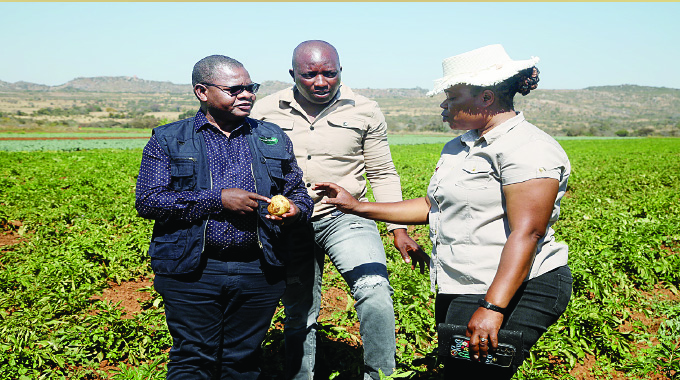
Theseus Shambare, Features Writer
IT is just after 6AM and the red soils on her farm are already awake.
Sprinklers dance quietly over rows of green mealies.
Chickens squawk in chorus as a farmhand hauls a sack of feed towards the poultry unit.
From a small shaded office near the pig pens, Mrs Chipiwa Chibamu (43) scribbles notes into a well-worn ledger.
Always smartly dressed, often in a clean shirt and jeans, she defies the common image of the farmer in tattered overalls and cracked hands.
She is precise. Observant. Calm
“People think farming is mud and misery,” she told journalists during a visit to her farm recently, smiling faintly.
“But there is dignity in growing something from the ground. It is not poverty — it is business.”
Her Shona name, Chipiwa, means “a gift.”
On this family-owned farm, Ruago, carved into the hills of Goromonzi, that name feels more like destiny.
Success, however, did not come easily.
In 2024, Mrs Chibamu tried her hand at wheat farming. Although she had been at the farm since 2015, this was her first serious attempt at a cereal crop.
The results were disheartening.
“We were hit hard by quelea birds,” she said.
“There is no one near us doing wheat, so the birds had no other field to turn to. Ours became their only feast.”
Despite investing in repellents and scarecrows, the damage was significant.
“It was a tough season. That is when I learned not every idea works just because it is logical. Farming will humble you.”
Ruago Farm is a hive of diversified activity.
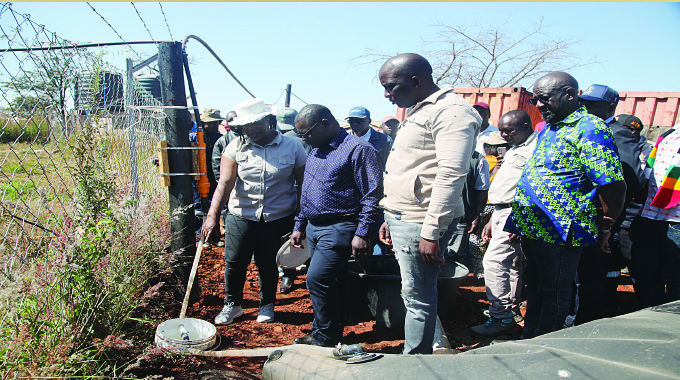
Of its 75 hectares, 45 are under cultivation — potatoes, paprika, cabbages and green maize — all neatly irrigated using a gravity-fed siphon system that requires no fuel or electricity.
The piggery — home to hundreds of large white pigs — is rapidly expanding. More sties are being built
In another corner of the farm, over 15 000 broiler chickens are raised per cycle.
Ducks, goats, sheep and soon-to-be-stocked fish ponds complete the mosaic of activity.
Nothing goes to waste
Manure and waste from the pigs, chickens and cattle feed into a biogas digester that powers parts of the farm.
“The idea is for everything to support everything else,” said Mrs Chibamu.
“That is sustainability.”
The location of Ruago Farm is no accident.
Just an hour’s drive from Harare, it sits at a critical junction between rural production and urban demand.
“Buyers drive here from Mbare Musika and the rest of Harare,” said Mrs Chibamu.
“They prefer coming to the source. We cut out middlemen that way — and they get fresher produce.”
She does not need to chase markets; the markets come to her.
“Being close to Harare gives us a big advantage. But it also means we have to meet high expectations. You can’t sell half-quality produce here.”
Despite her technical training as an agricultural extension officer—now formally called an Agricultural Business Advisor — Mrs Chibamu is quick to admit that books only take you so far.
“Theory can’t prepare you for everything. When pigs fall sick at night, or a hailstorm ruins your paprika, you realise farming is more about adjusting than knowing.”
Her first attempt at pig farming was almost her last.
Most of the piglets died due to poor feeding protocols.
“It was heartbreaking,” she recalled.
“I cried. But then I read, I asked others and we changed everything.”
That humility to learn is perhaps her greatest asset.
Currently, the farm supports a dozen full-time workers.
During harvesting, pruning, or slaughtering periods, dozens more are brought in on casual terms.
“She is tough but fair,” said one of her seasonal workers.
“You don’t just get paid here — you learn. I now have my own vegetable patch at home because of what she taught me.”
More than just a workplace, Ruago Farm is quietly becoming a rural learning centre.
“I want women, school-leavers, even pensioners to come and learn here,” said Mrs Chibamu.
“Agriculture can change lives if we remove fear from it.”
Redefining Heroism
As Zimbabwe prepares to commemorate Heroes Day on 11 August, the nation remembers its liberation veterans, but in rural fields like Goromonzi, another kind of battle is being fought — the fight for food, dignity and local resilience.
Mrs Chibamu shrugs off the word “hero.”
“My father and uncles were in the struggle. I do not compare myself to that,” she said.
“But maybe our children will say we fought in different ways.”
Lands, Agriculture, Fisheries, Water and Rural Development permanent secretary Professor Obert Jiri visited the farm recently.
While walking through the cabbage rows, he paused.
“This is what we talk about when we say rural industrialisation. These are the people shaping tomorrow quietly, without noise,” he said.
“Vision 2030 is already upon us!”
The quiet revolution
Mrs Chibamu has no national awards.
No fancy title
Just a deep belief that change begins where your feet are planted.
“My husband and I were given to this land,” she said, looking over the piggery wall where piglets squeal in a corner.
“And in return, we want to give others reason to believe they can stay on theirs.”
As the sun climbs higher over Ruago Farm, the day’s rhythm picks up.
Feed must be mixed.
Water lines checked.
Buyers will arrive by noon.
It is just another Monday for Mrs Chibamu — but in the story of Zimbabwe’s rural future, hers is a name worth remembering.