Online Reporter
Mbulelo Mpofu [email protected]
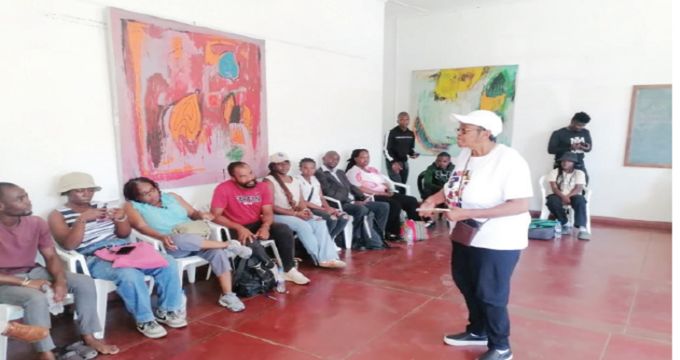
THE National Gallery of Zimbabwe became the epicentre of Bulawayo’s arts scene this week, hosting a powerhouse two-day masterclass led by legendary South African playwright and director Fatima “Fatts” Dike.
The intensive programme, which ran from Wednesday to Thursday, brought together a diverse cohort of local actors and directors eager to learn from one of Africa’s most revered theatrical matriarchs. Enthusiasm filled the space as participants immersed themselves in a rare opportunity to engage directly with a figure whose influence spans decades.
Hosted by Brahma Kumaris Bulawayo, the “Workshop for Actors” unfolded under the compelling theme, “Masterfully creating the part.”
For Dike, who is visiting Zimbabwe for the very first time in her storied career, the experience has been nothing short of transformative.
Stepping onto Zimbabwean soil armed with decades of international acclaim, Dike revealed that she deliberately chose to approach the local scene without preconceived ideas, guided instead by a genuine desire to connect with the city’s artistic community.
“Being in Zimbabwe for the very first time is an absolute joy and a profound eye-opener for me. I came here with an open mind and a restless curiosity, eager to cross borders and meet the brilliant thespians of Bulawayo. For years, I have heard whispers of the vibrant creative energy pulsing through this city, and I wanted nothing more than to submerge myself in this environment, sit down with local artists, and truly understand how theatre breathes, survives, and tells its stories on this side of the Limpopo,” Dike shared warmly.
Reflecting on the choice of venue and her initial impressions, she added:
“I wanted to assess how deep performing arts are here. I came here with a clean slate about Zimbabwean performing theatrical arts, but what impressed me the most was the hosting of the masterclass at the gallery, as this is a custodian of artistic expressions.”
Navigating a new creative landscape was made seamless through strong local artistic alliances.
Dike paid glowing tribute to Bulawayo arts stalwart Raisedon Baya, who played a pivotal role in structuring the local co-ordination.
“The organisers introduced me to Raisedon Baya and working with him made life easier for me because he knows the sector and the people in it and for me, he essentially put this together,” she acknowledged.
The workshop commenced on Day One with an intensive exploration of the anatomy of an audition.
Dike challenged participants with scripts centred on the heavy and socially critical theme of Gender-Based Violence (GBV). Through this, she emphasised that the ultimate duty of a performer is to fully inhabit, understand, and breathe life into the characters they portray.
Reflecting on the calibre of participants she observed over the two days, Dike offered a candid and insightful critique of the contemporary acting landscape.
“When you look into the eyes of young actors today, you see a fascinating dichotomy. During the masterclass, I noticed a few who seem to be chasing the glitz and glamour — those who want to be in the arts merely for the clout and social media validation. But thank goodness, that wasn’t the whole story. There was another, deeply moving group of raw talents who exuded pure, unadulterated passion. They aren’t looking for a quick shortcut to fame; they are hungry for the craft, eager to dig into the marrow of their characters, and it is that burning passion that keeps theatre alive,” Dike observed.
A key point of discussion during the masterclass revolved around the structural sustainability of the arts.
Dike shared reflections on how performing arts initiatives in her home city of Cape Town once played a crucial role in shaping the theatre sector. In that era, strong grant systems regularly produced professionals who progressed to formal university training, allowing for a smoother transition from theatre into mainstream television.
She noted that she was eager to explore Zimbabwe’s creative landscape further to determine whether similar structures are in place or whether local practitioners rely on alternative means to sustain their craft.
Dike’s artistic philosophy is inseparable from her lived experience.
She told this publication that her entire creative ethos is deeply rooted in the political struggles of her homeland.
“The foundation of my creative DNA is unapologetically rooted in the trenches of protest theatre, forged in the fires of the brutal Apartheid era,” she said.
“Back then, we didn’t just write plays for entertainment; our pens were weapons, and the stage was a battleground for human dignity. The work I do to this day still carries that historic weight, echoing the struggles, the defiance, and the resilient spirit of a people who refused to be silenced by an oppressive regime.”
Growing up, Dike initially aspired to become a schoolteacher.
However, systemic barriers imposed by the Apartheid regime obstructed that path, ultimately steering her towards theatre, which became her alternative classroom — a powerful platform for education, expression, and social commentary.
Her enduring literary and theatrical legacy includes her celebrated book, “These are the things that sit with us.”
Born in the historic township of Langa in Cape Town, where she still resides, Dike continues to draw inspiration from her immediate surroundings. The vibrancy of her storytelling — and the broader narrative of her Xhosa people — is fuelled by the energy of daily life, from local conversations to the sights and rhythms of community living.
Her journey, however, extended far beyond Cape Town.
She spent several years in political exile, including a pivotal four-year period in New York City, where she experienced life free from the constraints of Apartheid — a perspective that would deeply inform her work.
Dike’s entry into theatre came through poetry, a passion introduced by her close friend Sue Clarke.
At the age of 24, her career took a decisive turn when she met Brian Astbury, founder of the legendary non-racial Space Theatre. Starting in a modest backstage role, she later encountered Rob Amato, who recognised her talent and encouraged her to write her first major play, The Sacrifice of Kreli.
The work was eventually published and staged at the renowned Market Theatre in Johannesburg, marking the beginning of a powerful writing career.
Dike would go on to become the resident playwright at The Space Theatre. Fittingly, when the institution closed, it was her evocative play, Glasshouses, that was selected for its historic final performance.
Today, the veteran playwright continues to give back to the arts community. Alongside Roy Sargeant, she co-founded and runs the Siyanago Theatre Group, an initiative dedicated to mentoring young writers and helping them navigate the structural challenges she once faced on her own journey to realising her dreams. – Follow on X @MbuleloMpofu